
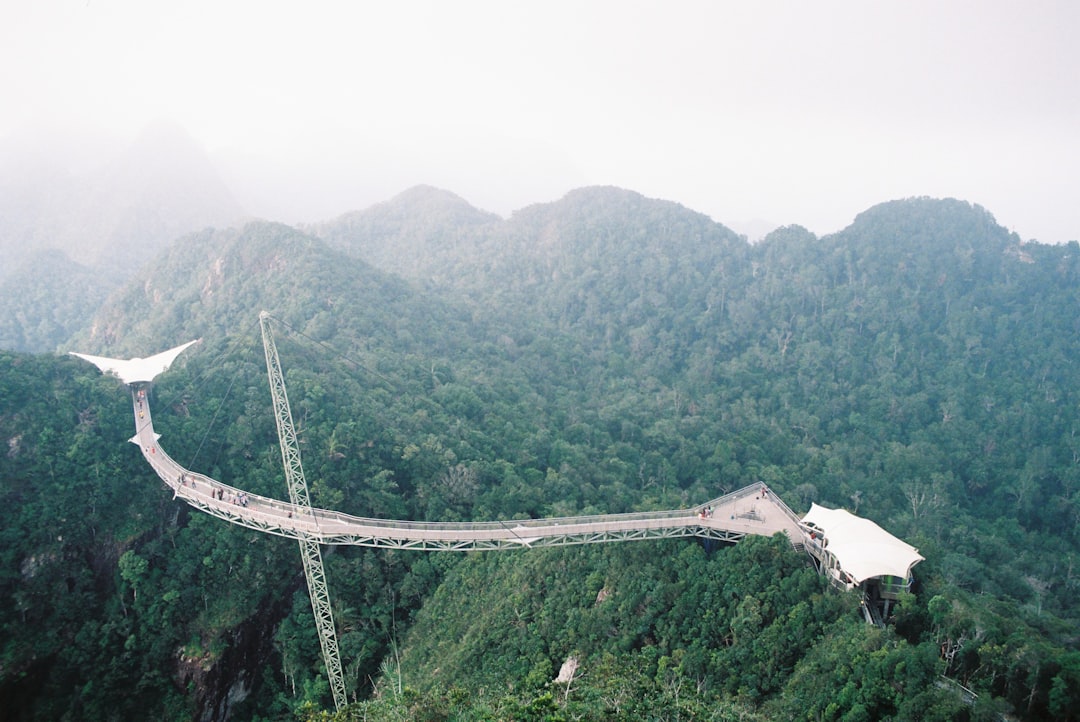

The floor beneath your feet is made of glass, and through it, only emptiness can be seen. At a height of 700 meters, suspended between the fog-covered peaks of the Machinchang mountain range, the Langkawi Sky Bridge is not just a pedestrian structure: it is a physical experience that redefines the relationship between the human body and height. The rainforest extends in every direction, dense and silent, while in the distance, the Andaman Sea opens up like a gray-blue mirror between the islands.

Inaugurated in 2005 on the island of Langkawi, Malaysia, this cable-stayed pedestrian bridge has become one of the most recognizable architectural symbols of the country. Its curved shape — an arc of about 125 meters in length — distinguishes it from most similar structures in the world. It does not follow a straight line, but gently bends, almost following the natural profile of the mountain. A single central pylon supports the entire structure via steel cables, an engineering solution that gives the bridge an almost suspended appearance in the air, devoid of visible supports on the outer side.
How to reach and how the visit works

To get to the bridge, it is necessary to take the Langkawi Cable Car, a cable car that departs from the Panorama Langkawi station, located at the foot of Mount Machinchang. The cable car is among the steepest in the world of its kind, with a slope that in some sections exceeds 42 degrees. The journey lasts about fifteen minutes and already offers spectacular views of the jungle below and the northwestern coast of the island.
Once you reach the intermediate or upper station, you continue on foot along a marked path that leads to the entrance of the bridge. Access to the Sky Bridge requires a separate ticket from the cable car, with an indicative cost of a few additional Malaysian ringgit. It is advisable to check the updated rates directly on the official Panorama Langkawi website, as prices may vary. The bridge can only be traversed in one direction at a time, with regulated entries to avoid overcrowding.
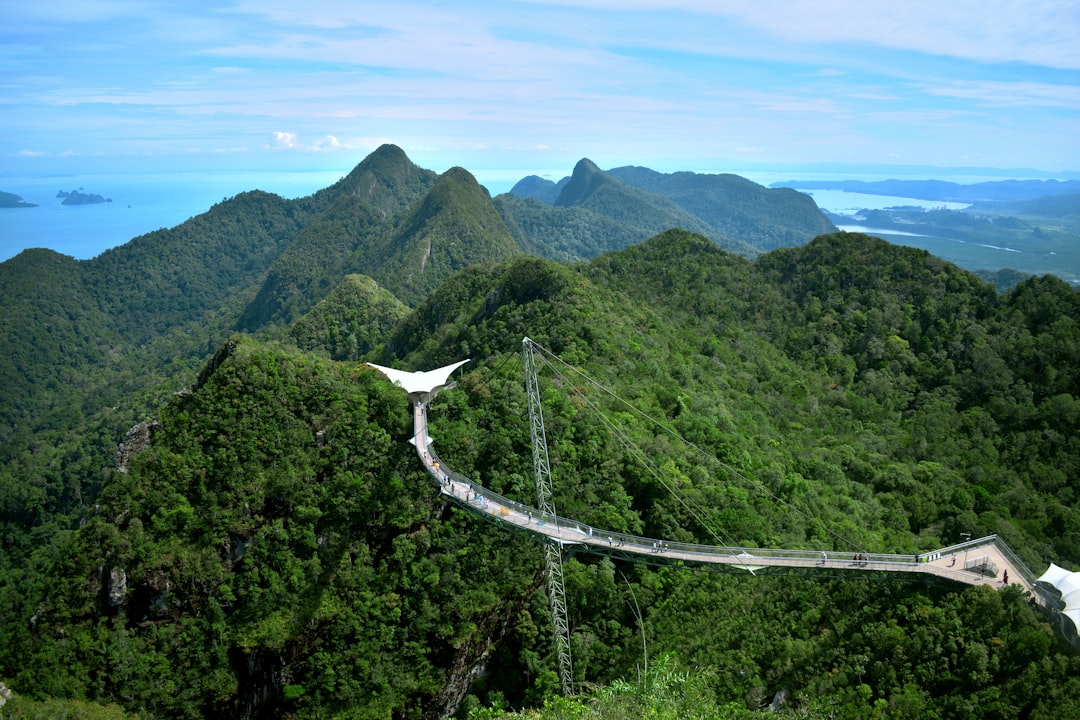
What can be seen from the bridge: physical details not to be missed
Walking on the bridge, the first thing that strikes is the sound: the wind whistling through the steel cables creates a sort of constant, almost musical vibration. The glass floor sections — positioned at strategic points along the path — allow you to look directly down, towards the dense vegetation covering the slopes of Machinchang. For those who suffer from vertigo, these transparent panels can be destabilizing even just to look at.

From the outer side of the curve, on clear days, the smaller islands of the Langkawi archipelago can be clearly distinguished, and in the morning hours, it is possible to observe the mist slowly rising from the forest like steam. The surrounding vegetation belongs to one of the oldest rainforests in Southeast Asia: Machinchang is considered geologically among the oldest rock formations in the region, with rocks dating back over 500 million years ago.
The best time to visit

The most useful advice for those planning the visit is to arrive as early as possible in the morning, preferably at the opening of the cable car. The lines can become very long during the central hours of the day, especially on weekends and during the tourist season from November to March. Besides the logistical aspect, the early hours of the morning offer softer light and a greater chance of finding a clear sky: in the afternoon, clouds tend to gather around the peaks, reducing visibility and, in some cases, leading to temporary closures of the bridge for safety reasons.
It is important to know that the bridge is periodically closed for maintenance, sometimes for extended periods. Before planning the trip specifically for this attraction, it is always wise to check the operational status of the facility through official channels. Wearing shoes with non-slip soles is strongly recommended: the metal of the walkway can become slippery with moisture, which is almost always high at altitude.
Why the trip is worth it
The Langkawi Sky Bridge is not one of those attractions that you visit to check a box on a list. It is a place that forces you to stop. The combination of the engineering structure — slender, curved, seemingly fragile — and the wild natural context of Machinchang creates a visual and emotional contrast that is hard to forget. Standing in the center of the bridge, with the cables radiating upwards and the forest dropping steeply on both sides, produces a feeling of suspension that is rarely experienced in other places.
Langkawi can be reached by plane from Kuala Lumpur in about an hour, or by ferry from Penang or the coast of mainland Malaysia. The island offers a variety of accommodations for all budget ranges, and the visit to the bridge easily fits into a broader itinerary that includes the northern beaches and southern mangroves. But the moment on the bridge, that remains separate from the rest.


