
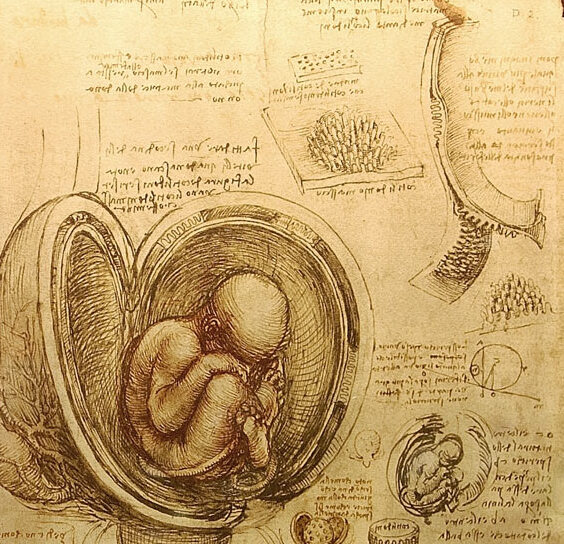

In the quiet corners of the British Isles, a treasure trove of art and science awaits discovery: Leonardo da Vinci's embryological drawings of the fetus. These extraordinary illustrations, housed in the third volume of his private notebooks, reveal the profound insights of one of history’s greatest minds. Created between 1510 and 1512, these drawings were crafted with meticulous detail using black and red chalk alongside pen and ink wash, showcasing Leonardo's revolutionary approach to human development.
Leonardo da Vinci, born in 1452 in Vinci, Italy, is often celebrated as a master artist, but his intellectual pursuits extended far beyond the canvas. His fascination with the human body and its inner workings led him to conduct dissections and studies, laying the foundation for modern embryology. The significance of his work transcends mere artistic endeavor; it is a testament to the Renaissance spirit of inquiry and the quest for knowledge. His drawings of the fetus, nestled within a womb resembling an opened horse chestnut casing, encapsulate the essence of human life and its biological beginnings.
The architectural style of the era mirrored Leonardo’s artistic genius; the Renaissance was marked by symmetry, proportion, and a return to classical ideals. In places like London, where Leonardo's influence lingers, you can find stunning examples of this style in St. Paul’s Cathedral and the British Museum, both of which house collections that reflect the era’s artistic revolution. While you may not find the original drawings here, their impact is felt in the reverence for the human condition that permeates these spaces.
Local culture in the UK is rich and diverse, steeped in traditions that celebrate both art and science. Festivals such as the London Science Festival highlight the intersection of these disciplines, drawing inspiration from figures like Leonardo. Events often include workshops, lectures, and exhibitions that engage the public in the wonders of science, echoing da Vinci’s belief in the importance of observation and inquiry.
Food culture, too, embodies a unique connection to local heritage. While not directly tied to Leonardo’s work, the UK offers a plethora of traditional dishes that reflect its rich history. Fish and chips, a beloved classic, encapsulates the simplicity of local fare. Pair it with a pint of cask ale, a staple in British pubs, and you’ll experience a taste of local life. For a more refined experience, explore dishes inspired by the Michelin-starred restaurants that focus on seasonal and regional ingredients, paying homage to the same attention to detail that Leonardo applied to his art.
Hidden curiosities abound in the realm of Leonardo’s legacy. Many are unaware that his studies were not solely confined to the human body; he also explored the development of animals. His detailed observations of the embryos of animals such as cats and horses showcase his overarching curiosity about life itself. Additionally, da Vinci's drawings were not widely recognized until centuries later, making them a lesser-known but pivotal aspect of his work. Visitors might be surprised to learn that these sketches not only advanced scientific understanding but also influenced the fields of art and anatomy in subsequent generations.
For those eager to delve deeper into the world of Leonardo da Vinci, a visit to the British Library in London can be particularly rewarding. Here, you can find digitized versions of his notebooks, including his embryological studies. The best time to visit is during the spring or autumn when the library hosts special exhibitions that celebrate his genius. Engaging with these works offers a glimpse into the mind of a man who was not only a master of art but also a pioneering scientist.
As you plan your journey, consider the stories etched in the lines of Leonardo's drawings. They are reminders of humanity's quest for knowledge and understanding. To make the most of your visit, utilize resources like the Secret World app to craft a personalized itinerary that brings you closer to the wonders of art and science.


