


The water here has a color that cannot be precisely named: it is not turquoise, it is not blue, it is not green. It is all three together, with a transparency that allows you to see the bottom at ten, fifteen, twenty meters deep as if there were a glass in between. Lifou, the largest of the Loyalty Islands in French New Caledonia, is a raised coral island — a geological fact that clearly distinguishes it from the nearby Grande Terre — and this origin explains everything: the white cliffs that plunge into the sea, the caves carved by the surf, the almost total absence of rivers and internal lakes.
The capital is Wé, a small center on the eastern coast where essential services, a few shops, and the Catholic church of Xépénéhé are concentrated, a building that dominates the landscape with its light facade visible from the sea. But Lifou is not a place to come for urban infrastructure. With an area of about 1,150 square kilometers and a population of just over 9,000 inhabitants, the island operates according to its own rhythms, far from the mass tourism that characterizes other Pacific destinations.
The geology that shaped the landscape
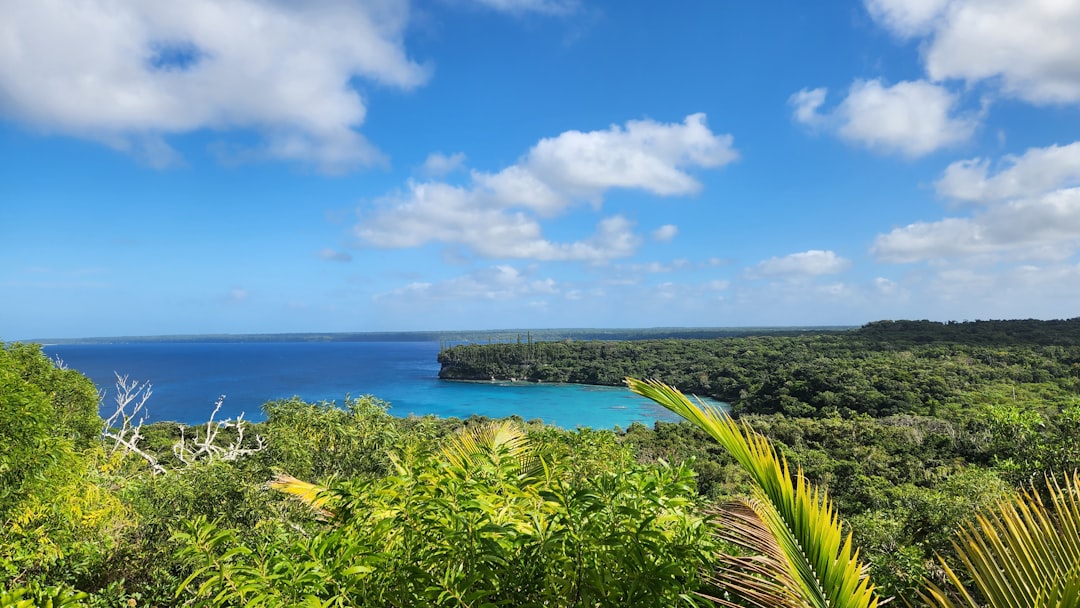
Lifou is technically a raised atoll: millions of years ago it was a submerged coral reef, then tectonic forces pushed it upwards to form a limestone plateau that reaches 100 meters above sea level in some places. The result is vertical cliffs that drop directly into the ocean, without transitional beaches, interrupted by semicircular bays where the sea enters calmly and the sand is white and very fine. Jinek Bay, on the west side, is one of the most photogenic examples: the walls of fossilized coral drop steeply and the bay collects still, almost lagoon-like water that locals use for snorkeling and swimming.
Below the surface of the island lies a system of karst caves fed by rainwater filtering through the limestone. Some of these cavities are accessible and visitable, although not always with organized guides. Those who walk inland often find themselves on porous and uneven terrain, where tropical vegetation mixes with outcrops of ancient coral rock — a landscape that resembles certain corners of the Mediterranean more than the imagery of the Pacific.
Life on the island and Kanak culture
The population of Lifou predominantly belongs to the Kanak ethnicity, the indigenous people of New Caledonia, and the island is administered according to a system that recognizes the traditional authority of tribal chiefs alongside French institutions. This dual level of governance is also visible in daily life: the villages are organized around the grande case commune, the ceremonial hut that indicates the center of social life, and many lands are collectively owned and not sellable.

The Kanak of Lifou primarily speak the drehu language, one of the dozens of Melanesian languages present in New Caledonia. French is the official language and the one used in communications with visitors, but listening to a conversation among locals means hearing something completely different. The local markets, when held, offer tropical fruits, yams, and handicrafts made from plant fibers — they are not tourist events but real exchanges among residents.
How to get there and when to go

Access to Lifou is mainly by air from Nouméa-La Tontouta International Airport or from Magenta Airport, which is closer to the city. Air Calédonie operates regular flights to Lifou Airport, with a flight duration of about 45 minutes. There is also a maritime connection with ferries departing from Nouméa, but the times are significantly longer — several hours of navigation — and the service is not always frequent.
The best time to visit is between July and September, during the southern winter: temperatures are pleasant, around 22-25 degrees, rainfall is rare, and the sea is calm. From November to March, there is a risk of cyclones, although Lifou is statistically less exposed than other islands in the region. Those planning to go snorkeling or diving should know that water visibility is exceptional all year round, but currents can be unpredictable in some bays during the rainy season. Bringing your own equipment is advisable because rentals on the island are not always available or reliable.
What to Really Expect
Lifou does not have luxury resorts with international services. The accommodation options focus on small bungalows and family-run gîtes, where breakfast may consist of local fruit and a baguette — a French colonial legacy found everywhere in New Caledonia. Internet is available but slow, and mobile coverage is partial outside populated areas. This isolation is not a flaw: it is the condition that has kept the island exactly as it is.
Those arriving looking for nightlife or standardized services will be disappointed. However, those who want to walk on trails that cross niaouli forests, swim in bays where there is no one else, and observe a way of life that has little to do with global tourism will find in Lifou something difficult to replicate elsewhere in the Pacific.


