
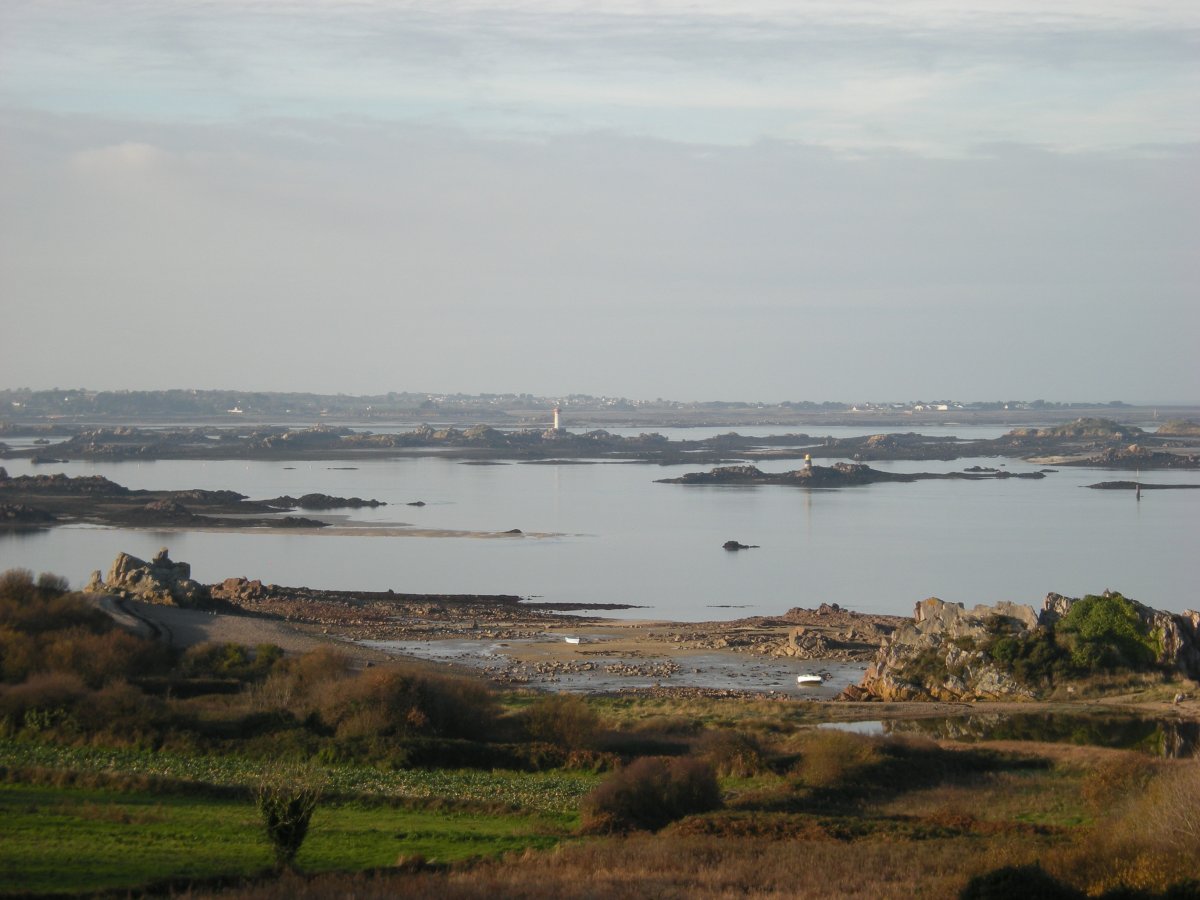

The pink granite rises from the water like an ancient signal, and the lighthouse that stands above it seems almost to float among the currents of the Trieux estuary. The Phare de la Croix, near Lézardrieux in Brittany, cannot be reached by car or on foot: the only way to get there is to take a small ferry from Paimpol, allowing oneself to be carried to an islet where time flows at a different pace, marked by the tides and the song of the seagulls.
This Breton lighthouse is built of local pink granite, the same stone that characterizes the entire Côte de Granit Rose, and its compact structure stands out for the warm color it takes on at sunset. The islet on which it stands is car-free, traversed by narrow paths lined with wild hydrangeas — the hortensias that the Bretons cultivate with almost devout care — and the atmosphere that permeates is that of a place that has remained on the fringes of mass tourism.
A lighthouse among the tides of the Trieux estuary
The Trieux estuary is one of the most picturesque in northern Brittany, a labyrinth of tidal channels that reveal and hide following the rhythm of the tides. When the low tide uncovers the seabed, corridors of sand and rock emerge that locals navigate by kayak, gliding through the channels with the familiarity of those who know every curve of that aquatic landscape. It is a spectacle that changes every six hours, and those who find themselves on the islet at the right moment witness an almost theatrical transformation of the surrounding landscape.
The Phare de la Croix still serves its function as a maritime signal, guiding vessels through the treacherous waters of the estuary. The tower, modest in height compared to the large oceanic lighthouses of the Breton coast, is designed to be visible to navigators making their way up the Trieux towards Lézardrieux and its river port. The granite structure has been conceived to withstand the extreme weather conditions that characterize this portion of the Atlantic coast, with some of the most intense winds and tides in Europe.
How to reach the islet from Paimpol
The starting point to visit the Phare de la Croix is Paimpol, a port town accessible by train from Saint-Brieuc on the Breton railway line. From Paimpol, the seasonal ferry connects the port to the islet in just a few minutes of navigation, already offering a privileged perspective on the morphology of the estuary during the crossing. It is advisable to check the ferry schedules before departing, as the trips depend on tidal conditions and vary significantly between the summer and winter seasons.
The most useful advice for those planning the visit is to check the tide tables and schedule the arrival on the islet around low tide: it is at that moment that the tidal channels open in their full splendor and local kayakers glide among the emerged rocks, offering a spectacle that is hard to forget. Bringing water and something to eat is a wise precaution, as services on the islet are minimal.
The islet and its flora: hydrangeas and granite
What immediately strikes anyone landing on the islet is the chromatic contrast between the pink granite of the rocks, the intense green of the vegetation, and the shimmering blue of the estuary. Hydrangeas grow everywhere, against low walls, along paths, in the small gardens of the few houses present. In Brittany, the hydrangea is almost a cultural symbol, and here it reaches a density and variety of colors — from white to purple, passing through all shades of blue — that transform the islet into something akin to an informal botanical garden.
The pink granite is not just an aesthetic feature: it is the very material of this territory, the rock that emerges from the sea, that builds the walls, that forms the cliffs. Observing closely the texture of the stone with which the Phare de la Croix is built allows one to understand why this coast is considered geologically unique in Europe. The pink feldspar crystals that make up the granite shine in the slanting afternoon light, giving the tower an almost luminous appearance.
The best time to visit
The most favorable season to visit the Phare de la Croix is between May and September, when the hydrangeas are in bloom, the ferry from Paimpol operates regularly, and the long days allow you to enjoy the Breton light until late in the evening. July and August bring a greater influx of visitors, especially on weekends, but the islet still maintains an intimate size that distinguishes it from the more frequented destinations along the coast.
Those who visit in spring or September will find a quieter and more authentic Brittany, with local fishermen engaged in their activities and the estuary's channels traveled almost exclusively by those who have lived in these waters for generations. It is during those moments that the Phare de la Croix reveals its truest nature: not a monument to photograph, but a living landmark in a landscape that continues to change with each tide.


