
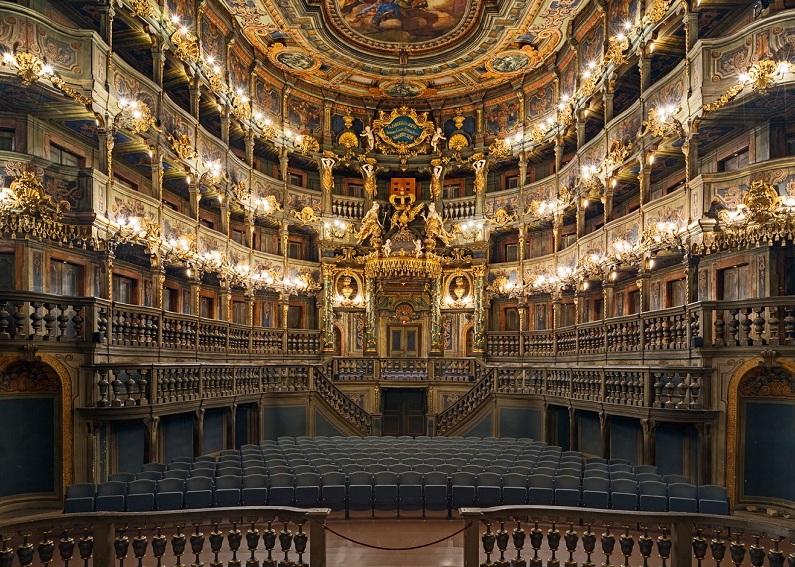

Nestled in the heart of Bayreuth, the Margravial Opera House stands as a stunning testament to the Baroque era, enveloping visitors in a world where music, architecture, and history intertwine. This remarkable structure, completed between 1744 and 1748, captures the imagination with its grandeur and artistry, making it the best-preserved example of a free-standing Baroque court theatre.
The origins of the opera house trace back to the vision of Margrave Friedrich, who sought to create a cultural hub that would draw the elite of Europe to Bayreuth. Inspired by the opulence of the grand theatres in Vienna and Dresden, he commissioned the Italian architect Giuseppe Galli Bibiena, renowned for his expertise in theatre design. With the help of his brother Carlo, Bibiena crafted a space that would not only serve as a venue for performances but also reflect the artistic aspirations of the time. The opera house was designed to accommodate the elaborate festivals and operatic performances that were emblematic of 18th-century European culture.
Art and architecture converge spectacularly within the Margravial Opera House. Its design is modeled on Italian loge theatres, characterized by a horseshoe-shaped auditorium that enhances acoustics and provides an intimate experience for the audience. The ornate interior decoration features gilded stuccos, intricate frescoes, and a magnificent chandelier, all contributing to the theatre's baroque splendor. Highlights include the Ceiling Fresco, painted by Johann Heinrich Tischbein, which depicts allegorical figures celebrating the arts. The craftsmanship is a remarkable feat, as many wooden elements were prefabricated and painted elsewhere, allowing construction to be completed in record time.
Local culture in Bayreuth thrives in the shadow of the Margravial Opera House. The city is perhaps best known for hosting the Bayreuth Festival, an annual celebration dedicated to the works of composer Richard Wagner, who was deeply influenced by the city’s rich musical heritage. During the festival, the opera house transforms into a vibrant stage for Wagner’s operas, drawing visitors from around the world. The tradition of performance here is steeped in history, with the theatre originally designed to host the lavish productions that would entertain the nobility.
A visit to Bayreuth would be incomplete without indulging in its unique gastronomy. Local specialties include the iconic Bayreuth beer, crafted in the city’s historic breweries, and the delectable Bayerische Bratwurst, a sausage that boasts a rich flavor and is often served with sauerkraut. The region is also known for its sweet pastries, particularly the Bayreuther Karpfen, a carp dish traditionally prepared during the festive season, showcasing the local commitment to seasonal and regional ingredients.
For the curious traveler, the Margravial Opera House harbors lesser-known treasures. One fascinating detail is the hidden trapdoors and complex stage machinery, which were revolutionary for the time and allowed for dazzling stage effects. Additionally, the theatre's original audience was carefully orchestrated to mirror the social hierarchy of the time, with the nobility seated in the best boxes, while commoners filled the upper tiers. This social stratification was a hallmark of the Baroque period, providing insight into the cultural dynamics of 18th-century Europe.
The best time to visit the Margravial Opera House is during the Bayreuth Festival, which typically runs from late July to late August. This period not only offers the chance to experience Wagner’s operas but also allows for the full splendor of the theatre to be appreciated. For those visiting at other times, guided tours are available, providing detailed insights into the building’s history and architectural significance. Be sure to look for the original stage and backstage areas, which reveal the workings of this historical theatre.
In summary, the Margravial Opera House is not just a building; it is a vibrant monument to the artistic spirit of the 18th century, a place where music and history resonate through time. For a truly personalized experience to explore Bayreuth, consider using the Secret World app to craft your unique itinerary.


