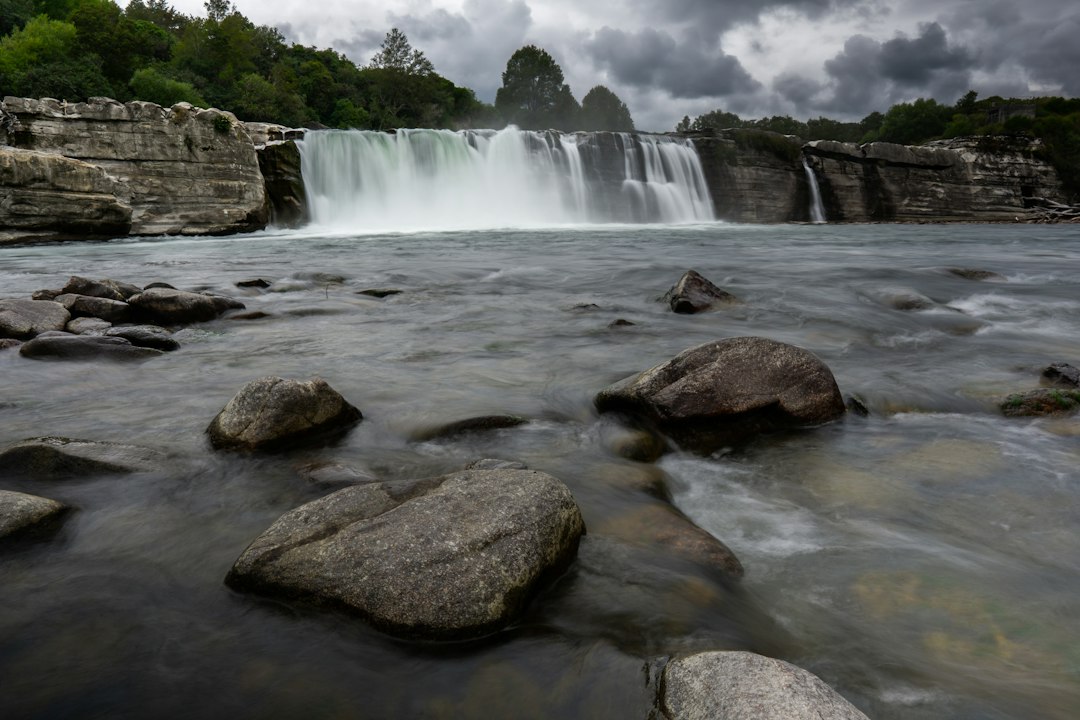

The roar of the water is heard even before seeing anything. Then, walking along a short gravel path that opens among the vegetation of southern New Zealand, the waterfall suddenly appears in all its glory: a powerful and continuous arc of dark water cascading down into the Maruia River, in the Tasman region, near the small locality of Shenandoah. This is not just any waterfall, and its geological history is as extraordinary as its shape.
The Maruia Falls owe their existence to a catastrophic event: the Murchison earthquake of June 17, 1929, one of the most devastating tremors in New Zealand's history, with an estimated magnitude of around 7.8. The earthquake shifted and reshaped the bed of the Maruia River so radically that it literally created this horseshoe waterfall where flat water once flowed. In just a few seconds, geology had written a new chapter in the landscape of the South Island.
The horseshoe shape and the power of water
What immediately strikes is the shape of the waterfall: an almost symmetrical arch, similar — on a smaller scale — to the structure of Niagara Falls, which embraces the river across its entire width. The water does not fall vertically but launches forward with a wide trajectory, generating a constant cloud of mist that rises towards the surrounding vegetation and soaks anyone who gets too close to the edge of the observation platform.
The sound is physical, almost corporeal: a low and continuous thunder that vibrates in the chest. In times of flood, after the frequent rains in this area of New Zealand, the flow of the Maruia River increases significantly and the waterfall becomes even more imposing. The mosses and ferns on the side rocks shine with an intense green, constantly nourished by the moisture produced by the falling water.
Effortless and Crowded-Free Access
One of the most surprising aspects of Maruia Falls is the ease with which it can be reached. From the parking lot, marked along the State Highway 65 that connects Murchison to Springs Junction, it only takes a few minutes to walk along a flat gravel path to find yourself directly in front of the waterfall. There are no tickets to purchase, no gate, no elaborate tourist facilities: just a wooden railing that allows you to look out over the water in complete safety.
Visitor traffic to the site is significantly lower compared to other more famous New Zealand waterfalls. It is common to find yourself alone, or almost, in front of the entire waterfall, which makes the acoustic and visual experience even more intense. The contrast between the power of the water and the silence of the surrounding forest is one of the elements that visitors remember most strongly.
The geological context of the Murchison earthquake
The earthquake of 1929 caused the death of 17 people and triggered widespread landslides throughout the Nelson and Tasman region. It was one of the strongest earthquakes ever recorded in New Zealand and left visible traces in the landscape for decades. The creation of the Maruia Falls is one of the most tangible and accessible examples of how tectonic movements can permanently and almost immediately transform a territory.
Observing the waterfall knowing that it did not exist before 1929 changes the perception of what is in front of you. It is not something ancient and unchanging, but a geologically young formation, born from a violence of the earth that redrew the course of a river in a matter of moments. This awareness adds a layer of meaning to what might otherwise seem like a simple scenic stop.
Practical tips for the visit
The Maruia Falls are located along State Highway 65, about 15 kilometers east of Murchison. The site is accessible year-round and has no entrance fee. The parking is small but sufficient for a few cars. The average visit time is between 20 and 40 minutes, depending on how long you want to stay to observe and photograph the waterfall from different angles along the path.
The best time to visit is early in the morning when the side light illuminates the mist and creates particularly intense visual effects. It is advisable to wear a lightweight waterproof jacket, as the mist produced by the waterfall easily reaches those on the observation platform. In case of recent rains, the river will be fuller and the spectacle more powerful, but the gravel path can be slippery: shoes with non-slip soles are always a good idea.