


At the first light of dawn, when the sun rises over the mountains of Eastern Anatolia, the shadows stretch over the gigantic stone heads lying on the ground and the faces of gods and kings seem to come to life for a moment. We are at Mount Nemrut, a height of 2,150 meters in the heart of southeastern Turkey, where in the 1st century B.C. King Antiochus I of Commagene had his mausoleum and a colossal sanctuary built, dedicated to himself and the deities of his syncretic kingdom, mixing Greek and Persian iconography in a way that is unprecedented in ancient art.
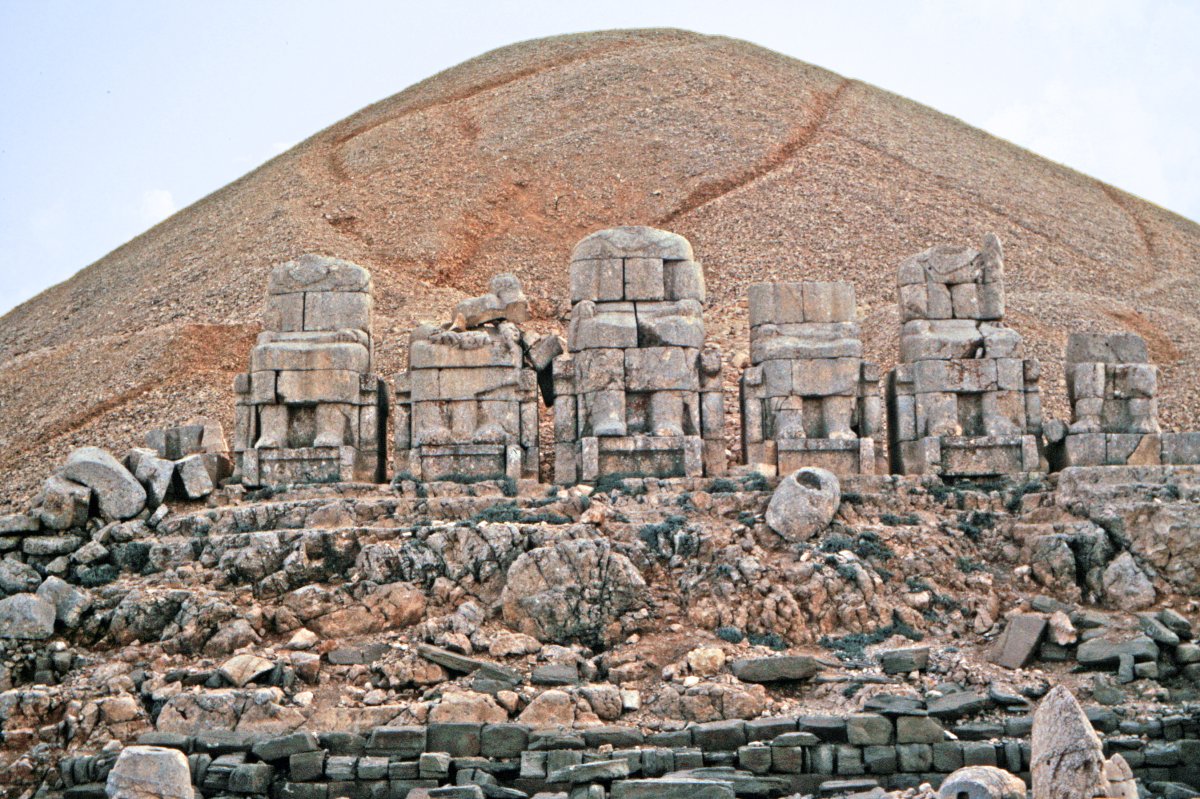
The site is located near the village of Karadut, in the province of Adıyaman, and was declared UNESCO World Heritage Site in 1987. Its discovery by Western scholars dates back to 1881, when the German geologist Karl Sester reported it during a topographical survey. Since then, the burial mound at the center of the summit — about 50 meters high and composed of fragments of limestone — has never been fully excavated, and the tomb of Antiochus I may still be hidden beneath that pile of rocks.
The statues and their meaning
What immediately strikes you upon arriving at the east and west terraces of the site are the colossal heads up to 2 meters tall that lie on the ground, detached from the seated bodies that originally supported them. The figures represent Antiochus I himself, along with syncretic deities such as Zeus-Oromasdes, Apollo-Mithras, and Heracles-Artagnes, a deliberate fusion between the Greek and Iranian pantheon that reflects the geographical and cultural position of the kingdom of Commagene, straddling the Hellenistic and Parthian influences.
Upon close observation of the heads, one notices details that are still well preserved: tiara-shaped crowns, wavy hair sculpted with precision, stylized beards. Some heads retain traces of the original polychromy, although exposure to the elements has eroded much of the surface. On the bas-reliefs of the terraces, inscriptions in ancient Greek can still be read, describing the religious rites desired by Antiochus and the cult of his divine person.
The experience of sunrise at the summit
Visiting Mount Nemrut at sunrise is not just an aesthetic matter: it is the moment when the slanting light enhances every carved detail, casting sharp shadows on the empty orbits of the heads and on the reliefs of the stone slabs. The eastern terrace is the first to receive the sun's rays, and it is here that visitors gather in the early morning hours. The air at that altitude is cool even in summer, and the silence — interrupted only by the wind — adds an almost ritual dimension to the experience.
Many local tour operators organize night departures from Adıyaman or Kahta, the two closest cities to the site, to allow visitors to reach the summit before sunrise. The paved road goes up to a parking lot about 600 meters from the top, from which one ascends on foot along a well-marked path in about 20-30 minutes. The route is not technically difficult, but it requires comfortable shoes and, during the night hours, a flashlight.
How to organize the visit
The site is open all year round, but the best months for visiting are from May to October, when the access roads are passable and the weather is more favorable. In winter, snow can make the summit inaccessible for weeks. The entrance ticket to the site is relatively inexpensive — on the order of a few dozen Turkish lira — and includes access to both terraces. It is advisable to check the updated prices directly on site or through local authorities, as rates change periodically.
From Adıyaman, it takes about an hour and a half by car to reach Karadut. Alternatively, minibuses and daily guided tours depart from Kahta. Those traveling independently can rent a car or take a private taxi: the scenic road that crosses the mountains of Eastern Anatolia is already part of the experience. It is advisable to book accommodation in Karadut or Kahta in advance during peak months, as the lodging options in the area are limited.
The historical context of the Kingdom of Commagene
Antiochus I ruled over the Kingdom of Commagene approximately between 70 and 36 BC, in a territory that today corresponds to southeastern Turkey. His kingdom was small but strategically positioned between Rome and the Parthians, and Antiochus managed to maintain its independence through a policy of balance and sophisticated religious propaganda. The sanctuary of Nemrut was an integral part of this strategy: a place where the king presented himself as equal to the gods, legitimizing his power through architecture and monumental-scale sculpture.
The bas-reliefs showing Antiochus shaking hands with the deities — the so-called dexiosis scenes — are among the most eloquent visual documents of this ideology. Seeing them in person, atop a remote mountain in Anatolia, with the wind sweeping across the limestone, powerfully conveys the extraordinary ambition of a king who wanted to leave his mark for eternity.


