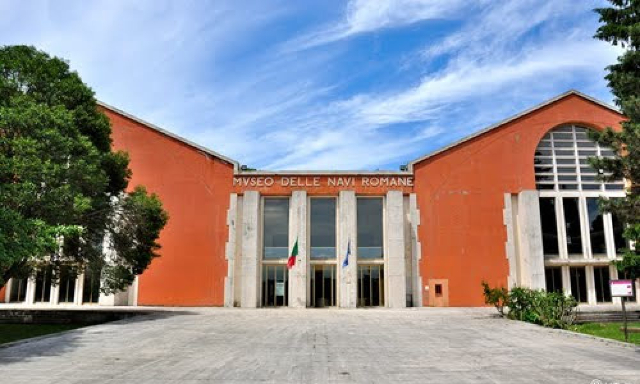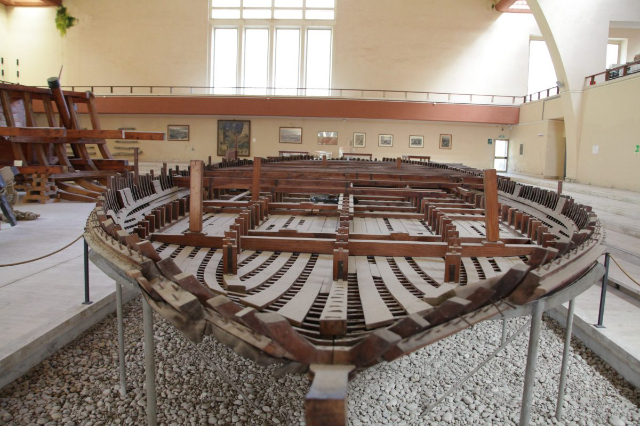

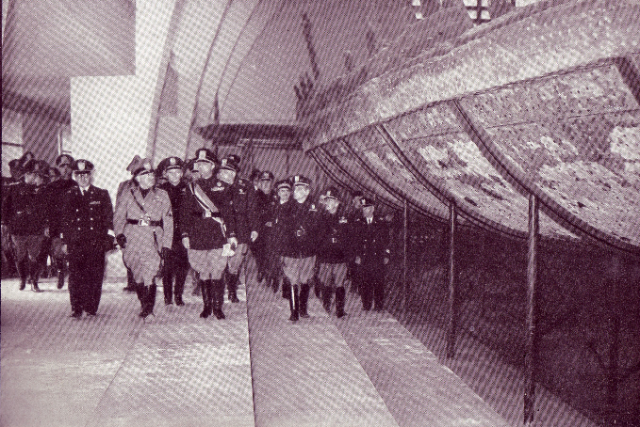
The Museum was built between 1933 and 1939 to house two gigantic ships that belonged to Emperor Caligula (37-41 A.D.) recovered in the waters of the lake between 1929 and 1931. It was thus the first museum in Italy to be built according to its contents, two hulls measuring 71.30 x 20 m and 73 x 24 m respectively, which were unfortunately destroyed during a fire in 1944. Reopened in 1953, the Museum was closed again in 1962 and finally finally reopened for good in 1988.
In the new layout, the left wing is devoted to ships, of which some materials are on display, such as a reconstruction of the roof with bronze tiles, two anchors, the lining of the bow wheel, some original or reconstructed shipboard equipment (a noria, a piston pump, a block, a platform on ball bearings). Also on view are two 1:5 scale models of the ships and a full-scale reconstruction of the stern aposticle of the first ship, on which bronze copies of boxes with ferine protomes were placed.
The right wing, on the other hand, is devoted to the peopling of the Albanian territory in the Republican and Imperial ages, with special emphasis on places of worship; votive materials from Velletri (S. Clemente), Campoverde (Latina) from Genzano (Pantanacci stipe) and the Sanctuary of Diana in Nemi, as well as materials from the Ruspoli Collection, are displayed there. Inside this wing it is also possible to admire a musealized section of the Roman paving of the clivus Virbii, which led from Ariccia to the Sanctuary of Diana.