
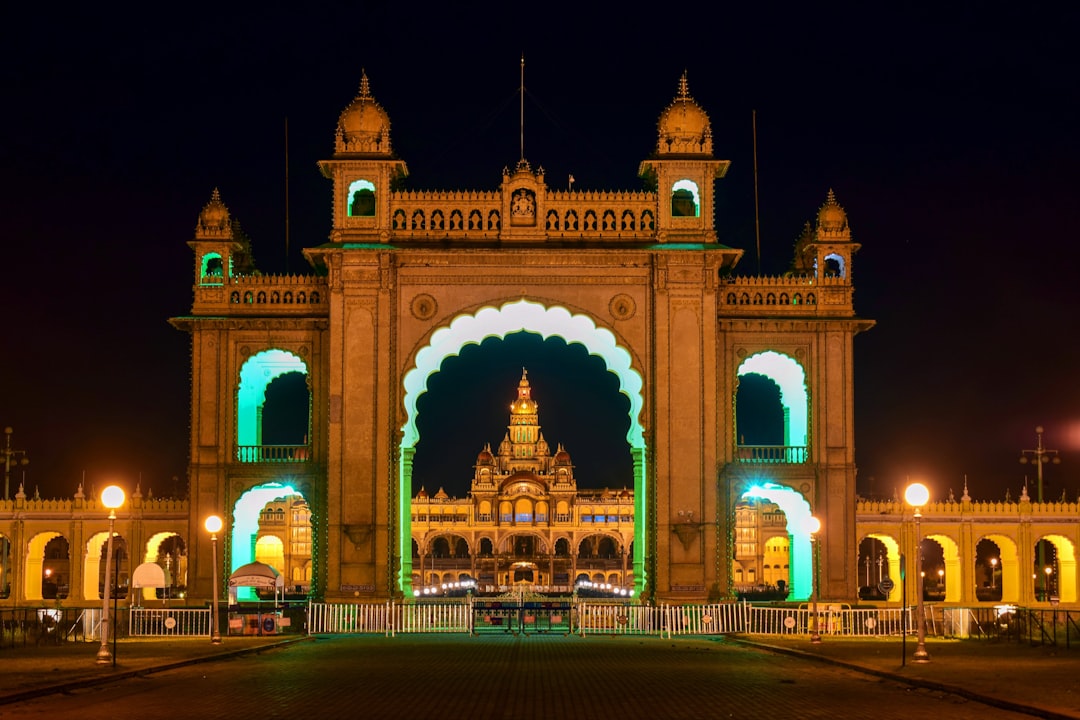

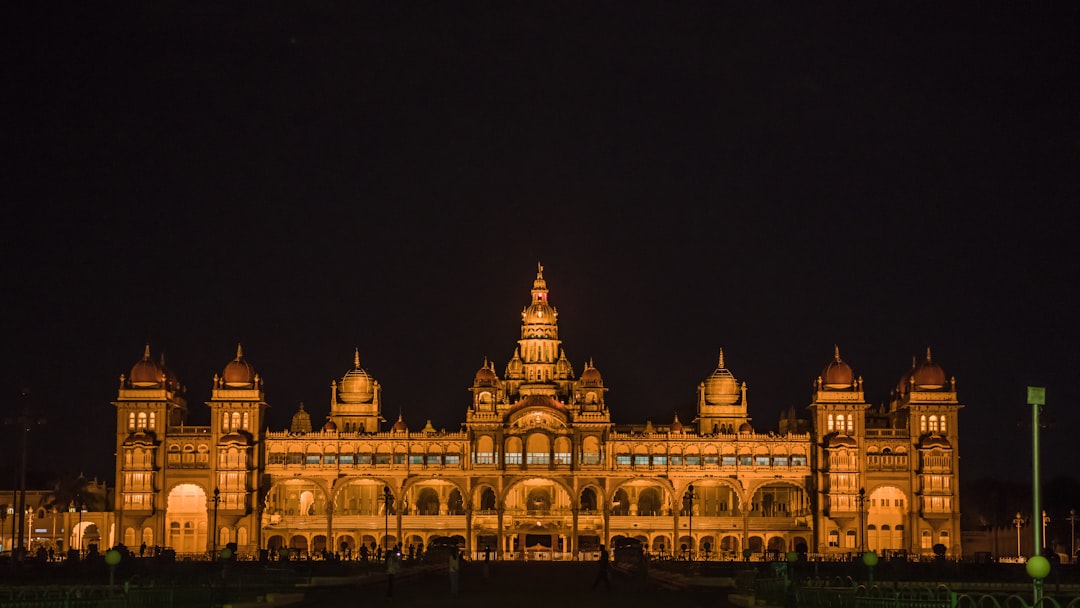
Every Sunday evening, 100,000 light bulbs light up simultaneously along the edges of the Mysuru Palace, transforming the building into a luminous structure visible from kilometers away. This is not a modern special effect: this lighting tradition has accompanied the palace for decades, making it one of the most recognizable architectural spectacles in southern India. But it is during the day, with natural light filtering through the colored glass panels imported from Scotland, that the palace reveals the complexity of its interior.

The current palace was completed in 1912 on commission from Maharaja Krishnaraja Wadiyar IV, after a fire had destroyed the previous wooden structure in 1897. The project was entrusted to British architect Henry Irwin, who worked in the Indo-Saracenic style, a synthesis of elements from Mughal architecture, Hindu architecture from Rajasthan, and Victorian Gothic. The result is a building made of gray granite with pink marble domes and a central tower that reaches almost 45 meters in height.
The exterior: towers, domes, and marble details

Approaching the palace through the gardens, one immediately notices the strict symmetry of the main facade, marked by horseshoe arches and balconies decorated with stone inlays. The three main domes — a larger central one and two smaller side ones — are clad in white and pink marble, while the minarets at the corners visually evoke Mughal architecture without imitating it slavishly. Every external surface is worked with floral and geometric patterns that require close observation to be appreciated in their complexity.
The main entrance is topped by a large trilobed arch, flanked by sculpted figures of elephants. The elephants are not just decorative: the palace historically housed royal animals, and even today during the Dasara festival — celebrated every year in October — a procession of festively adorned elephants departs from the palace, continuing a tradition that dates back centuries in the culture of the Mysore kingdom.

The Durbar Hall: Scottish glass and mosaic floors
Inside, the public Durbar hall is the space that most impresses visitors due to the quality of the materials and the decorative coherence. The ceiling is made up of colored glass panels with floral patterns, imported from Scotland during construction, which project green, red, and yellow lights onto the underlying mosaic floor. The cast iron columns that support the structure are decorated with golden motifs, and the walls host a series of paintings depicting scenes from the royal court and the Dasara festival.
The floor of the Durbar is made of Italian marble worked in mosaic, with geometric designs that extend the entire length of the hall. At the center of the back wall is the golden throne, used by the maharaja during official ceremonies: it is a wooden structure covered in gold that is displayed to the public on certain occasions. On ordinary days, visitors can observe it from behind a barrier, but visibility is still good.
The private Durbar hall and the artistic collections

Adjacent to the public hall is the private Durbar, a more intimate space but equally richly decorated, with walls adorned with paintings that document the history of the Wadiyar dynasty. Some of these works were commissioned from local artists during the 20th century and show a fusion between traditional Karnataka painting and painting techniques influenced by European art. The details of the garments and jewelry depicted in the paintings provide precise information about the ceremonial clothing of the Mysore aristocracy.
The palace also houses a collection of everyday objects of the royal family, including ceremonial weapons, intricately carved wooden palanquins, and ivory items. It is not a museum in the conventional sense, but rather spaces where the objects are arranged to evoke the original use of the spaces.
Practical Information for the Visit
The palace is located in the center of Mysore, easily reachable on foot from the main hotel area or by auto-rickshaw. The entrance ticket for foreign visitors is approximately 200 rupees, but it is advisable to check the updated price at the entrance. The visit takes an average of two hours for those who want to carefully observe the main halls. Shoes must be removed before entering the indoor spaces, and large bags and backpacks are not allowed: luggage storage is available at the entrance.
The best time to visit the exterior is on Sunday evening, when the lighting with 100,000 light bulbs is active for about half an hour after sunset. To visit the interiors without excessive crowds, the early morning hours on weekdays are preferable. During the Dasara festival, the palace becomes very crowded but offers the opportunity to see the additional decorations and traditional ceremonies.


