
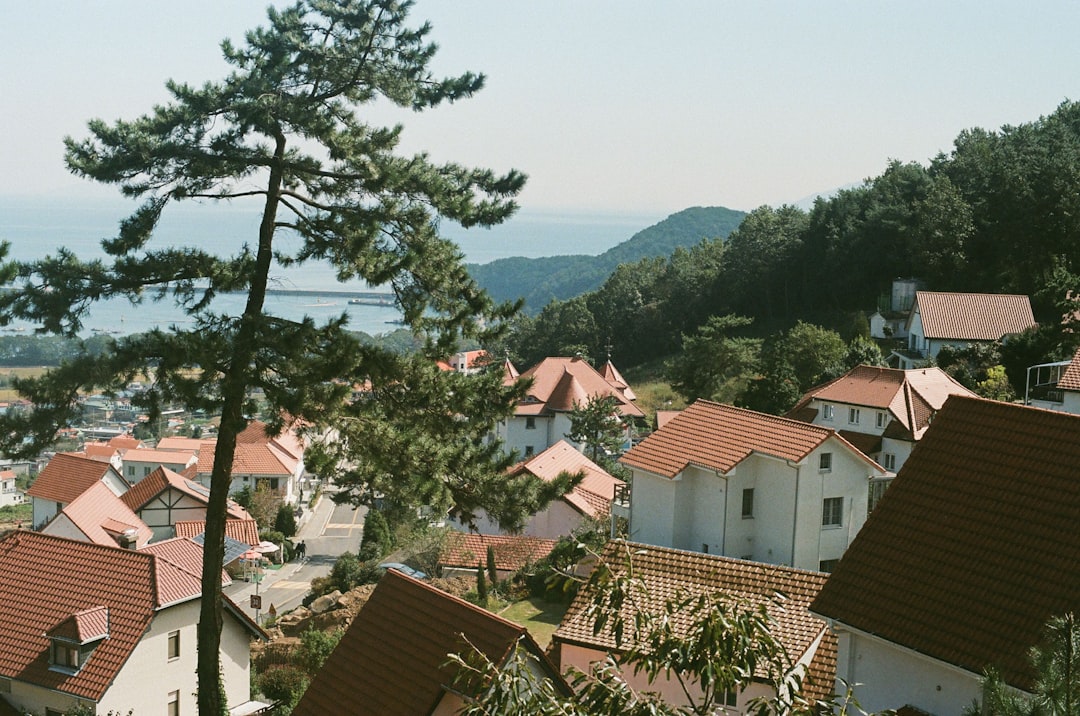

The ochre and white houses with sloping roofs climb the hillside as if someone had taken a corner of Bavaria and placed it on an island in South Korea. The German Village of Namhae — in Korean Dogil Maeul — is not a thematic reconstruction nor a theme park: it is a real residential neighborhood, built starting in the early 2000s by Korean workers who had emigrated to Germany in the 1960s and 1970s and who, in old age, wanted to return to their homeland bringing with them the architecture of the country that had welcomed them for decades.

The result is one of the most unusual landscapes of the Korean peninsula: about thirty German-style houses overlooking the Noryang canal, a body of water dotted with wooded islets that connects the island of Namhae to the mainland. Few foreign tourists venture this far, and this makes the place even more precious for those seeking something authentic outside the usual circuits.
The morning light on the Bavarian houses

At dawn, when the sea mist slowly rises from the underlying canals, the facades of the houses take on an almost golden hue. The sun emerging from the eastern hills of the island first hits the sloping roofs and then descends to illuminate the well-kept gardens, where it is not uncommon to find flowerbeds with typically European flowers alongside Korean garden plants. The color combination — the white of the plaster, the dark brown of the exposed beams, the intense green of the surrounding hills — works best in the early hours of the morning, when artificial lights do not compete with natural light.
Those who arrive before nine have a good chance of having the little streets almost to themselves. The village can be walked through in about forty minutes, climbing the hill along a path that leads to the highest point, from which one can embrace the entire Namhae archipelago with a single glance and, on clear days, distinguish the silhouettes of the smaller islands up to the horizon. The sea here is not open: it is fragmented, enclosed between headlands and islets, giving it an almost lake-like appearance, with the water changing color from the gray-silver of dawn to the deep blue of noon.

The history of Korean workers in Germany
Between the 1960s and 1970s, South Korea made agreements with West Germany for the sending of labor: miners destined for the mines of the Ruhr and nurses in German hospitals. It is estimated that during that period about eight thousand miners and about ten thousand nurses left Korea. Many of them settled permanently in Germany, but some, upon reaching retirement age, chose to return. The municipality of Namhae offered them building lots under favorable conditions, with the stipulation that the houses adhered to a German architectural style, to create a coherent and recognizable neighborhood.
The houses that can be seen today — built mainly between 2001 and 2010 — are not faithful replicas of a single model, but personal interpretations of Bavarian architecture filtered through decades of life in Germany. Some have carved wooden balconies, others have windows with colorful shutters, and still others have small cuckoo clocks or painted decorations on the facades. Each house tells a different story, and the owners, when present, are often willing to exchange a few words with visitors.
The colors of the sunset and the view of the Noryang canal
The most spectacular moment of the day is late afternoon, when the sun descends towards the west and paints the Noryang canal in shades of orange and pink. The small islands, dark against the light, stand out on the water like flat shadows. From the viewpoint at the top of the village, which can be reached by following the signs in Korean and English along the way, the view is completely unobstructed: no tall buildings, no visible power lines, just the succession of wooded hills and the sea that fades between the headlands.
In autumn, between October and November, the hills around the village turn red and orange, adding an additional layer of color to the landscape. It is the recommended time for those who want to photograph the contrast between the German roofs and the Korean vegetation in full seasonal transformation.
How to get there and practical advice
Namhae is an island connected to the mainland by a bridge, reachable by bus from Jinju or Busan. From Busan, the intercity bus journey takes about two hours. Once in Namhae city, you take a local bus to the German Village stop — the buses are infrequent, so it's advisable to check the schedules in advance or consider renting a car, which greatly simplifies getting around the island. Entry to the village is free, although some buildings host small museums or cafes with a reduced entrance fee. The minimum time to visit calmly is two hours, but those who want to enjoy the sunset from the viewpoint should plan to stay until five or six, depending on the season.


