
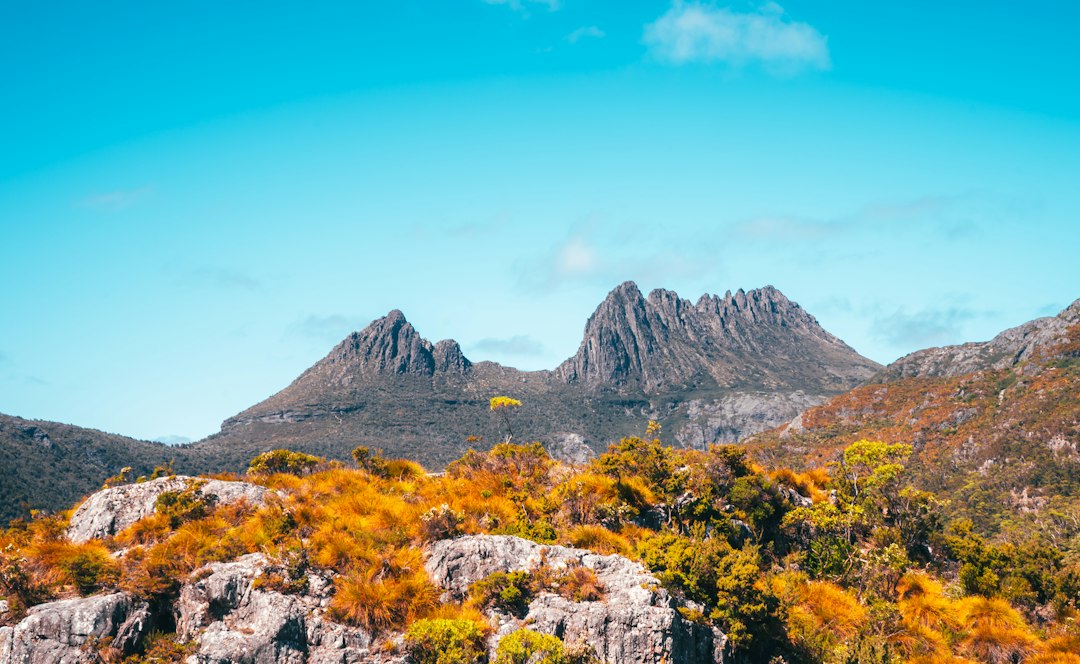

The first step on the Overland Track is often taken in the fog. The jagged silhouettes of Cradle Mountain slowly emerge from the low blanket that envelops Dove Lake at dawn, and the trail begins among exposed roots, wet rocks, and the dense scent of eucalyptus and moss. This 65-kilometer route traverses the Cradle Mountain-Lake St Clair National Park, in the heart of Tasmania, and is considered one of the most challenging and scenically rich multi-day treks in Australia.

The trail connects Cradle Mountain to the north with Lake St Clair to the south, the deepest lake in Australia at 167 meters deep. Most hikers travel the route from north to south in six to eight days, covering an average of about ten kilometers a day over constantly changing terrain: from alpine heathlands to ancient myrtle forests, from cushion plant expanses to glacial moraines left by the last ice age. It is not a walk, but a total immersion in an ecosystem that has existed for millions of years.
The path: what you encounter along the way

In the first kilometers, the trail winds around the shores of Lake Dove on wooden planks laid directly over the wetlands. This structure, called boardwalk, is designed to protect the fragile vegetation of the alpine marsh areas and extends for several stretches along the entire route. While walking, you encounter wombats digging burrows at the edges of the trail, pademelons — small marsupials similar to kangaroos — and, with a bit of luck, the Tasmanian devil, a marsupial predator that is becoming increasingly rare.
After passing the Waterfall Valley area, the landscape opens up into vast high plateaus where the vegetation drastically lowers. The cushion plants, intense green cushion-like plants that grow only a few millimeters a year, carpet the ground as if they were living sculptures. Stepping on even one causes damage that takes decades to repair: the signs along the path insistently remind you of this.

The structures along the trail
Along the Overland Track, there are eight public huts managed by the Parks and Wildlife Service of Tasmania. Each hut offers basic shelter with wooden bunks, but does not guarantee enough spots for all passersby, especially during peak season. For this reason, those trekking the trail between October and May — the officially regulated period — must book a spot and pay a specific access fee which in 2024 was around 200 Australian dollars per person, in addition to the normal entrance ticket to the national park. Booking is mandatory and the number of hikers who can depart each day is limited to reduce environmental impact.

Most hikers carry a tent as a backup, as the huts can be crowded and priority is given to those who have booked. Bringing all the necessary food for the entire duration of the trek is essential: there are no resupply points along the route.
Cradle Mountain and Dove Lake: the visual heart of the trail

The most photographed view of the Overland Track — and probably of all Tasmania — is the one that opens up to Dove Lake with Cradle Mountain in the background. The mountain, which reaches an altitude of 1,545 meters, gets its name from the shape that resembles a cradle when viewed from the side. Its dolerite walls, a dark volcanic rock, have been shaped by Pleistocene glaciers and feature a vertical and jagged surface that contrasts with the flat and reflective surface of the lake below.
On clear days, the reflection of the mountain on the water of Dove Lake is so sharp that it looks like a mirror image. On windy days, however, the lake ripples and the mountain disappears into the agitation of the surface. Both versions have their own precise beauty.
Practical tips for those who want to hike the Overland Track
The best time to hike the trail is from November to March, when temperatures are milder and daylight hours are sufficient for safe walking. However, even in summer, weather conditions can change rapidly: sudden snowfalls at high altitudes are not rare even in January. Bringing waterproof clothing and thermal layers is a concrete necessity, not a generic recommendation.
To reach the starting point at Cradle Mountain, the most common solution is to rent a car in Launceston or Hobart and drive to the park. There is no train connection. At the end of the trail, at Lake St Clair, a ferry service crosses the lake to Cynthia Bay, avoiding the last kilometers on foot. Booking the ferry in advance is strongly recommended, especially during peak season, as spots are limited and departures depend on weather conditions on the lake.


