
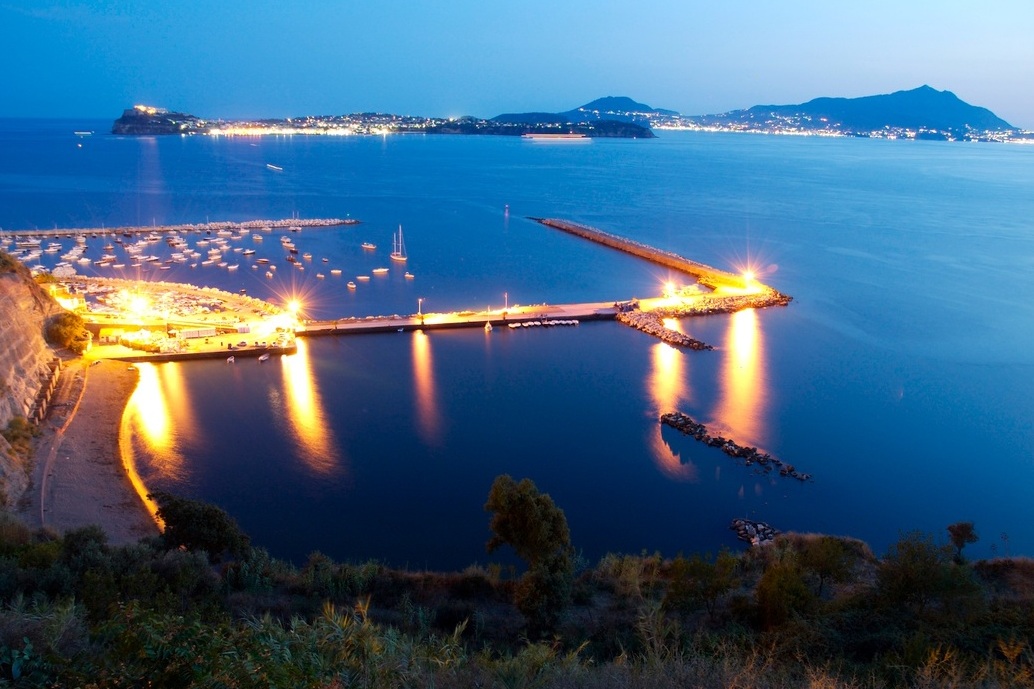

Perched majestically over the Tyrrhenian Sea, Monte di Procida offers one of the most breathtaking panoramas in southern Italy. This small town in the Metropolitan City of Naples is a hidden gem, rich in history and vibrant in culture, making it an essential stop for those exploring the Campanian coastline.
The history of Monte di Procida is deeply intertwined with the ancient civilizations that once thrived in the region. The area has been inhabited since the time of the Greeks, who founded nearby Cumae, one of the oldest Greek colonies on the Italian mainland, around the 8th century BC. Monte di Procida itself grew in prominence during the Roman era, as the fertile volcanic soil of the Phlegraean Fields made it an ideal location for agriculture. As a testament to its rich past, archaeological remains can still be found, offering glimpses into the lives of those who once walked its lands.
Architecturally, Monte di Procida is a blend of rustic charm and historical relics. The town is characterized by its quaint, pastel-colored houses that cascade down the slopes towards the sea. While the architecture here may not boast grandiose structures like those found in nearby Naples, its simplicity is part of its allure. Visitors should not miss the Chiesa Santa Maria Assunta, a beautiful church that stands as a beacon of faith and community. The church is a fine example of local craftsmanship, with its elegant bell tower and serene interior offering a quiet place for reflection.
Culture and tradition run deep in Monte di Procida, with local festivals providing a window into the soul of the community. One of the most vibrant celebrations is the Festa di San Michele Arcangelo, held each September, which honors the town's patron saint. The festival is marked by processions, fireworks, and a palpable sense of unity among residents. Another important event is the Sagra del Mare Flegrea, a celebration of the sea that highlights the town's strong maritime connections. These events are perfect opportunities for visitors to immerse themselves in local life and experience the genuine warmth of the Procidani.
No exploration of Monte di Procida would be complete without indulging in its gastronomy. The local cuisine is a delightful fusion of land and sea, with dishes that emphasize fresh, locally-sourced ingredients. One must-try is the spaghetti alle vongole, a simple yet flavorful dish that perfectly captures the essence of Campanian cooking. Another local specialty is ragu alla genovese, a slow-cooked meat sauce that pairs beautifully with handmade pasta. For dessert, the pastiera napoletana, a traditional Easter pie made with wheat, ricotta, and candied fruit, is a sweet indulgence that should not be missed.
Beyond its scenic vistas and culinary delights, Monte di Procida holds several lesser-known curiosities. For instance, the town is famous for its vineyards that produce the Falanghina and Piedirosso wines, both of which are highly regarded in the Campanian wine scene. Another interesting tidbit is the town's contribution to the Italian navy, with many local families having long maritime traditions. The proximity to the Phlegraean Fields also means the town is close to several geological marvels, such as the Solfatara crater, where visitors can witness fumaroles and mud pools.
When planning a visit to Monte di Procida, timing is everything. While the town is charming year-round, the best time to visit is during the late spring or early autumn. This period offers mild weather, fewer tourists, and the opportunity to partake in local festivals. Visitors should consider taking a leisurely walk along the coast to enjoy the stunning views, particularly at sunset when the sky is painted in hues of orange and pink. Those with a penchant for history should explore the nearby archaeological sites of Cumae and Baiae, both easily accessible from Monte di Procida.
In sum, Monte di Procida is a captivating blend of history, culture, and natural beauty. Its panoramic views are more than just a feast for the eyes—they are a gateway into the heart and soul of a community that cherishes its past while warmly welcoming the future.


