
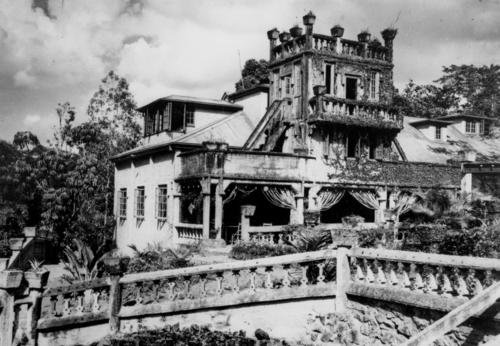

Amid the lush vegetation of the northern Queensland rainforest, in Mena Creek, stands a structure that seems to have come out of a dream: arches covered in ivy, partially crumbling towers, staircases leading to nowhere. It is Paronella Park, the Spanish-style castle that José Paronella, a Catalan immigrant from Tarragona, built almost entirely by hand starting in the 1930s.

Paronella purchased the land in 1929 and worked for years to transform a corner of tropical rainforest into a place of recreation for the local community. The park officially opened to the public in 1935 and included not only the main castle but also an outdoor cinema, gardens, fountains, and a system of stairs that descended to a gorge traversed by a natural waterfall. Today, the site is listed on the Queensland Heritage Register, a recognition that attests to its historical and architectural value.
The architecture of the castle: details to observe up close
The castle of Paronella Park was not designed by a professional architect, but by a man with a clear vision and extraordinary tenacity. José Paronella was inspired by the Mediterranean architecture of his native Catalonia, integrating full arches, open loggias, and corner turrets that recall Spanish neo-romantic constructions. The materials were largely sourced from the surrounding environment: the cement was produced locally, while the stones and sand came from the adjacent creek.
Walking among the ruins, it is still possible to observe the remains of the grand external staircase, the columns that supported the porches, and the foundations of the cinema, where local residents came to watch films in the 1940s. The walls of the main castle still show traces of the original plaster, and in some places, one can notice how the tropical vegetation has intertwined with the structure, creating a visual effect that blends architecture and nature in an almost indistinguishable way.
The waterfall and the gorge: the natural context of the park
One of the most scenic elements of Paronella Park is the natural gorge that runs through the property, traversed by a watercourse that feeds a waterfall visible from the main path. José Paronella took advantage of this geographical feature to create a hydraulic system that powered the park's fountains and, later, a small hydroelectric power station that provided electricity to the structure — one of the first installations of this kind in the region.
The paths that descend towards the gorge are lined with tree ferns, palms, and other plants typical of the Queensland rainforest. The constant humidity and the light filtered through the vegetation create a special atmosphere, in which the ruins of the castle seem to be an integral part of the natural landscape rather than a foreign element. This dialogue between architecture and forest is probably the most distinctive aspect of the entire experience.
Night Tours: Lights and Atmosphere Among the Ruins
Paronella Park offers guided tours both during the day and at night, but it is the evening tours that give the site its most evocative dimension. As the sun sets, a theatrical lighting system is activated along the paths and on the structures: the ivy-covered arches are bathed in warm lights, the towers cast shadows on the surrounding vegetation, and the waterfall is illuminated, creating reflections on the water. The result is an atmosphere that vaguely recalls certain European romantic parks of the nineteenth century, while maintaining a completely original character.
The guides accompany visitors through the history of José Paronella and his family, also recounting the difficulties the park faced over the decades: floods, cyclones, and periods of abandonment. The fact that the structure still exists, albeit in the form of ruins, is partly the result of conservation efforts carried out by the current owners, who manage the site as a tourist attraction and a place of memory.
Practical Information for the Visit
Paronella Park is located along the Bruce Highway, near Innisfail, in northern Queensland, about an hour and a half drive from Cairns. The site is open every day and the entrance ticket includes both the daytime and nighttime tour, allowing visitors to return in the evening with the same ticket. The indicative price is around 50 Australian dollars for adults, but it is advisable to check the updated rates on the official website before the visit.
The most useful advice for those planning the visit is to arrive in the late afternoon: this way you have time to explore the park in natural light, observe the architectural details and the paths in the gorge, and then wait for the nighttime tour without having to return a second time. Wearing suitable shoes for wet terrain is essential, as the paths go through rainforest areas where the ground often remains wet. In the months of the rainy season, from November to April, some areas may be partially inaccessible.


