



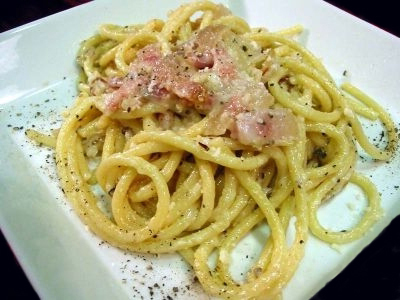
The seasoning of pasta alla gricia è consists of oil, guanciale, black pepper and plenty of pecorino romano.This very simple and quick preparation can be considered as the base from which è the most famous pasta all’ amatriciana (simply by adding tomato) was created.
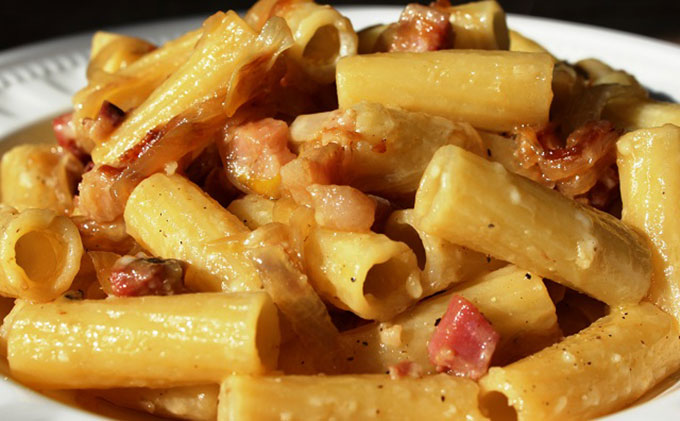
Actually, there are many theories about the birth of pasta alla Griscia (or Gricia). Many of them relate it to the moreù famous pasta all’ Amatriciana (or matriciana), others consider it as if it itself was the real pasta all’amatriciana, the one in which è tomato is present being only a version modified later by Amatricians who emigrated to Rome.
According to others, the ’origin of the term dates back to the Rome of the ‘400s where “Gricio” was the appellation by which bakers, almost all of whom came from the German regions of the Rhine and Canton de’ Grisons, were referred to. But “griscium” was also used with special reference to the “duster” or “gray bag” that formed a kind of uniform for members of the bakers' guild (the masters of the white art), with which they used to defend themselves against flour. The appellation Gricio, in addition to the positive sense of the regional reference, quickly took on another derogatory meaning, equivalent to burino, to indicate an ill-dressed man of coarse manners: in fact, bakers used to dress rather carelessly under their duster, especially during the summer period. Over time their ankle breeches became famous as “er carzone a la gricia”, equivalent to the Neapolitan pantalone alla “zompafuossi”. Great professional skill, handed down solely within family circles, allowed the Grici to hold supremacy in the ’white art in Rome. In the 19th century, the ’appellation “Gricio” was used not only for immigrants from the German and Swiss regions, but also for the natives of northern Lombardy (Sondrio, etc.), known in Rome as rough, hard-working, very frugal mountain people and great savers. The Grici entertained with the population a relationship of both hate and love, due to their aptitude for setting up on their own and plying the trade of orzaroli. L’orzarolo sells bread, flours, legumes, foodstuffs of all kinds, as well as inexpensive kitchen crockery, è’ forced to give credit, little and shrewdly, but he marks everything on pieces of paper, attached ar chiodo (hence the saying: “Er Gricio, si nun fosse rafacano sarebbe puro bbono!”). On the other hand, even the Gricio has to be attached to the nail, because è the store è is open from dawn to night, waiting for customers to scrape together money to eat; this is also why the Grici arrive in Rome in family or village cordatas. To provide for their needs, the Gricio ès store is equipped with a coal stove, where he cooks his dish, pasta alla gricia, which quickly becomes a popular dish.
