


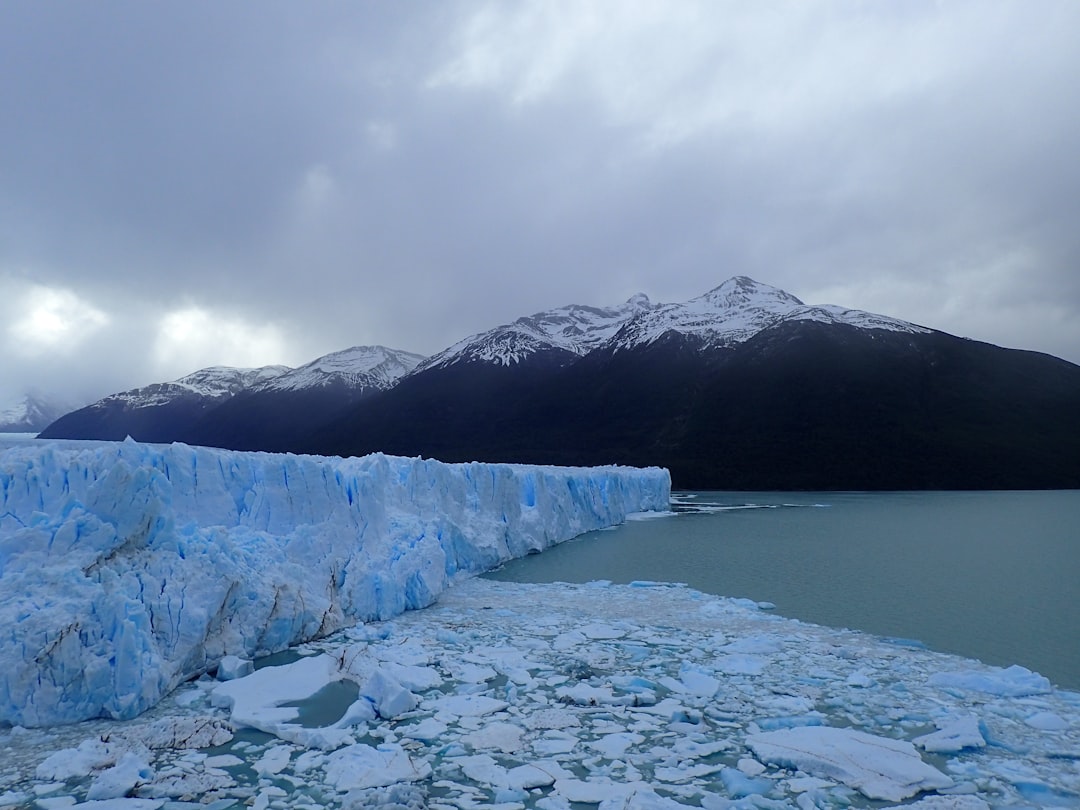
The noise arrives before the image: a dull crackling, almost a distant thunder, rising from below as one walks on the metal walkways of the Perito Moreno Viewpoint. Then, turning the corner of the last viewpoint, the glacier appears in its entirety — a white and blue wall rising up to 74 meters above the level of Lake Argentino, slowly advancing towards the Magallanes Peninsula. It is not a postcard. It is something that is felt in the bones.

The Perito Moreno Glacier extends for about 250 square kilometers and is one of the few glaciers in the world considered to be in dynamic equilibrium, which means it is not retreating like most of its counterparts. This makes it an exceptional phenomenon in the context of Argentine Patagonia, and the system of walkways built within the Los Glaciares National Park — a UNESCO World Heritage site since 1981 — allows for close-up observation, sometimes less than a hundred meters from the front wall.
The walkways and the sunset on the ice

The system of balconies and walkways that makes up the Mirador is organized on multiple levels, descending along the hillside towards the lake. In the central hours of the day, the ice appears almost blindingly white, but when the sun begins to set on the Patagonian horizon — and in the Southern Hemisphere summer, between November and March, this often happens after 9:00 PM — the light changes everything. The deep cracks in the glacial surface are tinged with an intense, almost electric blue, while the highest ridges capture the golden and orange tones of the sunset. The contrast is physically astonishing: the same block of ice seems to contain two impossible colors at the same time.
It is in these moments that one understands why nature photographers deliberately choose to stay until the park closes. The slanting light enhances every crevice, every serac, every tower of ice that juts out from the vertical wall. Bringing a tripod is recommended, but even without professional equipment, the images obtained at this hour are difficult to replicate elsewhere.
How to get there and practical information
El Calafate, the nearest city, is about 80 kilometers from the glacier. The road is paved and can be traveled in about an hour. Numerous organized transfers depart from the city, which represent the most convenient option for those who do not have a rental car. The entrance fee to the national park for foreign visitors is approximately around 5,000-6,000 Argentine pesos, but the amount is subject to frequent changes related to local inflation — it is always useful to check the updated price before leaving.

The park generally opens at 8:00 and closes in the late afternoon, with hours that vary slightly depending on the season. To enjoy the sunset on the ice, it is essential to arrive in the afternoon and plan to stay until closing time, which in the high summer season can be postponed. Avoid Argentine holidays and weekends in July, when the flow of local visitors increases significantly.
What to observe on site

Walking along the lower walkways, it is possible to observe the phenomenon of calving: pieces of ice that break off from the front wall and fall into Lake Argentino with a sudden roar. It is not possible to predict when it happens, but the frequency is high — especially during the warmer hours — and the wait becomes part of the experience. Many visitors stand still for twenty or thirty minutes in a fixed spot, waiting for the next break-off.
A detail that surprises almost everyone on their first visit is the color of the water of Lake Argentino in the immediate vicinity of the glacier: a milky gray-blue, caused by glacial flour, that is, the very fine particles of rock crushed by the movement of the ice. This color is very visible even from above, and creates a sharp contrast with the darker waters of the open lake.
The right time for the visit
The best season is the southern summer, from October to April, when the days are long and the weather is milder. However, Patagonia is known for its weather unpredictability: strong winds, rain, and sun can alternate within the same afternoon. Dressing in layers is essential. Wearing polarized sunglasses helps to see the details of the ice better during full daylight hours and protects against the intense glare that the white surface produces on clear days.
Those who have the option to choose the day should keep an eye on the local forecasts and aim for a day with scattered clouds in the late afternoon: the filtered lights that result at sunset are often more spectacular than those of a completely clear sky, as they add depth and color variation to the ice wall.


