


Two glacial rivers meet beneath its white walls: the Mo Chhu, the mother river, and the Pho Chhu, the father river. It is at this precise point, at the confluence of these two currents that descend from the Himalayas, that the Punakha Dzong rises, one of the most imposing architectural structures in Bhutan. To reach it, one crosses a traditional cantilever wooden bridge, slightly swaying underfoot, which psychologically prepares for entry into a world separate from the rest.

Built in 1637 at the behest of Zhabdrung Ngawang Namgyal, the Tibetan monk who unified Bhutan and defined its national identity, the dzong was designed following the indications of a prophetic dream. Namgyal personally chose this site after seeing a white elephant in the vision. Since then, the building has withstood floods, earthquakes, and fires, being rebuilt and restored several times over the centuries, while preserving its original structure with multiple inner courtyards.
The architecture: whiteness and Himalayan proportions

Approaching the dzong means confronting its scale. The outer walls, coated in bright white, rise for several stories without windows at the bottom, creating an effect of an impenetrable fortress. Only by ascending can one glimpse the golden decorations of the curved roofs in Bhutanese style, with ornamental edges in copper and painted carved wood. The entire structure extends over 180 meters in length, making it one of the largest dzongs in the country.
Inside, the complex is divided into two main sections: an administrative one, housing the district government of Punakha, and a religious one, where monks reside during the winter months. Every year, in fact, the Central Monastic Body of Bhutan moves here from Thimphu between November and May, bringing with it hundreds of monks who enliven the inner courtyards with daily prayers and rituals.

The murals: a pictorial heritage to observe up close
Once past the main gate, the eye is captured by the murals that cover every internal surface. Hand-painted with natural pigments and mineral colors, these frescoes depict scenes from the life of the Buddha, tantric deities, cosmological mandalas, and episodes from Bhutanese history. The details are extraordinary: expressive faces, garments with millimetric embroidery, stylized mountain landscapes that resemble maps of a parallel universe.

Particularly noteworthy is the throne room, where royal ceremonies take place. Bhutan still uses this dzong for state events: the marriage of King Jigme Khesar Namgyel Wangchuck to Queen Jetsun Pema was held right here in 2011, confirming the symbolic and political role that the building still maintains today. Observing the red and gold lacquered columns of the main hall gives a sense of how each architectural element is designed to convey spiritual and temporal power.
The Punakha Tshechu Festival: when the dzong transforms
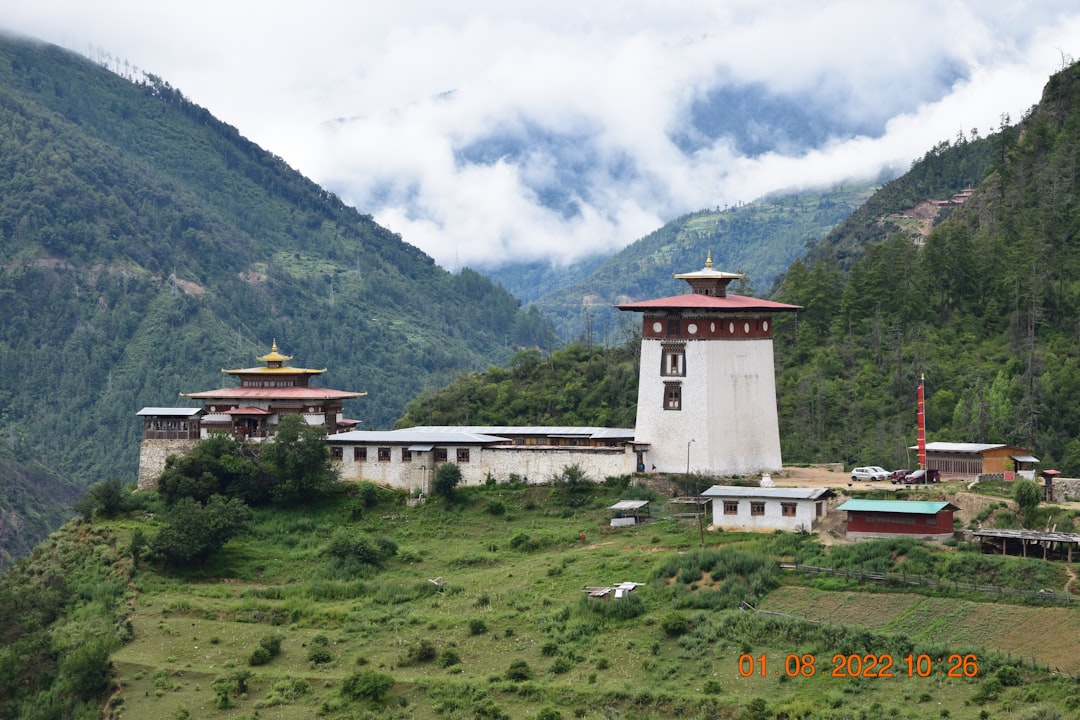
If the calendar allows, try to visit Punakha during the Punakha Drubchen or the Punakha Tshechu, two religious festivals that usually take place between February and March. During these days, monks perform sacred dances in costume in the inner courtyards, accompanied by traditional instruments such as the dungchen, the long Tibetan trumpet, and the kangling. The colors of the ritual costumes, crimson red, saffron yellow, and ultramarine blue, contrast with the white of the walls in a way that no photograph can fully capture.
The celebrations attract both Bhutanese pilgrims from all over the country and foreign visitors. The atmosphere is intimate yet vibrant, with families in traditional clothing, elderly people turning prayer wheels, and children running between the columns. It is one of the few contexts in which one can observe Bhutanese religious life in an authentic and participatory way, without the feeling of being mere spectators.
Practical Information for the Visit
Punakha is located about 75 kilometers from Thimphu, the capital, via the Dochu La pass at an altitude of 3,116 meters. The drive takes about two and a half hours, with the option to stop at the pass to admire the 108 commemorative chortens and, on clear days, the Himalayan range. Entrance to the dzong is included in the Sustainable Development Fee that every foreign tourist is required to pay in Bhutan, currently set at 100 dollars per day. There is no separate ticket for the dzong.
The best time to visit is early in the morning, before organized groups arrive in large numbers. Wearing clothes that cover shoulders and knees is mandatory to access religious areas. Allow at least two hours to calmly visit the courtyards, the throne room, and the terraces by the river. Walk slowly on the wooden bridge at the entrance and stop to watch the water of the two rivers mix beneath it: this is the best way to understand why this place was chosen six hundred years ago.


