
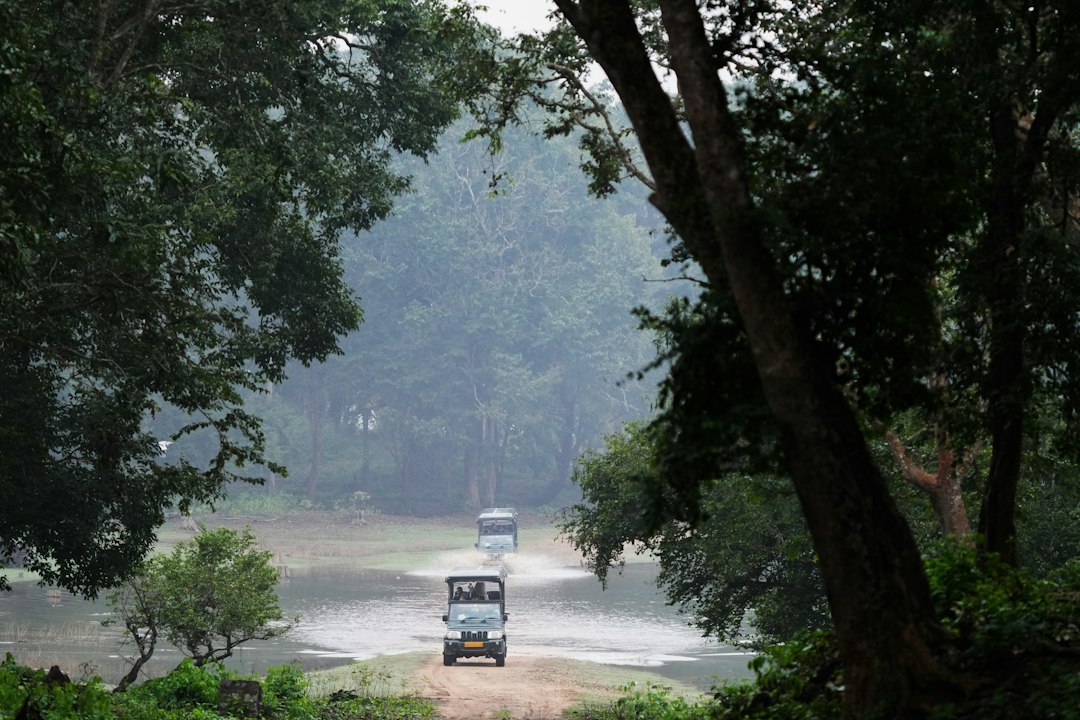

The water is still, dark green, framed by hills that rise towards skies often veiled in mist. At Pykara Lake, inland from the Nilgiri Hills in Tamil Nadu, there are no crowds jostling on the shores, nor noisy stalls. Instead, there are the dense canopies of the shola forest, the open stretches of montane grassland, and, if one is lucky and patient, the unmistakable silhouette of the Nilgiri tahr on the steep slopes above the reservoir.
Pykara is an artificial reservoir built by the British during the colonial period to power the hydroelectric system of the region, and it still forms part of a facility that provides energy to the area. This practical origin does not detract from its beauty: the lake is located about 19 kilometers from Ooty, the famous hill station of the Nilgiris, but seems to belong to a completely different world, far from the mass tourism that characterizes the capital.
The shola forest and mountain meadows: a unique ecosystem
What makes the landscape around Pykara truly extraordinary is the alternation between two natural environments typical of the Nilgiris: the shola forest and the mountain grasslands. The shola are subtropical evergreen woods that grow in the valleys and the wetter areas, with twisted trees covered in moss and ferns, a dense undergrowth, and an almost fairy-tale atmosphere. Between one forest and another, wide grassy expanses, the grasslands, rise along the slopes up to high altitudes.
This combination is not only aesthetically fascinating: it is a fundamental habitat for the local fauna. The Nilgiri tahr (Nilgiris tahr), a wild goat endemic to the region and a vulnerable species according to international classifications, frequents the slopes above the lake. Spotting it requires calm and a bit of luck, but it is not rare for those who stop to observe the hills in the cooler hours of the morning.
On the lake by boat: a tranquil experience
One of the simplest and most rewarding activities in Pykara is renting one of the small boats available at the shore. These are generally pedal boats or rowboats operated by local vendors, with modest rates typically around 100-200 rupees for a session. Don't expect sophisticated facilities: it is this simplicity that makes the experience authentic.
Paddling slowly towards the center of the basin, with the shola forest reflecting in the water and the silence broken only by the singing of birds, is an experience hard to find elsewhere in the Nilgiri area. Visibility is often excellent in the morning, before the fog rises from the valleys. On clear days, the surrounding hills display their entire layering of green, from the dark forest below to the light meadows above.
Pykara Waterfalls: a few steps from the lake
In the immediate vicinity of the lake are the Pykara waterfalls, fed by the river of the same name that descends from the Nilgiris. The waterfalls develop in several successive drops immersed in vegetation, and can be reached on foot from the lake in just a few minutes. The site is equipped with a small park and resting areas, and is frequented mainly on weekends by families coming from Ooty and Coimbatore.
It is worth visiting both the lake and the waterfalls on the same day, dedicating the early morning to the lake to take advantage of the best light and the greater likelihood of spotting wildlife, and moving to the waterfalls mid-morning before the larger crowds arrive.
How to get there and when to go
Pykara can be reached from Ooty by taking the state road towards Mysore for about 19 kilometers. You can take one of the local buses that connect Ooty with the nearby villages, or rent a taxi or a scooter, which is a more convenient option to manage your time. The road is paved and accessible year-round, although during the monsoon, from June to September, conditions may worsen and fog can reduce visibility.
The best time to visit Pykara is from October to April, when the rains have ceased and the sky is mostly clear. Mornings remain cool even in the warmer months, with temperatures rarely exceeding 20 degrees at this altitude. Arriving by eight in the morning means enjoying the lake almost in solitude, with the slanting light illuminating the water's surface and the hills still shrouded in a light mist. It is advisable to bring water and something to eat: services in the area are limited, and this scarcity is an integral part of its understated charm.


