


Forty thousand years ago, someone stopped on these limestone rocks overlooking the Caspian Sea and carved the outline of a bull. Today, walking among the boulders of the Qobustan State Reserve in Azerbaijan, you can still see that image — along with over 6,000 petroglyphs that depict hunts, dances, boats, and stylized human figures, layered over millennia of human history. This rocky plateau, located about 60 kilometers south of Baku, is one of the densest and best-preserved rock art sites in the entire Eurasian region.
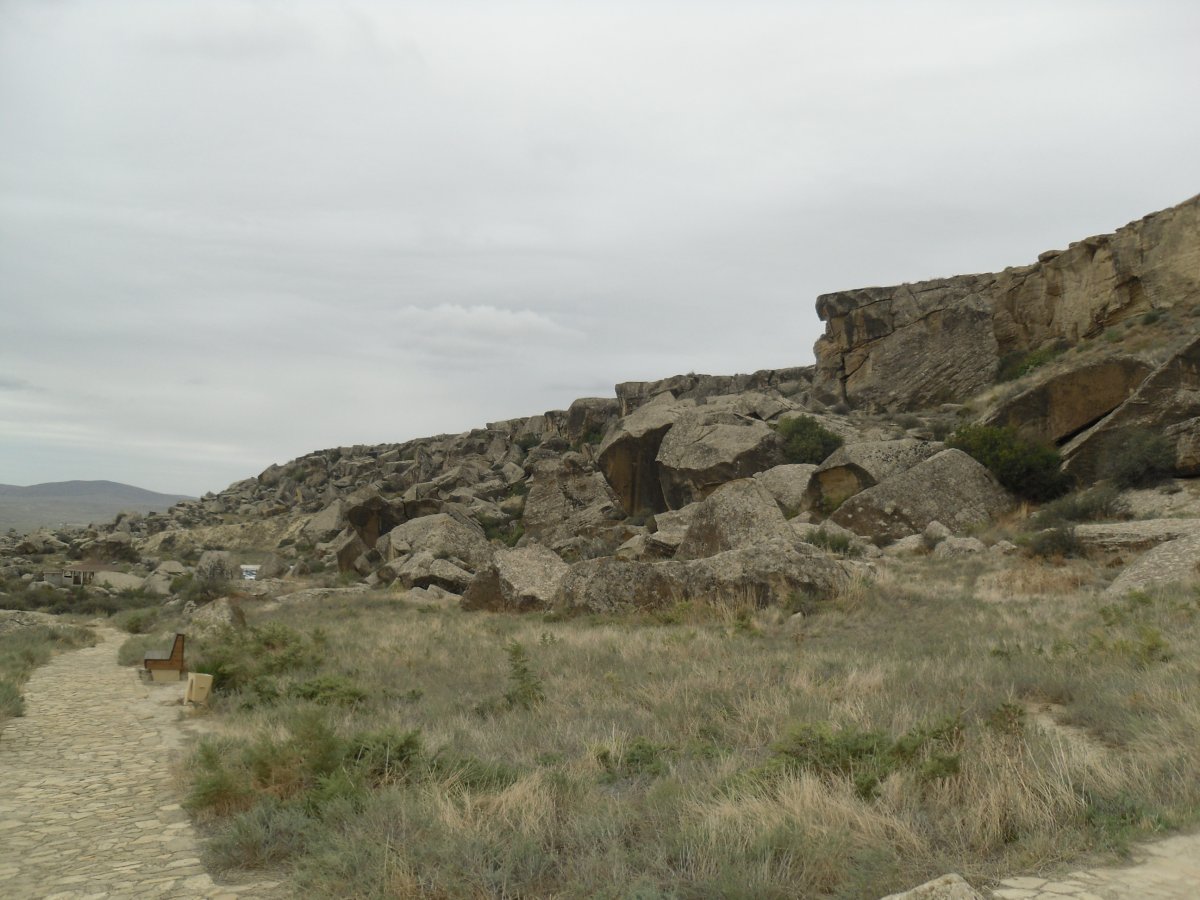
The reserve was officially established in 1966, and in 2007 UNESCO inscribed Qobustan on the World Heritage List, recognizing the exceptional value of its engravings that span a time frame from the Upper Paleolithic to the medieval period. But Qobustan is not just an archive of ancient images: a few kilometers from the main site, dozens of active mud volcanoes bubble silently, expelling cold gray mud in small eruptions that seem to have come from another planet.
The petroglyphs: an archive of 40,000 years carved in stone
The engravings of Qobustan are not concentrated in a single point but distributed across three main areas — Böyükdaş, Kiçikdaş, and Cingirdağ — each with its own characteristics. On the Böyükdaş massif, the most accessible and most visited, are some of the most iconic images: large aurochs bulls with long horns, anthropomorphic figures dancing in a line, and even one that some researchers interpret as a depiction of a rowing boat, similar in shape to Viking vessels. Right next to one of these rocks, a plaque reminds us that the famous Norwegian explorer Thor Heyerdahl visited the site in the 1990s and was convinced that the similarities between these engravings and Scandinavian symbols suggested ancient cultural ties between the peoples of the Caspian and those of Northern Europe.
Walking along the marked path, one can also notice Latin inscriptions left by a Roman legion — the Legio XII Fulminata — dating back probably to the 1st-2nd century AD, tangible evidence that these rocks were a landmark even in classical antiquity. The modern museum inaugurated in 2012 at the foot of the site offers scale reproductions, explanatory panels, and a collection of artifacts that help contextualize what is seen outside. The entrance ticket to the museum and the rock site is about 15 Azerbaijani manat (just under 9 euros at the indicative exchange rate), an accessible amount that includes the audiovisual guide.
The mud volcanoes: a lunar landscape a few kilometers away
About twenty kilometers from the main site, the semi-desert plain surrounding Qobustan hosts an exceptional concentration of mud volcanoes. Azerbaijan accounts for about half of all the mud volcanoes on the planet, and those in the Qobustan area are among the most active and visible. They are not imposing structures: most are small cones or depressions in the ground from which a slow flow of gray-blue and cold mud emerges, mixed with saltwater and natural gas. Occasionally, with a dull gurgle, a larger bubble breaks the surface and leaves a perfect circle that slowly expands.
The visual effect is both hypnotic and disorienting at the same time. The ground around the volcanoes is crusted with salt and etched with streams of dried mud that form natural geometric patterns. Some more intense eruptions — which occur rarely but unpredictably — can project mud several meters high. It is advisable not to get too close to the active cones and to stay on the beaten paths, also because the surrounding ground can be unstable.
How to Organize the Visit Effectively
The most convenient way to reach Qobustan from Baku is to rent a car or take a private taxi: the journey takes about an hour along the coastal road that runs parallel to the Caspian Sea. There are also public buses that stop near the entrance, but connections to the mud volcanoes still require a private vehicle. The best time to visit is early in the morning, when the slanting light enhances the reliefs of the rock carvings and the temperatures are more bearable, especially in the summer months when the sun on the limestone can become intense. Allow at least three hours for the museum and the Böyükdaş site, plus an additional hour and a half if you decide to reach the mud volcanoes.
Bringing plenty of water, closed shoes with non-slip soles, and a hat is essential: the site is completely exposed and the uneven terrain requires caution. The most pleasant seasons are April-May and September-October, when the weather is mild and the colors of the landscape — between the beige of the rocks, the gray of the mud, and the blue of the Caspian Sea on the horizon — reach their best yield.


