



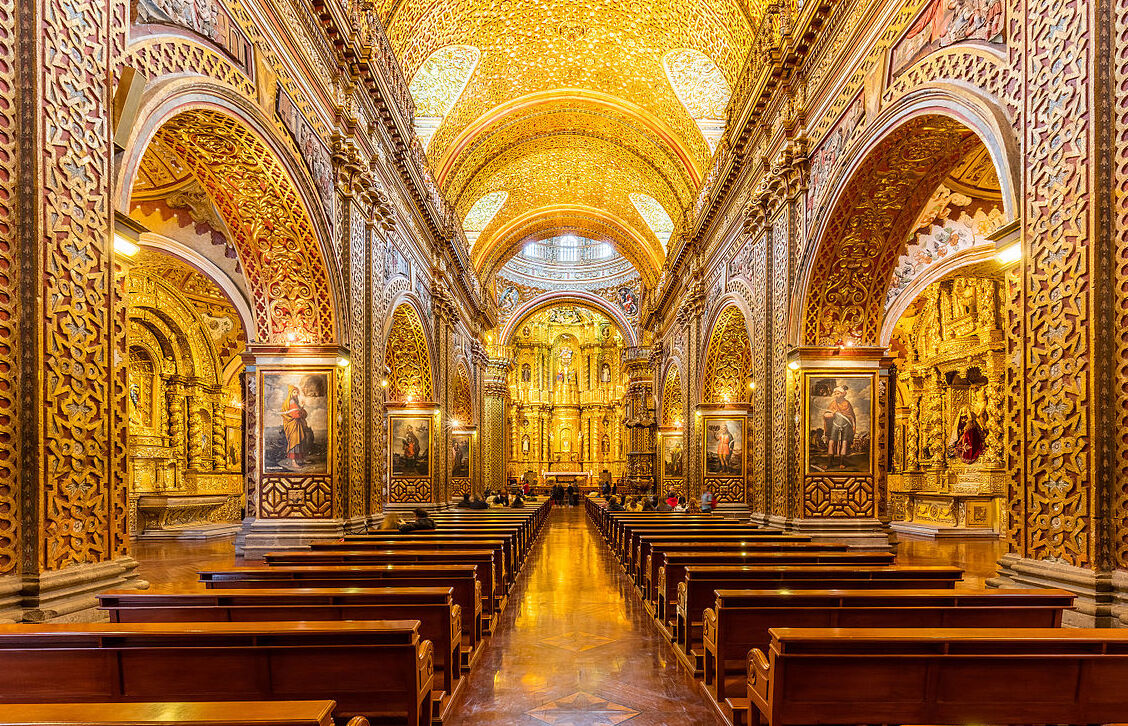
The Company Church is the pinnacle of baroque in Latin America, and is known as the Jewel of America. Started to be built in 1605, it took 160 years to be completely finished. Its baroque style facade maintains the traditional Jesuit churches, whose main example is the church of the Gesu of Rome, although with a more elaborate decoration. The intention of the Jesuits when they arrived in Quito in 1586 went beyond the construction of a church, so in 1622, in an annex building to the church they built a university, which is now the headquarters of the Metropolitan Cultural Center. The Compañía church is the best example of Quito's baroque style, although given its long period of construction, it also mixes other styles such as Renaissance, Mudejar, Neoclassical or Churrigueresque. When you enter the church of the Company, which in our case was also completely empty of visitors, you will not be surprised by its dimensions. I mean, it's a big church, whose central nave vault is 26 metres high; what will leave you amazed is to see it completely covered in gold. What will amaze you is that it is completely covered in gold. It is covered in gold leaf, with fine 23-carat sheets in every centimeter of the church. It is estimated that in total it should hold up to a ton of gold. This was the way the Jesuits tried to attract the Indians to come to church and thus assume the Catholic religion. The gold was contributed by the indigenous families who thus "bought" places so that their children could go in the future to the new Jesuit university that was later built. The church has the characteristic configuration of a Latin cross, with a transept, and is composed of three naves, one central and two lateral in a consecutive way. In the architecture of the church of the Company of Jesus, symmetry prevails. The main altarpiece is the work of the famous artist from Quito, Bernardo de Legarda, also author of the sculpture of the Virgin of Quito, icon of the city, and from which the silvery winged Virgin of the Panecillo hill was built. You will be amazed by the images of the holy founders of the religious communities that came to Quito. In one of the chapels of the cruise is also dedicated to St. Ignatius of Loyola, the holy founder of the Society of Jesus. On the other hand, the remains of Mariana de Jesus, the first Ecuadorian saint, are kept in the altar. In the other chapel of the transept, if you look closely you can see the difference of the glow in the balcony where it was restored by a fire. It is also worth mentioning the numerous artistic works that are distributed throughout the church. In its atrium is one of the crosses that make up the street of the 7 crosses in the historic center of Quito.
