
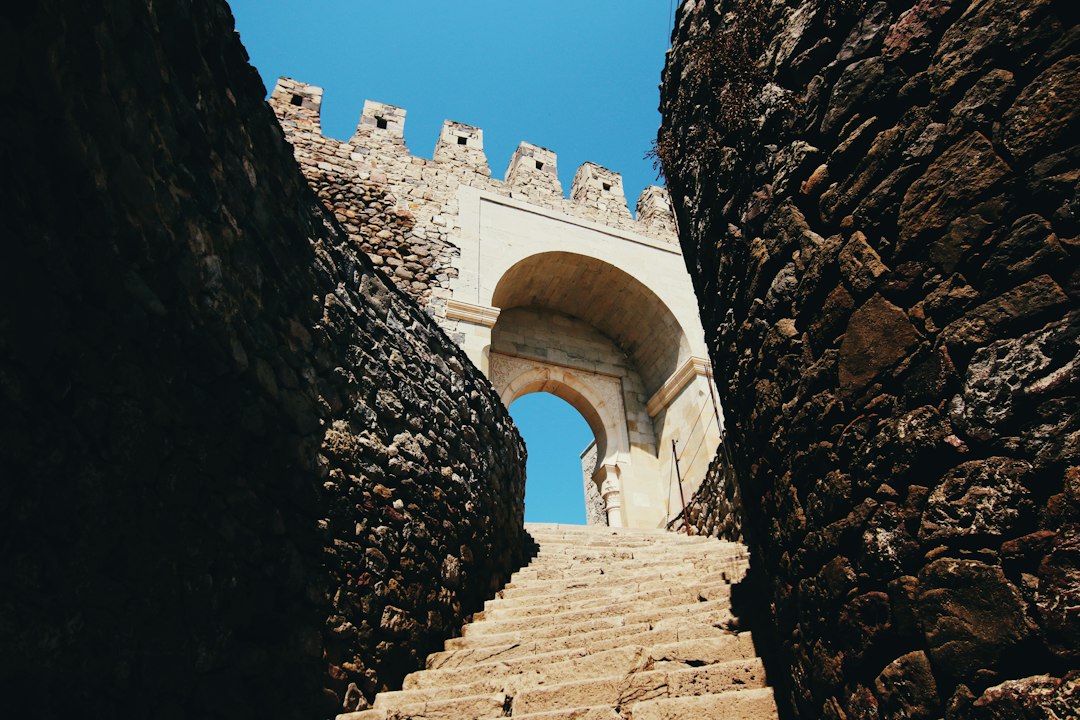

The walls of the Rabati Castle rise above the center of Akhaltsikhe like a city within a city: an Ottoman minaret and an Orthodox church dome share the same sky, separated by a few meters of paved courtyard. This juxtaposition is not the result of a modern aesthetic choice, but of centuries of overlapping dominations that have left visible physical layers still today, from the dark volcanic stone of the Georgian medieval towers to the white stuccos of the restored mosque.
The complex is located in the city of Akhaltsikhe, in the Samtskhe-Javakheti region, in southern Georgia, about 200 kilometers from Tbilisi along the road leading to Turkey. The fortress stands on a promontory overlooking the gorge of the Mtkvari River, and its walls enclose an area of about 7 hectares divided into two main sections: the lower town, freely accessible and animated by cafes and shops, and the upper citadel, the historically oldest and militarily most significant part, which requires an entrance ticket.
The layered history of the castle
The first defensive structures on the site date back to the 9th century, when the fortress was a stronghold of the principality of Samtskhe. In the 14th and 15th centuries, it became the seat of the powerful Jakeli princes, who ruled the region with relative autonomy. The most radical turning point came in 1578, when Ottoman troops conquered Akhaltsikhe and transformed the fortress into an administrative center of the Empire: the Ahmadiyye mosque, built in the 18th century within the complex, is the most evident sign of that long period of domination, which lasted until 1828, the year when the Russian troops of Tsar Nicholas I took the city.
After decades of abandonment and decay, the Georgian government launched an ambitious restoration project between 2011 and 2012, partially funded by public funds and partially by private investments. The works, which sparked some controversy among historians for certain reconstruction choices considered too invasive, have nonetheless restored to the complex a legibility that had been lost. Those who visit today can clearly distinguish the original parts, made of dark and irregular stone, from the sections rebuilt from scratch.
Architecture and details not to be missed
Entering the upper citadel, the first element that captures attention is the Ahmadiyya mosque, with its slender minaret reaching about 30 meters in height. The interior has been converted into a museum and preserves some original geometric decorations on the walls, typical of Islamic art from the Ottoman period. A short walk away is the Orthodox Church of San Marino, a single-nave building with a semicircular apse and remnants of partially legible medieval frescoes on the east wall, where the figure of a saint is visible in a frontal position with a golden halo.
The corner towers of the city walls deserve a close visit: the basalt stone used in the original construction has a rough and porous texture that sharply contrasts with the light limestone used in recent restorations. This chromatic contrast, which at first glance may seem an aesthetic flaw, actually becomes a valuable historical reading tool. From the walkway, accessible via steep stone stairs, the view opens up to the gorge of the Mtkvari and the roofs of Akhaltsikhe: on clear days, it is possible to see the southern Caucasus mountains on the horizon.
The museum and the internal collections
Inside the citadel is the Museum of History and Ethnography of Samtskhe-Javakheti, which occupies some of the restored buildings. The collection includes objects found during the excavations of the site: medieval ceramics, coins from various periods of domination, weapons, and jewelry. Particularly interesting is the section dedicated to the Armenians who inhabited the region for centuries, with inscriptions and traditional textiles. The captions are in Georgian and English, making the visit accessible to foreign travelers as well.
The entrance ticket to the upper citadel costs about 7 Georgian lari for adults, an amount equivalent to less than 3 euros at the time of writing this article. Children and students benefit from reduced rates. The lower town, with its craft shops and restaurants offering local cuisine from Samtskhe-Javakheti, is instead freely accessible and free of charge.
Practical tips for the visit
The best time to visit the castle is in the early morning, between 9 and 11, when the slanting light enhances the textures of the stone and organized groups have not yet invaded the courtyards. The complete visit, including the museum and the walk on the walls, takes an average of two and a half hours. From Tbilisi, you can reach Akhaltsikhe in about three hours by marshrutka, the shared minibuses that leave from the Didube station: the cost is around 15 lari. Alternatively, some agencies offer day tours that combine Rabati with the Vardzia monastery cave, about 60 kilometers away, making logistics easier for those with little time.
Those who suffer from vertigo should be cautious on the tower stairs, which lack handrails in some sections and have irregular step heights. In summer, the stone gets very hot: comfortable shoes and water are essential.


