
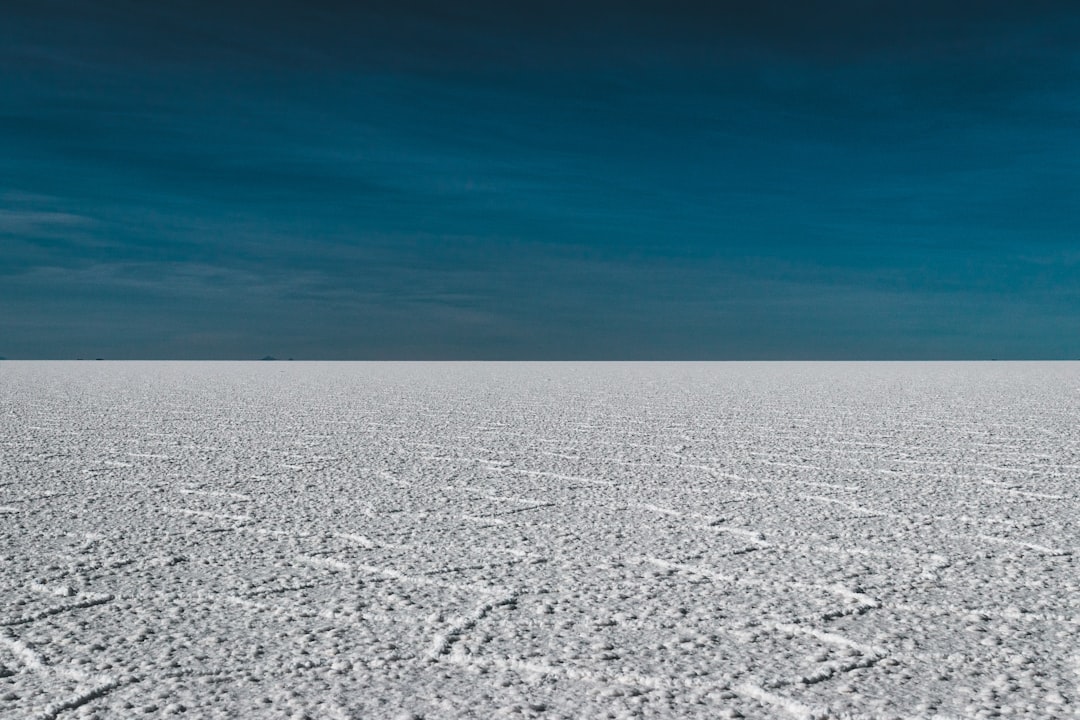

In November, when the waters of the monsoon season completely recede, something extraordinary happens in the Kutch district of the Indian state of Gujarat. The bed of what has been a salt marsh for months emerges into the open air and crystallizes into a flat, white, and dazzling expanse that stretches for about 7,500 square kilometers. There are no dunes, no undulations, no trees: only salt, sky, and silence.

The Rann of Kutch — literally the "desert of Kutch" — is the largest seasonal salt flat in the world. The village of Dhordo, in northern Gujarat, is the main access point for visitors and hosts every year the Rann Utsav, a cultural festival organized by the government of Gujarat that takes place from November to February, during the window of time when the desert is traversable and the dry season ensures ideal conditions.
The silence as a landscape

Those who arrive at the Rann expecting a desert of sand are taken aback. There are no dunes here, no vertical elements that interrupt the line of the horizon. The surface is hard underfoot, composed of salt crystals that crunch with every step like frozen snow. The white is so intense that it requires sunglasses even in the least bright hours of the day. The boundary between land and sky dissolves into a haze of light.
The silence of the Rann is physical, almost oppressive. The absence of vegetation eliminates any barrier to the wind, which blows free and constant, carrying only its own sound. In the distance, on the clearest days, the silhouettes of the sandy islands called bets can be distinguished, small elevations that emerge from the salt plain and that in the past were seasonally inhabited by the shepherds of the Rabari community.

The Night of the Full Moon
The reason why many visitors plan their trip to coincide with the full moon is concrete and verifiable on site: when the moon is full, the white surface of the Rann reflects the night light with an intensity that makes any flashlight unnecessary. The entire plain becomes silver, glowing with its own light, and the shadow of a person is projected sharply and long on the salt as if it were noon. It is a real optical effect, produced by the combination of a reflective surface and total absence of light pollution.

Night temperatures in mid-winter drop significantly, often reaching values close to 8-10 degrees Celsius between December and January. Bringing thermal layers is essential, especially for those who intend to stay after sunset. The sky during those hours, far from any significant urban center, shows the Milky Way with a clarity that is now almost forgotten in Italian cities.
How to get there and when to go

The nearest airport is Bhuj, the capital of the Kutch district, connected to Mumbai, Ahmedabad, and other Indian cities with regular flights. From Bhuj, Dhordo is about 85 kilometers away and can be reached by car or with transfers organized by Rann Utsav operators in about an hour and a half. There is no direct public bus connection that is convenient for foreign tourists, so renting a car with a driver from Bhuj remains the most practical solution.
The most important practical advice: plan your visit between November and February, preferably during the full moon weeks. The Rann Utsav offers accommodations in equipped tents right on the edge of the desert, bookable through the official tourism portal of Gujarat. Prices vary considerably based on the type of tent and proximity to the full moon, but a standard tent typically starts from 5,000-8,000 rupees per night for a couple. Avoid the monsoon period, from June to September, when the entire area is flooded and inaccessible.
The community that lives on the margins of white
Around the Rann live communities such as the Banni, shepherds and artisans known for their traditional embroidery called Kutchi embroidery, recognizable for the use of mirrors sewn into the fabric and for the geometric complexity of the patterns. During the Rann Utsav, artisans from these communities display and sell their works within the festival, offering visitors direct contact with techniques passed down through generations.
Walking on the salt at sunset, when the slanting light transforms the white into shades of orange and pink, is the experience that visitors most often describe as the hardest to photograph and the easiest to remember. Not because it is spectacular in a conventional sense, but because it is radically silent: a place where the absence of everything becomes, paradoxically, the presence of something very specific.


