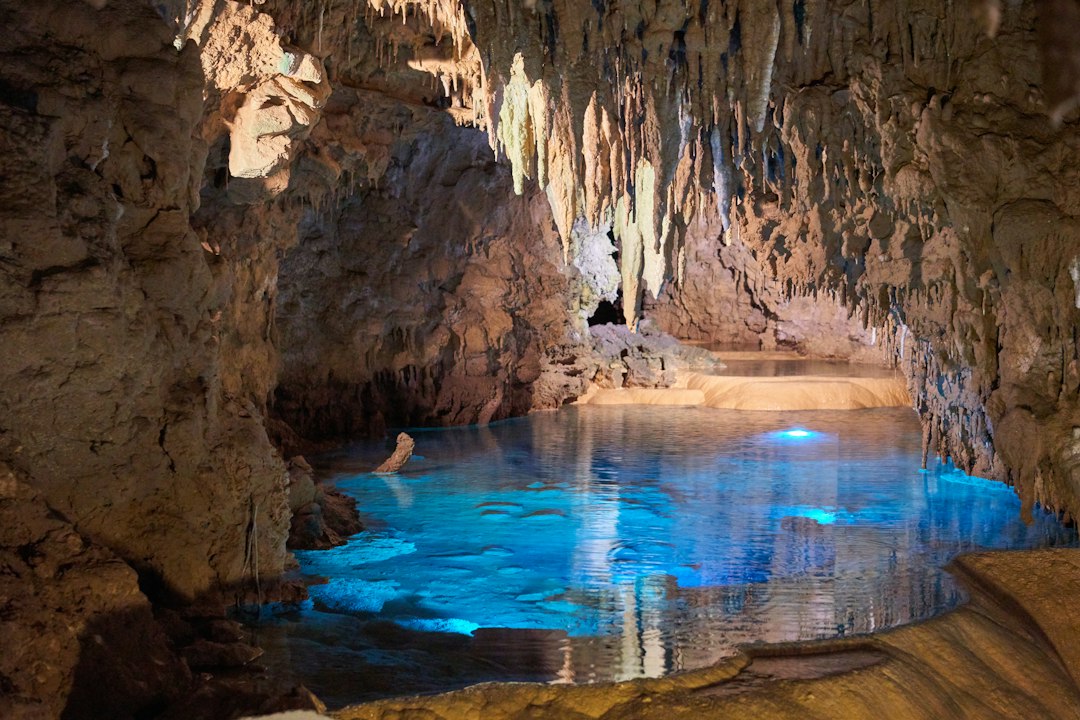

The water changes color even before entering the cave. From the deep blue of the open sea, it gradually becomes more intense, almost artificial, until it transforms into an electric glow that seems to come from below, as if the seabed itself were illuminated. This is the first sign that the Blue Grotto of Rhodes is something different from a simple rocky cavity on the Greek coastline.

The cave is located along the southern coast of the island of Rhodes, Greece, in an area of limestone cliffs that the sea has carved over the centuries. It is not accessible on foot: access is exclusively by sea, aboard small boats that typically depart from nearby beaches, such as Glyfada or Lindos. It is precisely this inaccessibility that preserves the place from excessive mass tourism, making it still today an experience that retains something authentic.
How the magic of light works

The luminous phenomenon that makes this cave famous is not an artificial effect nor a local legend: it is pure physics. Sunlight penetrates through underwater openings in the rock and refracts in the water, projecting intense and shimmering blue reflections on the walls of the cave. The effect is similar to that of the more famous Blue Grotto of Capri, Italy, although the Blue Grotto of Rhodes is much less known internationally.
Inside the cave, the limestone walls appear iridescent, as if coated with a luminescent material. The color varies with the movement of the water: at certain moments it is an almost white turquoise, at others a deep cobalt blue. The reflections continuously move across the low ceiling of the cavity, creating a visual effect that is difficult to photograph accurately and that remains etched in memory more vividly than any image.

The natural environment and the coast of Rhodes
The southern coast of Rhodes, where these rock formations are located, is geologically characterized by compact limestone shaped by marine erosion. The sea caves in this area have formed over millennia of combined action from waves, currents, and chemical dissolution of the rock. The Blue Grotto is one of the most accessible and spectacular cavities along this stretch of coast, but it is not isolated: nearby, there are other small caves and natural arches that local boatmen often show during excursions.

The water in this part of the eastern Mediterranean is generally very clear, with underwater visibility that can exceed twenty meters on windless days. This clarity is essential for the luminous phenomenon: without such clean water, light would not refract with the same intensity. Those who go snorkeling in the immediate vicinity can observe the sandy bottom and rocks covered with posidonia, the marine plant that indicates the good health of the local ecosystem.
How to organize the visit

Boat trips to the Blue Grotto depart from various points on the island. Among the most common are departures from Lindos, the medieval village on the eastern coast of Rhodes, located about 55 kilometers from the city of Rhodes. The boat tours that include the grotto generally last between two and four hours, with stops for swimming and snorkeling. The cost of these excursions typically ranges from 20 to 40 euros per person, depending on the operator and duration.
The best time to visit the grotto is during the central hours of the morning, when the sun is high enough to allow light to penetrate through the underwater openings, but not yet so overhead as to reduce the refraction effect. Between 10 and 12 in the morning, optimal lighting conditions are generally recorded. It is advisable to avoid days with rough seas: small boats cannot safely enter the grotto when there is strong wind, and many excursions are canceled or diverted. Checking the marine weather forecasts before booking is a simple but essential precaution.
What to expect and what to bring
The inside of the cave is low and narrow: the boats must slow down and at some points passengers need to duck to avoid hitting the rock. It is not a place suitable for those who suffer from claustrophobia. The stay inside lasts a few minutes, just enough time to observe the reflections and take some photographs. For photos, it is useful to set a high ISO sensitivity and give up the flash, which tends to flatten the colors instead of capturing them.
Bringing a mask and fins is a good idea: many excursions include a stop for swimming in the waters near the cave, which are among the most beautiful and clear on the island. A water-resistant sunscreen and a hat are essential for the hours spent on the boat, where sun exposure is direct and intense, especially in the summer months between June and August.