


At almost two hundred meters above sea level, nestled in the volcanic rock of Risco de Famara, the Mirador del Río offers one of the most stunning views of the entire Canary archipelago. From here, one overlooks the Río channel, the narrow stretch of sea about a kilometer and a half wide that separates Lanzarote from the island of La Graciosa, and the horizon opens up to a landscape where the blue of the Atlantic meets the pale green of the shallow waters and the ochre tones of the volcanic earth.

The viewpoint was designed by the Lanzarote artist and architect César Manrique and inaugurated in 1973. Manrique, born on the island in 1919, had a clear vision: to integrate architecture into the natural landscape without violating it. The result is a structure almost invisible from the outside, carved directly into the cliff face, with two large circular windows framing the panorama as if they were open eyes to the sea.
The architecture hidden in the rock
Approaching the Mirador del Río means not seeing it until the last moment. The building is almost completely buried in the volcanic cliff, with an exterior facade minimized and painted white, camouflaged among the dark basalt rocks. Only once inside does one understand the scale of the intervention: two communicating floors, with a panoramic room on the upper level and a bar-restaurant on the lower floor, both overlooking the two large circular windows that constitute the heart of the project.
Inside, Manrique has taken care of every detail: the walls made of raw lava stone, the sculptures and ceramics that recall local materials, the low ceilings that amplify the feeling of being inside the mountain. The contrast between the darkness of the interior and the dazzling brightness of the external panorama is one of the most successful visual effects of the entire work. The entrance ticket is about 5 euros for adults, an amount that includes access to the panoramic terrace.
The colors of the landscape at different times of the day
The light in Lanzarote changes radically throughout the day, and the Mirador del Río reveals it better than any other point on the island. In the early morning, when the sun is still low on the eastern horizon, the Río channel appears almost silver, with La Graciosa emerging from the mist like a flat, golden silhouette. The shallow waters of the strait, in certain places no more than a few meters deep, take on an emerald green hue that sharply contrasts with the darker blue of the open ocean.
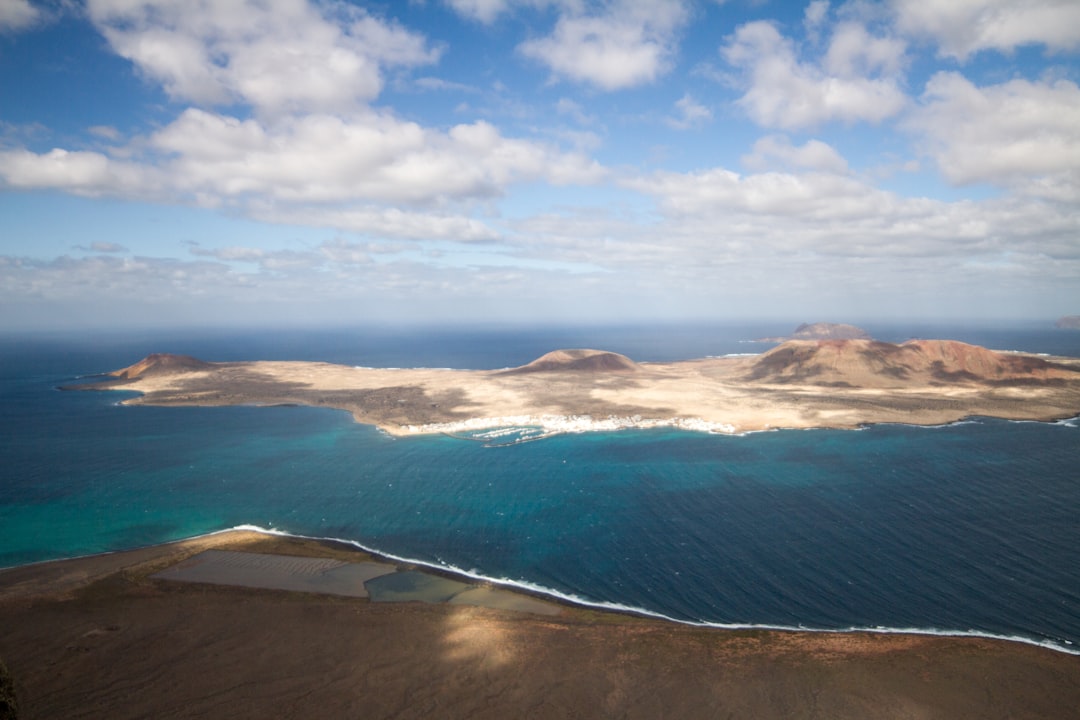
In the afternoon, when the light becomes warmer and more slanting, the colors intensify: the rusty red of Lanzarote's volcanic rocks, the white of the villages of La Graciosa visible to the naked eye, the burnt yellow of the deserted beaches of the islet. At sunset, with the sun descending towards the west, the entire scene is tinged with orange and purple, and the long shadows of the hills draw ever-changing geometries on the surface of the water. It is at this moment that the landscape reaches its maximum chromatic intensity.
La Graciosa seen from above

From the Mirador del Río, one can observe La Graciosa in its entirety: a flat and deserted island, devoid of paved roads, with two small inhabited areas and some of the most isolated beaches in the Canary Islands. La Graciosa officially became the ninth island of the Canary archipelago in 2018, a recognition that solidified its status as a protected territory. Viewed from above, its elongated shape and sharp contours seem almost unreal, like an island drawn on a map rather than a real place.
With binoculars, one can clearly distinguish the white roofs of the village of Caleta del Sebo, the main inhabited center, and the sandy paths that cross the interior of the island. The feeling of looking at a separate and almost motionless world, reachable only by ferry from Órzola, adds an almost melancholic dimension to the panorama.
Practical tips for the visit
The Mirador del Río is located at the northern tip of Lanzarote, near the small village of Ye, accessible by car via the LZ-201 road. There is no direct public transport service, so it is practically essential to have a rental vehicle. External parking is free and generally available even during peak season.
The best time to visit is early in the morning, when the tourist buses have not yet arrived and the light is softer. The visit itself takes about thirty to forty minutes, but it is easy to linger longer on the panoramic terrace. Avoid the central hours of the day in the summer months: the overhead light flattens the colors and the crowding reduces the pleasure of contemplation. In any season, it is advisable to bring a jacket: the wind on the Risco de Famara can be intense even on the warmest days.


