



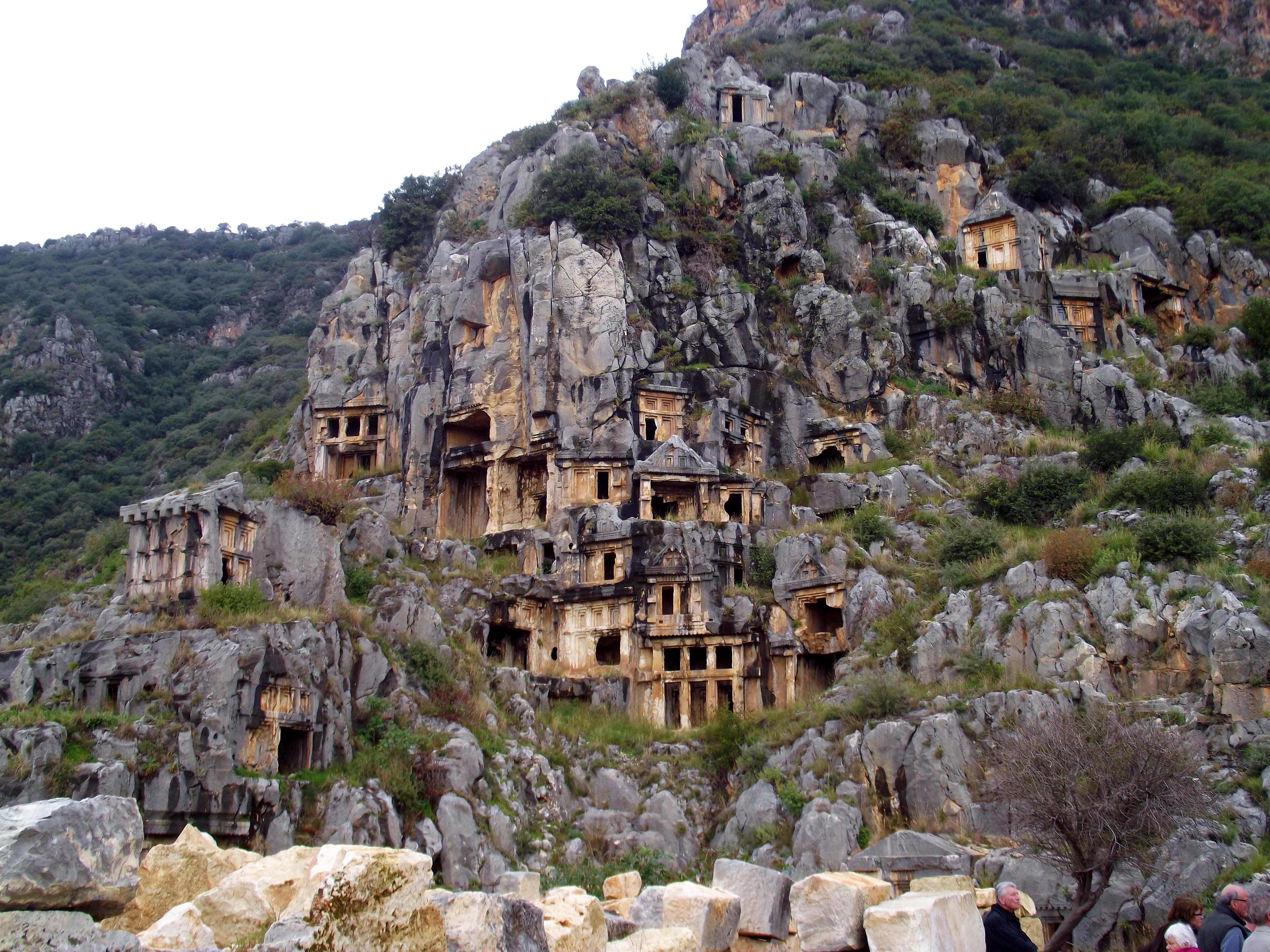
Carved into the rugged cliffs overlooking the ancient city of Myra in present-day Demre, Turkey, the rock tombs stand as a silent testament to the once-flourishing Lycian civilization. These ancient sepulchers, dating back to the 4th century BCE, offer a glimpse into a society that revered its ancestors and celebrated life beyond death. The Lycians, known for their unique blend of Hellenistic and indigenous cultures, found in these cliffs an eternal resting place for their elite, ensuring their journey to the afterlife was as grand as their earthly existence.
The striking architectural style of the Myra rock tombs is a marvel of ancient engineering and artistry. Each tomb is meticulously carved to resemble the facades of Lycian houses or temples, complete with intricate reliefs and pediments. This architectural choice reflects the Lycians' belief in providing the deceased with a home-like environment in the afterlife. Notable among these is the Lion’s Tomb, adorned with carvings of lions, a motif symbolizing power and protection. The artistry extends to finely detailed reliefs depicting scenes of daily life, mythological figures, and funerary processions, each telling a story of the person entombed within.
While visitors cannot wander among the tombs, standing at the base of the necropolis and gazing upwards offers an evocative sense of the Lycians' cultural and spiritual values. Their traditions were deeply intertwined with nature and the supernatural, believing that the soul's journey to the afterlife was aided by these elevated tombs, closer to the heavens. This spiritual connection is celebrated in local traditions, where remnants of Lycian culture continue to permeate the region’s identity.
The cultural tapestry of Myra and its surroundings is rich with traditions that have evolved over centuries. The nearby town of Demre is particularly known for its connection to Saint Nicholas, the 4th-century bishop of Myra, whose legacy as the protector of children and sailors has inspired countless legends, including that of Santa Claus. Every December, the town hosts the St. Nicholas Festival, drawing visitors who wish to celebrate the life and deeds of this beloved figure.
While exploring Myra, indulge in the local gastronomy, which carries the flavors of the Mediterranean with a unique Turkish twist. Dishes such as Gözleme, a traditional flatbread filled with spinach and cheese, and Meze platters, featuring an array of small dishes like hummus and stuffed grape leaves, offer a culinary journey through the region’s history. Don't miss the opportunity to sample Piyaz, a tangy bean salad seasoned with tahini, lemon, and garlic, often enjoyed with freshly caught fish from the nearby coast.
Beyond the well-trodden paths, Myra holds lesser-known curiosities that add depth to its already fascinating history. The ancient city was once a major center on the Lycian Way, an extensive network of trade routes that connected various Lycian cities. This strategic position made Myra a cultural melting pot, influencing everything from its architecture to its religious practices. Moreover, recent archaeological efforts have uncovered Roman-era baths, theaters, and agorae, offering further insights into the daily lives of its ancient inhabitants.
For those planning a visit, the best time to explore Myra is during the spring or autumn months, when the weather is mild and the landscape is lush with blooming wildflowers or autumn hues. Arriving early in the day allows you to experience the site in tranquil solitude, as the morning light casts a golden hue over the tombs. Be sure to bring a good pair of binoculars to appreciate the detailed carvings from a distance, as well as comfortable walking shoes for exploring the surrounding areas.
In Myra, the echoes of ancient history reverberate through the rock-hewn tombs, the vibrant local customs, and the tantalizing flavors of its cuisine. As you stand before these majestic relics of the past, you’ll find yourself transported to a world where the passage between life and death was marked by art, architecture, and enduring traditions.
