
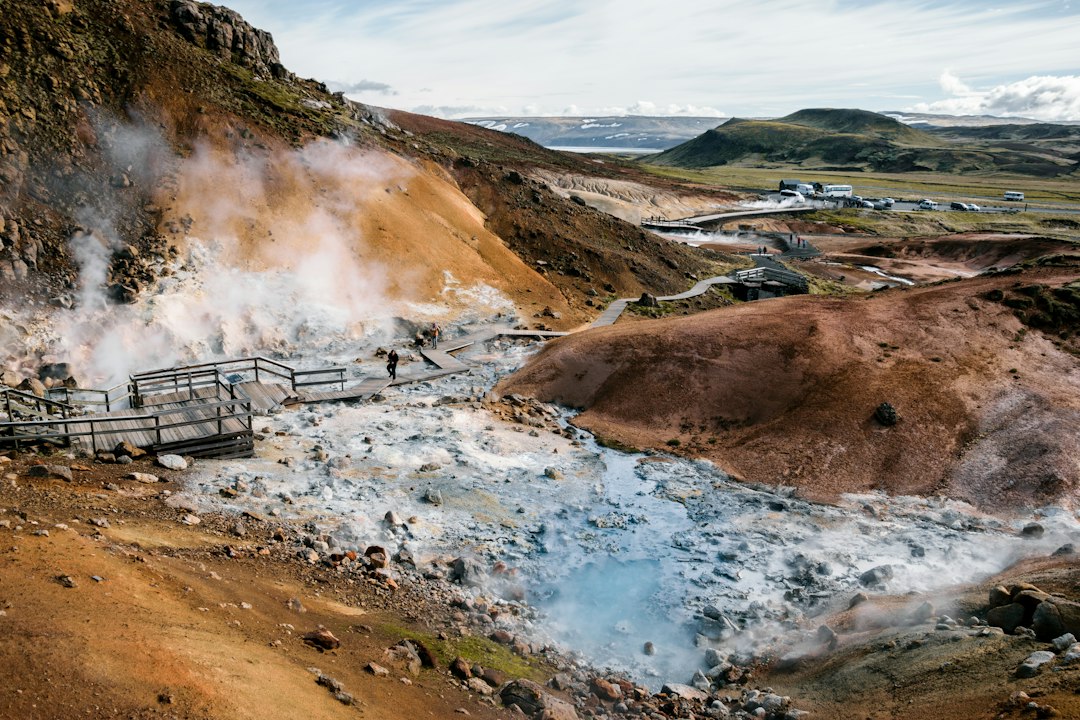

The mud bubbles a few centimeters from your feet. The smell of sulfur is immediate, almost physical, and the steam rises in white columns from the dark ground as if the earth is breathing. Welcome to Seltún, a geothermal area located in the Reykjanes peninsula, in the Krýsuvík district, about 40 kilometers southwest of Reykjavík. Here, the landscape is nothing tamed: it is volcanic in the most literal sense of the term.
Unlike Geysir, which attracts hundreds of thousands of tourists every year with its spectacular geysers, Seltún remains a relatively uncrowded place, accessible via a short wooden walkway that winds between boiling mud pools, sulfur-crusted fumaroles, and veins of colorful minerals that stain the ground red, orange, and green. There are no tickets to purchase, there are no elaborate tourist barriers: just the working earth.
A landscape that changes before your eyes
The most surprising characteristic of Seltún is its visible geological instability. In 1999, a sudden steam eruption destroyed part of the area, radically altering the shape of the land. Since then, the site has partially reconstituted itself, but still bears the marks of that event: some areas appear fractured, with cracks from which hot steam continuously escapes. Walking on the walkway, one can observe gray-blue mud pools that bubble slowly, with bubbles forming and bursting on the surface with a dull, rhythmic sound.
The soil around the paths is covered with deposits of crystallized sulfur, recognizable by the intense yellow color that contrasts with the black of the basalt rock. In some fumaroles, the steam reaches temperatures exceeding 100°C, and the signs along the path remind visitors never to leave the walkway: the ground outside can give way without warning, hiding pockets of boiling mud just beneath the surface.
The sensory experience and its therapeutic value
Seltún is not a spa in the conventional sense of the term, but the experience it offers has something profoundly rejuvenating. The air filled with sulfur steam, though pungent, creates a feeling of total immersion in the natural environment that few destinations can replicate. Some local traditions attribute beneficial properties for the skin and respiratory system to Icelandic geothermal baths, and even just standing still to observe the bubbling pools produces an almost meditative effect.
The Reykjanes Peninsula as a whole has been classified as a UNESCO Global Geopark since 2015, a recognition that enhances the geological uniqueness of the entire area, of which Seltún is one of the most accessible and visually powerful examples. The contrast between the silence of the surrounding landscape — low hills, sparse vegetation, often cloudy skies — and the frenetic activity of the underground makes the visit an experience that remains etched in memory.
How to get there and when to visit
Seltún is easily reachable by car from the capital: from Route 1 take Route 42 towards Krýsuvík, and the area is marked with clear signs. Parking is free and the walkway is accessible without entrance fees. The main path takes about 20-30 minutes at a leisurely pace, but many visitors stop longer to observe the various pools and photograph the details of the terrain.
The most important practical advice: wear closed and sturdy shoes, not sandals. The ground around the walkway is uneven, and in case of rain — frequent in Iceland in any season — the wooden planks can become slippery. Visiting in the early morning hours, before ten, offers softer light and fewer visitors, although the site never reaches the crowd levels of major destinations. In winter, the steam from the fumaroles is even more spectacular, visible from a distance against the cold sky, but the weather conditions require appropriate clothing.
What to expect and what not to forget
Seltún is not a place to relax on a deck chair with a cocktail in hand. It is a place where the earth reminds you that Iceland is still forming, where volcanism is not history but a daily presence. Bring water with you, as there are no dining facilities in the immediate area, and keep children close along the path. The mud pots are most active in the central section of the walkway, while the densest steam fumaroles are concentrated at the upper part of the path, from which there is also a good panoramic view of Lake Kleifarvatn on clear days.
Those visiting the Reykjanes peninsula can combine Seltún with a stop at Lake Kleifarvatn, just a few minutes' drive away, and with the famous Blue Lagoon, which is about 30 kilometers away. This way, you get a complete geothermal itinerary that showcases two very different faces of the same natural phenomenon: one wild and free, the other curated and commercial. Seltún is the former.


