
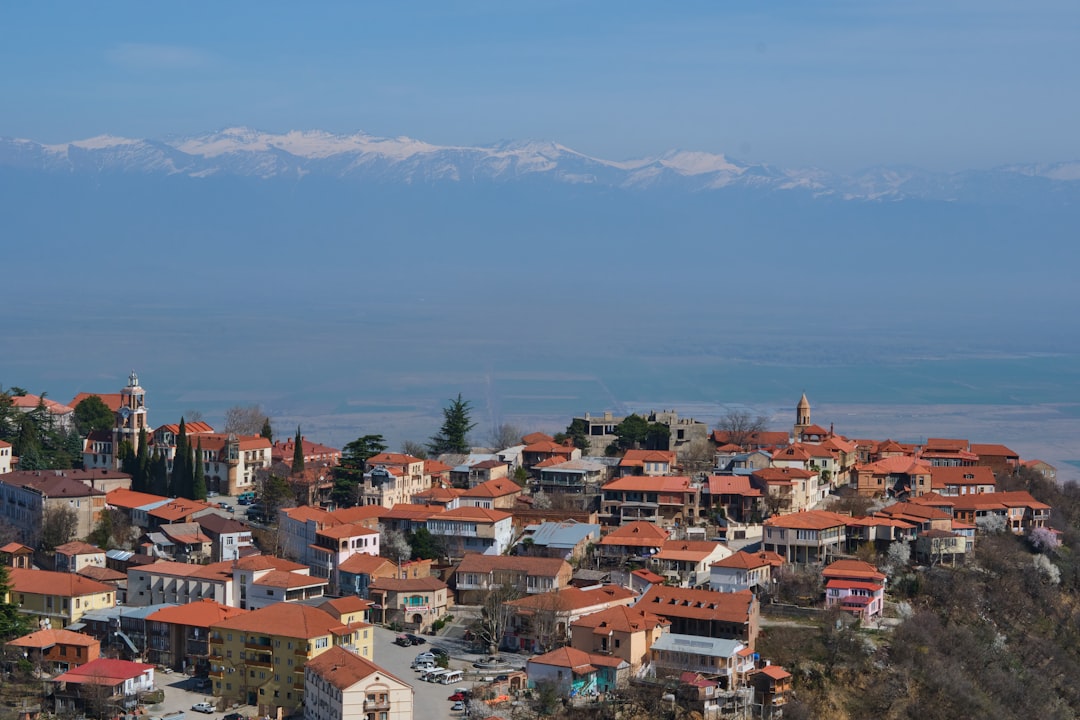

The walls of Sighnaghi stretch for about four kilometers around the hill, dotted with twenty-three watchtowers that Georgian restorers have restored to their original appearance in the 2000s. Walking along this perimeter of gray stone means finding oneself suspended between two worlds: below, the green and ochre carpet of the vineyards of the Alazani valley; in the distance, the Caucasus mountain range with its snow-capped peaks that on clear days seem painted against the sky. Sighnaghi is a small town in the Kakheti region, in eastern Georgia, and owes its current fame precisely to this combination of defensive architecture and open landscape.
The city was founded as a fortress in the 18th century, during the reign of Erekle II, to protect the local population from incursions by the Lezgins from the north. This military origin is still evident today in the structure of the village: the terracotta-colored houses with carved wooden balconies lean against each other along narrow alleys, while the outer walls served as refuge for the entire community in case of attack. Today, those same walls have become the most scenic walking path in the region.
The Light on the Alazani: Morning and Sunset
At dawn, when the fog slowly rises from the plain, the Alazani valley appears like a gray-mother-of-pearl sea that gradually lightens. The rows of vines emerge from the mist in geometric order, and the first slanting lights color the rooftops of the village in antique pink. It is the moment when the colors are softer and more melancholic, suitable for those seeking a quiet and intimate atmosphere.
At sunset, however, the scene transforms radically. The sun descends towards the west and illuminates the Caucasian peaks from the side, which first turn golden and then pink, with the snows reflecting almost violet hues. The valley takes on an amber tint, and the vineyards assume shades ranging from deep green to burnt orange depending on the season. The stretch of wall facing east, towards the plain, is the best spot to observe this spectacle, as it offers an uninterrupted view without architectural obstacles.
The path on the walls: what to expect physically
The walk on the walls is not equipped like an alpine trail, but it is passable without particular difficulties. Some sections are paved, others are dirt; the overall elevation change is modest, but the walkways at height require attention because not everywhere are there guardrails. The towers, rectangular in shape and built of local stone, offer resting points and slightly different viewpoints: some look directly over the plain, others overlook the maze of roofs of the village.
From the highest tower of the path, it is possible to distinguish, on clear days, the outline of Mount Shavi Klde and, further north, the peaks that mark the border with Russia. Visibility is better between October and April, when the air is drier and the mountains are not veiled by summer heat. In summer, the afternoon haze can considerably reduce visual distance, making the peaks almost invisible during the central hours of the day.
Colors and Seasons: When to Go
Autumn is the season that offers the richest color palette. In October, the vineyards shift from green to yellow, to orange, to deep red, creating a mosaic that stretches for miles across the plains below. It is also the time of the grape harvest in Kakheti, and the air carries a faint scent of must rising from the plains. The walls during this time are frequented by photographers and travelers who come specifically for the season of colors.
Spring, from April to June, offers a bright and uniform green, with the almond trees already in bloom in the valley. Winter is less visited but not lacking in charm: the snow on the Caucasian peaks is more abundant and visually closer, and the country empties of tourists, returning to the walls a tranquility that is hard to find in summer.
Practical tips for the visit
Sighnaghi is about one hundred and twenty kilometers from Tbilisi and can be reached in about two and a half hours by marshrutka that depart from the Samgori station in the capital. The recommended departure time is around six in the morning to be on the walls at dawn, before the daily tourists arrive in droves. The complete walk along the walls takes about an hour and a half of leisurely walking, but those who want to stop to take photos or simply observe can take three hours without difficulty.
Access to the walls is free and does not require a ticket. Wearing shoes with non-slip soles is helpful, especially if the ground is wet. The town has a handful of small restaurants where you can taste the local wines of Kakheti, a region that produces some of the most well-known labels in Georgia: one more reason to stay at least one night instead of making a day trip.


