
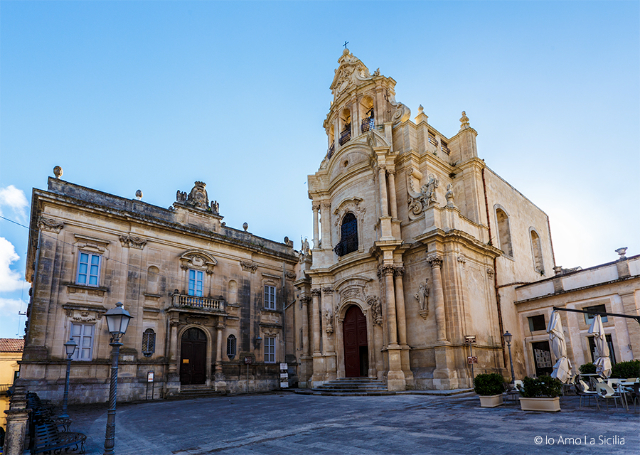

The Church of St. Joseph is located in Ragusa Ibla, in Piazza Pola, which was formerly known as Piazza Maggiore. The church was built on the site where the Church of St. Thomas, which was completely destroyed in the 1693 earthquake, once stood. The work is believed to be attributed to Rosario Gagliardi and is considered, together with the Church of St. George, to be one of the highest expressions of Sicilian Baroque.The history of the Church of St. Joseph is closely linked to that of the Benedictine Monastery, which is located nearby on Torrenuova Street, and the old Town Hall, which was once part of the monastic complex and was the seat of city government until 1926.Reconstruction work on the church began in 1701 and lasted until 1705. Subsequently, further work was carried out between 1723 and 1737. In 1756 the occupation of the buildings of St. Thomas Church, by then moved elsewhere, took place, leading to the current version of the church.Between 1756 and 1760, the architectural design changed from a Baroque style to a Rococo style. This change led to a new version of the Church of St. Joseph, which bore similarities to the Church of St. George and the nearby Church of Our Lady of Mount Carmel.The facade of the church has architectural elements that recall those of the Church of St. George. It is divided into three orders. The first order has four columns and two Corinthian half-pillars, a portal with a semicircular arch decorated with elegant sculptures and four statues depicting St. Gertrude, St. Augustine, St. Gregory and St. Scholastica. In the second order is a central window with a semicircular arch, decorated with sculptures, four columns and two half-pillars with Ionic sculptures, two scrolls and two statues depicting St. Maurus and St. Benedict. Finally, the third order has three belfries with panciette railings enriched with volutes and decorations, on a gable broken from the previous order. On the bell tower are three bells, the largest of which is adorned with a statue of St. Joseph from 1857, while the others date from 1844.The interior of the church has an oval plan, similar to that of the nearby Church of Santa Maria Valverde, and features pilasters with Ionic capitals. There are wooden bleachers with gratings, used in the past by nuns to attend religious services. The altars, five in total, are made of stone and decorated with painted vetti that look like marble. Inside the church are valuable paintings, including the canvas depicting St. Gertrude by Tommaso Pollace, the Trinity by Giuseppe Crestadoro, and the Holy Family by Matteo Battaglia, which is on the central altar. On the large domed vault is a fresco by Sebastiano lo Monaco depicting the Glory of St. Joseph and St. Benedict. The altars are adorned with painted glass, while the floor consists of majolica tiles alternating with white limestone slabs inlaid with pitch stone. Also worth mentioning is the presence of a splendid 17th-century silver statue depicting St. Joseph.The Church of St. Joseph in Ragusa Ibla is a true jewel of Sicilian Baroque. Its majestic architecture, frescoes, sculptures and works of art inside testify to the artistic and historical richness of the city. It is a still active place of worship and an important landmark for the local community and visitors who wish to admire the beauty of Sicilian Baroque art.


