
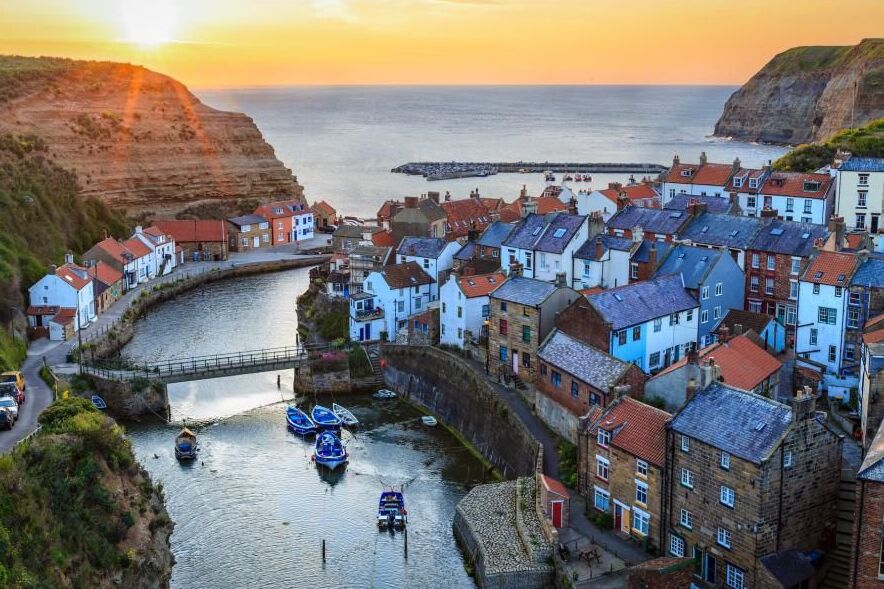

Mit seinen verwinkelten Häusern und gewundenen Straßen hat Staithes den Hauch eines in der Zeit verlorenen Ortes. Dieser charmante Küstenort an der Nordostküste Englands ist ein wahres Juwel, das Geschichte, Kunst und Natur in perfekter Harmonie vereint. Die bunten kleinen Häuschen säumen den natürlichen Hafen, während größere, mehrstöckige Häuser mit unterschiedlichen Farben sich über die atemberaubenden Lehmklippen erstrecken und einen spektakulären Blick auf das glitzernde Meer bieten.
Geschichte und Ursprünge
Die Ursprünge von Staithes reichen bis ins 14. Jahrhundert zurück, als es zunächst als kleiner Fischereihafen gegründet wurde. Der Name „Staithes“ stammt von dem alten englischen Wort „staithe“, was so viel wie „Anlegestelle“ bedeutet. Im 18. Jahrhundert erlebte der Ort seinen Höhepunkt als einer der größten Fischereihäfen an der Nordostküste mit einer florierenden Fischindustrie, insbesondere dem Heilbutt. Die im 19. Jahrhundert gegründete Staithes Art School zog viele Künstler an, darunter den berühmten Landschaftsmaler **William H. H. C. F. H. H. W. F. H. W. W. W. W. W. W. W. W. W. W. W. W. W. W. W. W. W. W. W. W. W. W. W. W. W. W. W. W. W. W. W. W. W. W. W. W. W. W. W. W. W. W. W. W. W. W. W. W. W. W. W. W. W. W. W. W. W. W. W. W. W. W. W. W. W. W. W. W. W. W. W. W. W. W. W. W. W. W. W. W. W. W. W. W. W. W. W. W. W. W. W. W. W. W. W. W. W. W. W. W. W. W. W. W. W. W. W. W. W. W. W. W. W. W. W. W. W. W. W. W. W. W. W. W. W. W. W. W. W. W. W. W. W. W. W. W. W. W. W. W. W. W. W. W. W. W. W. W. W. W. W. W. W. W. W. W. W. W. W. W. W. W. W. W. W. W. W. W. W. W. W. W. W. W. W. W. W. W. W. W. W. W. W. W. W. W. W. W. W. W. W. W. W. W. W. W. W. W. W. W. W. W. W. W. W. W. W. W. W. W. W. W. W. W. W. W. W. W. W. W. W. W. W. W. W. W. W. W. W. W. W. W. W. W. W. W. W. W. W. W. W. W. W. W. W. W. W. W. W. W. W. W. W. W. W. W. W. W. W. W. W. W. W. W. W. W. W. W. W. W. W. W. W. W. W. W. W. W. W. W. W. W. W. W. W. W. W. W. W. W. W. W. W. W. W. W. W. W. W. W. W. W. W. W. W. W. W. W. W. W. W. W. W. W. W. W. W. W. W. W. W. W. W. W. W. W. W. W. W. W. W. W. W. W. W. W. W. W. W. W. W. W. W. W. W. W. W. W. W. W. W. W. W. W. W. W. W. W. W. W. W. W. W. W. W. W. W. W. W. W. W. W. W. W. W. W. W. W. W. W. W. W. W. W. W. W. W. W. W. W. W. W. W. W. W. W. W. W. W. W. W. W. W. W. W. W. W. W. W. W. W. W. W. W. W. W. W. W. W. W. W. W. W. W. W. W. W. W. W. W. W. W. W. W. W. W. W. W. W. W. W. W. W. W. W. W. W. W. W. W. W. W. W. W. W. W. W. W. W. W. W. W. W. W. W. W. W. W. W. W. W. W. W. W. W. W. W. W. W. W. W. W. W. W. W. W. W. W. W. W. W. W. W. W. W. W. W. W. W. W. W. W. W. W. W. W. W. W. W. W. W. W. W. W. W. W. W. W. W. W. W. W. W. W. W. W. W. W. W. W. W. W. W. W. W. W. W. W. W. W. W. W. W. W. W. W. W. W. W. W. W. W. W. W. W. W. W. W. W. W. W. W. W.


