



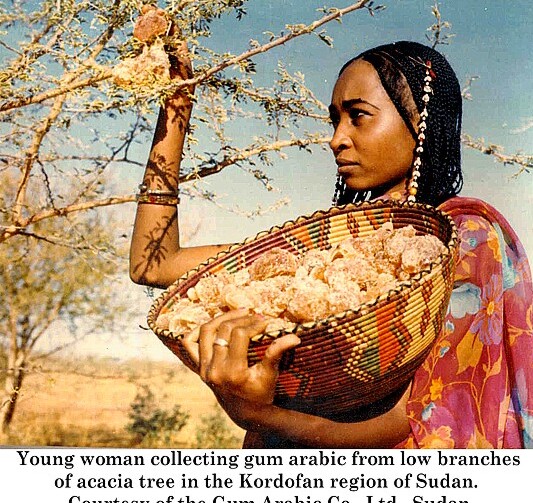
Sudan's rich history of gum arabic production stretches back centuries, intertwining with the nation's cultural and economic fabric. Gum arabic, also known as acacia gum, is a natural gum made from the hardened sap of acacia trees. Sudan, notably the Kordofan region, stands as the world's leading exporter, supplying about 80% of global demand. The gum has been traded since ancient times, with mentions in records dating back to the Pharaonic era, highlighting its long-standing value.
The Kordofan region, with its arid landscapes, is particularly renowned for the quality of its gum, making it a pivotal area for this agricultural product. The Senegal acacia and Seyal acacia trees, the primary sources of gum arabic, thrive in Sudan's climate, allowing a harvesting period from October to May and February to June, respectively. This cycle has been integral to local economies and livelihoods, deeply embedding gum arabic into Sudan's cultural heritage.
Architecturally, Sudan offers a fascinating blend of influences, with its Nubian pyramids and Islamic architecture. Although not directly linked to gum arabic, these structures echo the country's rich history. The pyramids of Meroë and the architectural style of the Mahdi's Tomb in Omdurman reflect the diverse cultural influences that have shaped Sudan over millennia.
Culturally, gum arabic is more than an economic product; it's part of the Sudanese identity. Local customs around harvesting and trading are deeply rooted in tradition. Festivals and markets become vibrant social gatherings, celebrating the harvest season. In these settings, visitors can witness traditional music and dance, offering a window into the fabric of Sudanese society.
The culinary scene in Sudan is equally intriguing. While gum arabic itself is not a staple food, its influence can be indirectly felt. In the broader region, it is used in food industries, particularly in beverages and confectioneries. Visitors should indulge in local delicacies such as ful medames (a fava bean dish) and kisra (a type of flatbread), which reflect the rich tapestry of Sudanese gastronomy.
A lesser-known curiosity is the role of gum arabic in global industries. Beyond Sudan, it is a critical ingredient in products ranging from soft drinks to pharmaceuticals. In wine-making, gum arabic's stabilizing properties enhance texture and flavor, a practice embraced in many parts of the world.
For visitors, the best time to explore Sudan is during the cooler months from November to February, when temperatures are milder. Travelers should consider timing their visit with the gum arabic harvest season to observe this fascinating process firsthand. Engaging with local communities can provide deeper insights into the traditional methods and cultural significance of gum arabic.
As you plan your personalized journey to explore the rich cultural tapestry of Sudan and its gum arabic heritage, consider using the Secret World app for an insightful itinerary tailored just for you.
