


At a 508 meters high, Taipei 101 does not just dominate the skyline of the Taiwanese capital: it completely redefines it. Looking at it from below, amidst the hustle and bustle of Xinyi District, the profile of the building immediately tells its inspiration: every eight floors forms a distinct segment, like the internodes of a giant bamboo stalk. This is not a casual metaphor. Bamboo, in Chinese culture, symbolizes resilience, growth, and fortune — values that the architect C.Y. Lee wanted to crystallize in steel and glass when he designed this tower, officially inaugurated in 2004.

For almost six years, until 2010, Taipei 101 held the title of the tallest building in the world. Today that primacy belongs to others, but the tower has lost none of its strength. Every corner of the building is designed to withstand the typhoons and earthquakes that cyclically hit Taiwan: eight mega-peripheral steel columns, X-shaped beams visible on the outside of each segment, and in the center — visible to visitors between the 87th and 88th floors — a damping sphere weighing 660 tons that slowly sways to compensate for vibrations. It is one of the largest pendulum dampers in the world, and seeing it suspended in mid-air is one of those experiences that stays with you.
The ascent: speed and vertigo

Reaching the internal observatory on the 89th floor takes less than a minute. The pressurized elevators of Taipei 101 have long been among the fastest in the world, capable of covering the distance in about 37 seconds at a speed of around 60 km/h. The ears feel it, but the pressurization system reduces the discomfort. When the doors open, you find yourself nearly 390 meters high, with the basin of Taipei stretching out in every direction and, on clear days, the green hills surrounding the city clearly visible on the horizon.
The internal observatory is air-conditioned and equipped with informational panels in multiple languages. Here you can closely observe the damping sphere, painted in golden yellow, and understand through models and graphs how the building's seismic structure works. It is a level designed for those who want to understand, not just look.

The outdoor terrace: wind and a 360-degree view
Going up again, to the 91st floor, you access the outdoor terrace. Here the wind can be felt, and the view becomes total: no glass between the gaze and the city. The Xinyi district, with its shopping centers and modern skyscrapers, appears almost miniature directly beneath your feet. Further away, you can recognize the National Palace with its curved roofs, the Tamsui River flowing northwest, and on lucky days even the silhouette of Yangmingshan mountain.
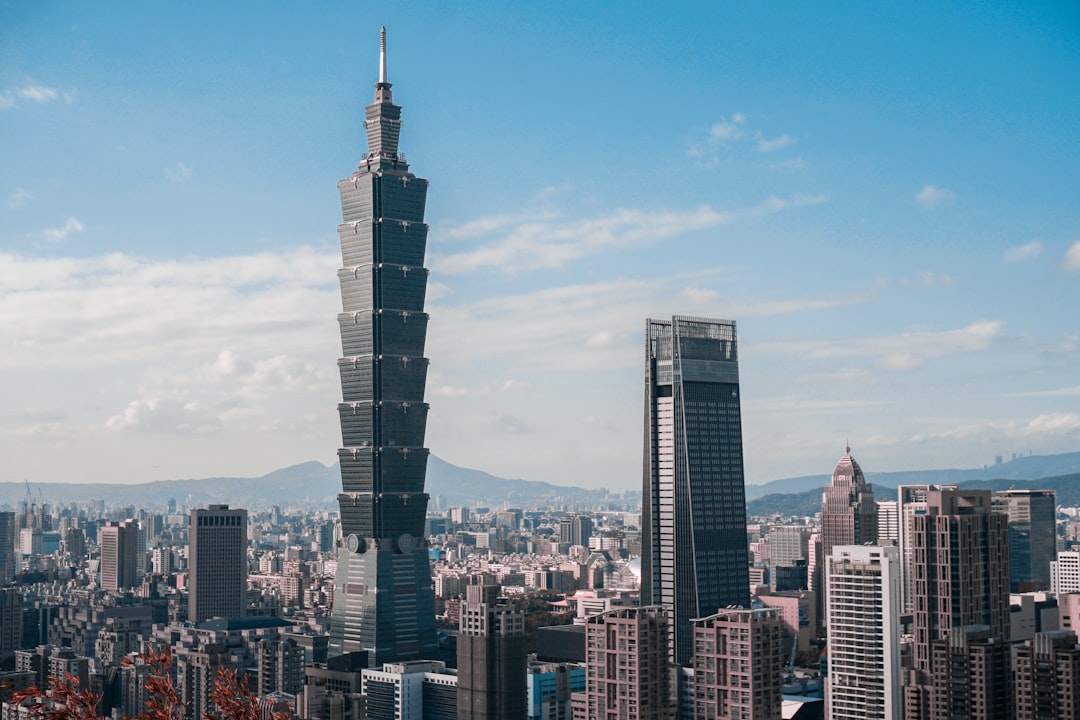
The outdoor terrace is open only when weather conditions allow: in case of strong winds or rain, it is closed for safety reasons. Before going up, it is worth checking the weather conditions — not only for the terrace, but because the frequent haze in Taipei can significantly reduce visibility. The months between October and December tend to offer clearer skies compared to summer, which brings humidity and low clouds.
Architecture and symbolism: the numbers that are not random

The number 8 is everywhere in Taipei 101, and not by chance. In Chinese aesthetics, eight is the number of prosperity and fortune. The building is divided into 8 segments of 8 floors each. Even the decorative openings at the corners of each segment evoke ancient Chinese coins, with their circular shape inscribed in a square. The architectural details are not ornamental: they are a language.
At the base of the building, the commercial podium — a multi-level shopping center — hosts international luxury brands and restaurants. But the architecture of the podium itself deserves attention: the decorative motifs evoke traditional Taiwanese art, with reliefs and shapes that converse with the modernity of the tower above. It is a building that is not afraid to be hybrid, to straddle cultures and centuries.
Practical tips for the visit
The ticket for the indoor and outdoor observatory costs about 600 TWD for adults (about 17-18 euros at the current exchange rate). The building is located in the Xinyi district, easily accessible by MRT subway: the Taipei 101/World Trade Center station on the red line (Danshui-Xinyi) is directly connected to the shopping podium. From Taipei Main Station, it takes about 10-15 minutes of travel.
The best time to go up is late afternoon, about an hour before sunset: you can witness the transition from daylight to the city lights, with an extraordinary visual effect. Weekends and holidays attract many local visitors, with possible lines at the elevators. Arriving on weekdays, preferably in the morning, ensures a quieter experience and reduced waiting times. Allow at least 90 minutes for the complete visit, including the outdoor terrace when it is open.


