🎄 Win a month in Italy for two — €10,000 · The Secret Italy Prize GO →
Takht-i-Bahi monastery — Takht Bhai
← Back
Religious places 📍 Takht Bhai, Pakistan 437 views

Takht-i-Bahi monastery

During the 5th and 6th centuries, as the Huns of Central Asia expanded their empire across present-day Pakistan and Afghanistan, hundreds of Buddhist sites fell victim to destruction. However, some monasteries and temples were spared from the onslaught due to their remote and ina...

Photo · Reena K.

Takht-i-Bahi monastery — Takht Bhai, Pakistan.

Location
Takht Bhai
Type
Religious places
Opening hours
Weather now
26°C
↗ Directions

About Takht-i-Bahi monastery

Takht-i-Bahi monastery - Takht Bhai | Secret World Trip Planner

During the 5th and 6th centuries, as the Huns of Central Asia expanded their empire across present-day Pakistan and Afghanistan, hundreds of Buddhist sites fell victim to destruction. However, some monasteries and temples were spared from the onslaught due to their remote and inaccessible locations.

Takht-i-Bahi monastery - Takht Bhai | Secret World Trip Planner

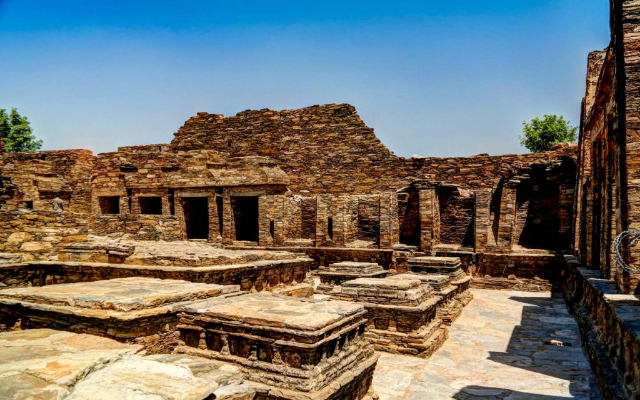
One such site is the Takht-i-Bahi monastery, which remains an important Buddhist site to this day. Situated in the elevated terrain of the Mardan province in Pakistan, Takht-i-Bahi derives its name from Persian, where "takht" means throne and "bahi" means spring. Despite suffering some damage, it stands as one of the most well-preserved early Buddhist sites in the region.

Originally built as a small stone monastery in the 1st century, Takht-i-Bahi's historical significance is evident from early inscriptions referring to Gondophares, the Indo-Parthian king of the time. Over the centuries, successive rulers patronized the monastery, leading to the addition of more structures to the original complex. By the 9th century, it had evolved into a sprawling Buddhist complex, supported by the nearby fortified town of Sahr-i-Bahlol. The residents of Sahr-i-Bahlol regularly provided offerings and sustenance to the monks residing at Takht-i-Bahi.

Takht-i-Bahi monastery - Takht Bhai | Secret World Trip Planner

Despite enduring the tumultuous invasions of the era, Takht-i-Bahi experienced a gradual decline in the 7th century as Buddhism's influence waned and donations dwindled. Eventually abandoned by the monks, the monastery lay forgotten until its rediscovery in the late 19th century.

Excavations conducted from 1907 unearthed hundreds of statues and sculptures, shedding light on early Buddhist history and Pakistan's heritage. The complex comprises a main court of stupas, meditation cells, meeting halls, and covered passages. Recognizing its cultural significance, UNESCO declared Takht-i-Bahi and the nearby ruins of Sahr-i-Bahlol as a World Heritage site in 1980.
Takht-i-Bahi monastery - Takht Bhai | Secret World Trip Planner

Frequently Asked Questions

Takht-i-Bahi survived the 5th and 6th century Hun invasions because of its remote and inaccessible location in the elevated terrain of Mardan province, Pakistan. While hundreds of other Buddhist sites were destroyed during this period, its isolated position protected it from the widespread destruction that swept across the region.
The name Takht-i-Bahi comes from Persian, where 'takht' means throne and 'bahi' means spring, referring to its geographical location. The monastery was originally built as a small stone structure in the 1st century and is historically significant for its connection to Gondophares, the Indo-Parthian king of that era.
The complex features a main court of stupas, meditation cells, meeting halls, and covered passages that showcase early Buddhist architecture. Excavations beginning in 1907 unearthed hundreds of statues and sculptures that provide insight into early Buddhist history and are displayed throughout the site.
The monastery was sustained by regular patronage from successive rulers and by the nearby fortified town of Sahr-i-Bahlol, whose residents provided offerings and sustenance to the monks. By the 9th century, Takht-i-Bahi had grown into a sprawling Buddhist complex with strong community support from the surrounding area.
Yes, Takht-i-Bahi and the nearby ruins of Sahr-i-Bahlol were declared a UNESCO World Heritage site in 1980 in recognition of their cultural and historical significance. The site was rediscovered in the late 19th century after being abandoned and forgotten for centuries following Buddhism's decline in the region.

Experiences nearby · Takht Bhai

Powered by Viator

See more on Viator.com

Secret World Hidden places, real stories — plan your trip
Get the app
