
At a 3,200 meters above sea level, where the wind blows sharply from the passes of the Tian Shan mountain range and snow can arrive in any month of the year, stands a gray stone structure that seems to emerge directly from the rock of the mountain. Tash Rabat — whose name literally means “stone fortress” in Kyrgyz — is a 15th-century caravanserai that has withstood centuries of isolation, storms, and oblivion, preserving itself in a state of extraordinary integrity. It is not a ruin to be imagined: it is a building that you can still walk through, room by room, feeling the weight of the stone above your head.
The structure is located in the Naryn province, in the At-Bashy region, within a remote valley accessible by a dirt road that winds through high-altitude pastures. For centuries, merchants, pilgrims, and caravans traveling the Silk Road found refuge here before facing the Torugart pass to China. Today, those who arrive at Tash Rabat undertake a double journey: in space, to one of the most isolated corners of Central Asia, and in time, to a Middle Ages that seems never to have fully concluded.
The architecture: stone, vaults, and calculated darkness
The building is entirely constructed of unworked local stone, with a layout that scholars estimate includes over thirty rooms distributed around a central hall covered by a dome. Entering through the only access portal, the eyes take a few seconds to adjust to the dim light: light filters through small openings in the vaults, creating beams of light that fall on the earthen floor. Each side room is separated from the others by stone semicircular arches, and in many of them, the niches in the walls can still be recognized, where travelers would place their goods or light oil lamps.
The central hall, with its hemispherical dome, is the architectural heart of the complex. The construction is attributed to the 15th century, a time when this part of Central Asia was crossed by still vital trade routes. Some researchers have hypothesized that the building could also have had a religious function — perhaps a Buddhist monastery or an Islamic place of worship — but the prevailing interpretation remains that of a caravanserai, supported by the arrangement of the rooms and the strategic location along the transit routes.
The context: a valley out of time
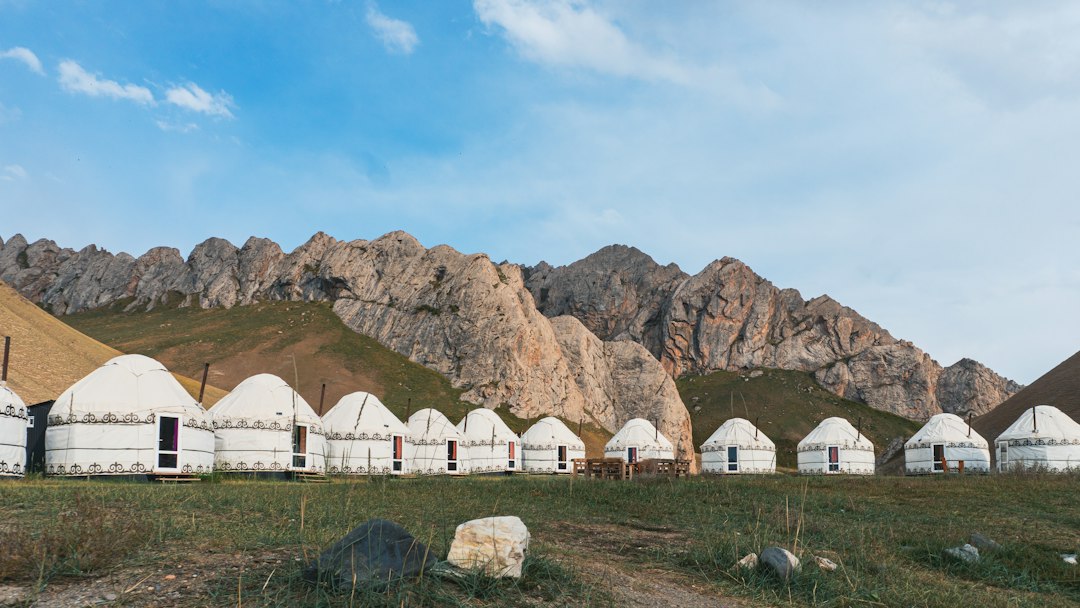
Reaching Tash Rabat requires effort, and this effort is part of the experience. The dirt road that starts from the city of At-Bashy travels about 90 kilometers through a valley that progressively narrows, flanked by rounded hills covered with tall grass and by streams that flow swiftly in summer with meltwater. Along the way, one encounters the yurts of Kyrgyz shepherds who take their flocks to summer pastures — a nomadic practice that has remained unchanged for centuries.
The landscape around the caravanserai is austere and open: no trees, no permanent settlement, just the vastness of the valley and the silhouette of the mountains that close the horizon. In this context, the stone building appears almost incredible in its solidity, as if someone had decided to challenge the isolation by building something permanent right where everything seems temporary.
What to Observe Up Close
Anyone visiting Tash Rabat should take time to explore the side corridors, often overlooked by visitors who only stop in the central hall. In some secondary rooms, you can notice traces of plaster still adhering to the walls, a sign that the spaces were carefully finished. The stone thresholds of the internal doors show the wear of centuries of passage: a thin but visible concavity, worn down by thousands of feet. It is one of those physical details that make history concrete and immediate.
It is also worth climbing onto the roof of the building, accessible by an external path, to observe the central dome from the outside and have a complete view of the valley. The view that opens up is identical to what the medieval guardians saw: no modern elements disturb the line of the horizon.
Practical Information for the Visit
The best time to visit Tash Rabat is between June and September, when the dirt road is passable and daytime temperatures are acceptable, although nights remain cold even in the height of summer. In winter, the valley is often inaccessible due to snow. The site is managed by a small local cooperative and requires a payment of a