
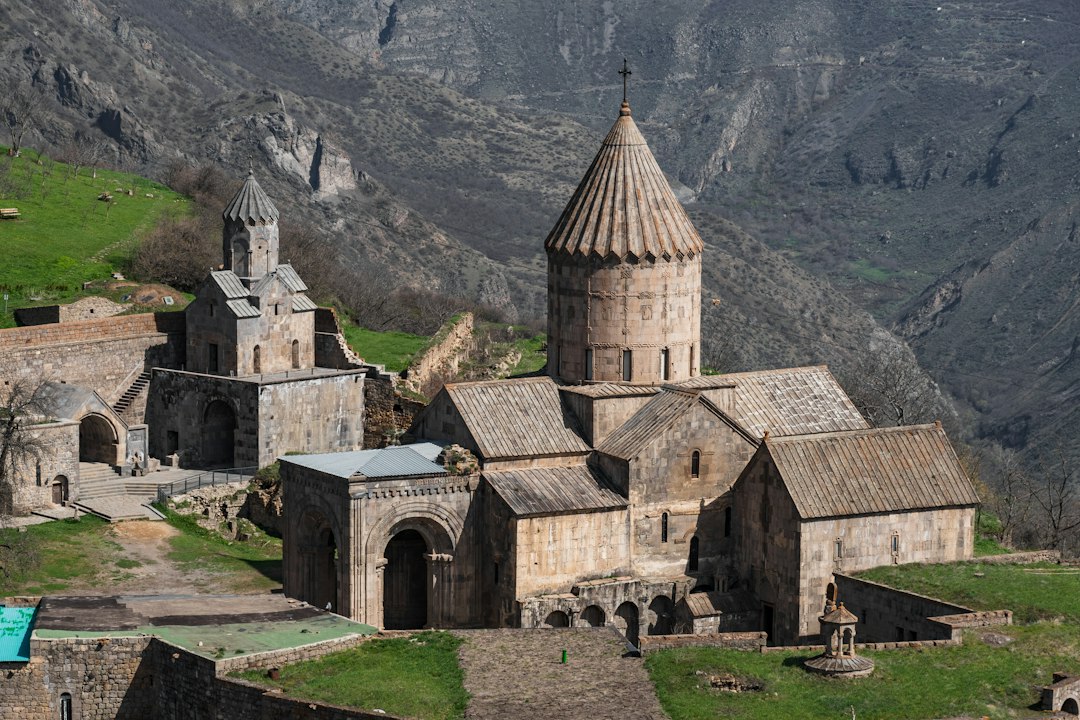

The sunset light first hits the towers of the Monastery of Tatev as if the sun wants to bid farewell to this stone outpost clinging to the edge of the gorge. We are in southern Armenia, in the Syunik region, about 270 kilometers from Yerevan. The monastic complex, founded in the 9th century and expanded in the following centuries, stands on a basalt plateau that drops vertically into the Vorotan Gorge, a deep canyon hundreds of meters where the river of the same name has been carving the rock for millennia.
Reaching it is already part of the experience. The Wings of Tatev — in Armenian "Tatevi Orer" — is the longest reversible cable car in the world, with its 5,752 meters of cable connecting the village of Halidzor to the monastery. Inaugurated in 2010, it takes about twelve minutes to cover the route, and during the descent into the gorge, there is a feeling of flying over a landscape that changes color every hour of the day. At sunset, that feeling becomes something difficult to describe rationally.
The gorge that changes color
When the sun descends towards the western horizon, the Vorotan Gorge transforms into a succession of chromatic layers. The rocky walls, composed mainly of dark basalt and light tuff, absorb the slanting light and return shades ranging from deep amber to brick red, passing through hues of orange that seem to set the stone ablaze. The contrast with the dark green of the oak and beech forests that cover the slopes makes the spectacle even sharper.
From the natural viewpoint located on the southern side of the monastic complex, the gaze embraces a panorama that extends for dozens of kilometers. You can see the villages perched on the opposite ridges, the roads winding through the bends, and in the distance, on clear days, the profiles of the mountains that mark the border with Iran. It is not a standardized postcard sunset: each evening is different, conditioned by the clouds, humidity, and season.
The monastery as the protagonist of the scene
The Monastery of Tatev is not just a scenic backdrop. Its main structures — the Church of Saints Paul and Peter, built between 895 and 906, and the Church of Saint Gregory the Illuminator from the 10th century — are buildings that show concrete and readable signs of their age. The stones are worn unevenly, the bas-reliefs on the facades have lost definition in the areas most exposed to the elements, and the Armenian inscriptions carved into the walls tell centuries of restorations, donations, and reconstructions after the earthquakes that have struck the region.
One element that visitors almost always notice is the Gavazan, a swaying column about eight meters tall built in 904. It is a stone pillar resting on a spherical base and, according to tradition, served as a seismic alarm system: it swayed perceptibly before tremors. Even today it is physically mobile if pushed with force, a mechanical peculiarity that amazes with its engineering simplicity.
When to go and how to organize the visit
The best time to watch the sunset from the gorge is between May and October, when the days are long and the sky tends to be clearer. In summer, the sun sets late, around 8:30-9:00 PM, which allows for visiting the monastery in the afternoon and staying for the evening light without rush. In autumn, between September and October, the forests covering the slopes of the gorge add warm colors that complement those of the sunset, making the landscape even more saturated.
The Wings of Tatev cable car has hours that vary seasonally, but generally operates from 10:00 AM to 6:00 PM or 7:00 PM. The round-trip ticket costs about 3,500 Armenian drams (just under 10 euros at the time of publication, but it is advisable to check the updated price on site). It is also possible to reach the monastery by car or on foot along marked trails, but the cable car offers a perspective of the gorge that the road cannot provide. Those who want to stay for the sunset should consider that the last evening connection may leave before sunset: it is worth checking in advance or having your own means of returning to Halidzor or Goris, the nearest city, located about 25 kilometers away.
An experience that requires slowness
Tatev is not a place that can be exhausted in an hour. The monastery has internal corners that deserve attention — the khachkar, the carved stone crosses, scattered in the courtyard and along the walls — and the surroundings offer paths that lead to waterfalls and rock formations in the gorge. Bringing water and suitable shoes is essential, as well as an extra layer for the evening: even in summer, at this altitude and with the setting sun, the temperature drops quickly.
Those who arrive with expectations of a spectacular sunset are rarely disappointed. But what remains etched in memory, more than the photographs, is the silence that falls over the monastery when the groups of tourists thin out and the last gondolas of the cable car take away the visitors. In those minutes, with the light changing every second over the gorge and the bells occasionally ringing inside the complex, Tatev shows a quality that few places can offer: the feeling of being in a place that existed before us and will continue to exist after.


