
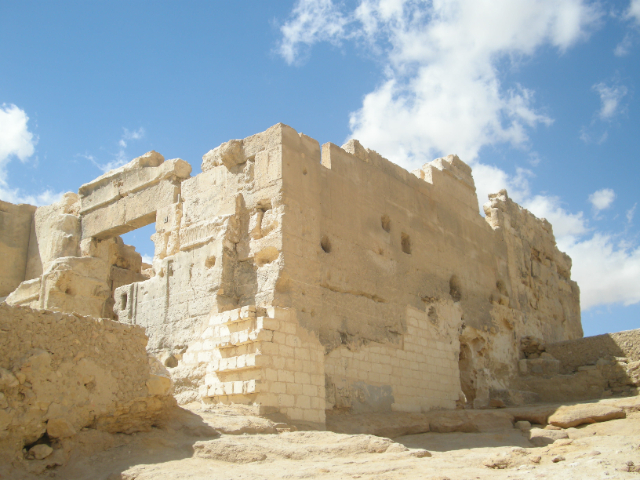

The temple of Ain El Muftella is located in the central part of the Bahariya oasis at the exit of the road that connects Bahareya to the Siwa Oasis. This temple was once the center of the ancient city of El Qasr. It was probably built at the time of the 26th dynasty, although some parts of the temple may date back to earlier times in the New Kingdom. The temple was probably enlarged by the Greeks and later by the Romans.

Some parts of the temple were built by a high priest named Zed-Khonsu-efankh, whose brother, Sheben-Khonsu, was a priest under the reign of Ahmose II. District Governor.
This site contains four chapels that were discovered in 1939 by Ahmed Fakhry, the Egyptian archaeologist, who is known for most of the discoveries in the western Egyptian desert. The four chapels belong to the 26th dynasty, the last indigenous dynasty that ruled Egypt before the Persian conquest in 525 BC.
These chapels belong to a group of temples built during the reign of the Amasis, are decorated with painted and recessed reliefs and have a style similar to other Egyptian temples of the time.
In the first chapel, considered the largest, there are decorated images on the walls of the chapel dedicated to Pharaoh Amasis and sacrifice to a number of gods; the second chapel was built by Zed-Khonsu-ankh, who was once a rich merchant; there is a scene depicting the high priest with a shaved head worshiping Osiris. Almost exclusively dedicated to the goddess Bes is the third chapel was probably, while the fourth chapel was also built by Zed-Khonsu-ankh, it is simpler, made of brick and stone, but probably never painted.
Many tombs were built there, such as that of Zed-Amun-ef-Ankh and his son Bannentui, who was considered a priest and prophet.
The old town once extended to Ain al-Muftillah, a spring that now stands on the edge of the desert. It is possible to cycle here, but it is better to take the car, as the route is not marked out or easy to describe. Just south of the spring is a wooden fence with four small shrines from the 26th dynasty, excavated by Steindorff and Fakhry. Built-in friable sandstone, alternating with ochre and his own (which makes them sensitive to flakes and exceptionally colorful), none of them correspond to the canons of pharaonic architecture. They were dedicated to Bes, the patron god of musicians, dancers, and prostitutes; all that remains of his statue is an evil foot and a tail.
If you cross the ascent and a dune, you can enjoy a panoramic view of Al-Qasr, Bawiti and the surrounding landscape.


