
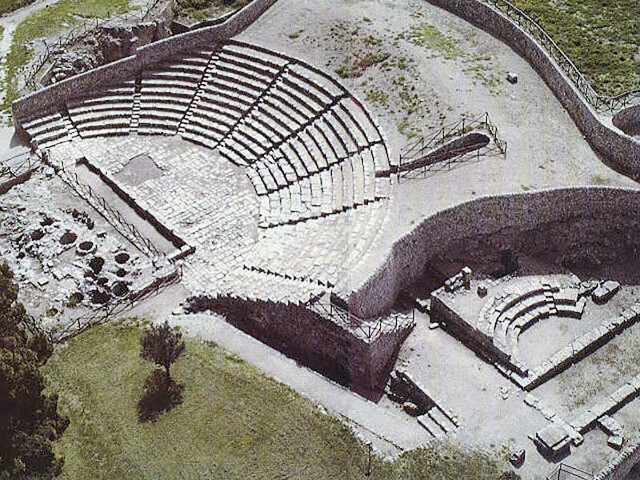

The "Bouleuterion" is located adjacent to the theater. It was discovered through the passionate work of Gabriele Iudica in 1820 and studied by Luigi Bernabò Brea in 1944. Initially, it was thought to be a small covered theater for musical performances (odeon).However, it is now certain that it was a bouleuterion, a place where the senate (boulé) of Akrai met. It is a small covered structure that housed a semicircular orchestra and a "koilon" divided by three spaces with six rows of steps-seats. The seating blocks are similar to those of the theater and better preserved, suggesting that the two monuments may be considered contemporary. Today, part of the short staircase and the sturdy perimeter foundations remain, allowing for accurate reconstruction. The bouleuterion opened onto the square (agora) of the city.The present enclosure wall does not allow an immediate view of the surrounding area. Therefore, before leaving this archaeological site, it is recommended to visit the two quarries "Intagliata" and "Intagliatella," and then explore the area of the "agora." It is also interesting to note the Hellenistic road to the north, which we will discuss later, and the deep well from which numerous tunnels were dug in ancient times at different depths to access water sources. In the 16th century, this well was in the center of the cloister of the Convent of the Minor Observants, built around 1530.In the older church of Santa Maria "di Jesù," which was later part of the convent, was the splendid statue of the Madonna sculpted by Laurana between 1470 and 1475. The 1693 earthquake completely destroyed both the church and the convent. Both were rebuilt in the surrounding lower area closer to the village. In the present church, still dedicated to the Immaculate Conception, a statue of the "Madonna and Child" by Laurana is preserved.


