
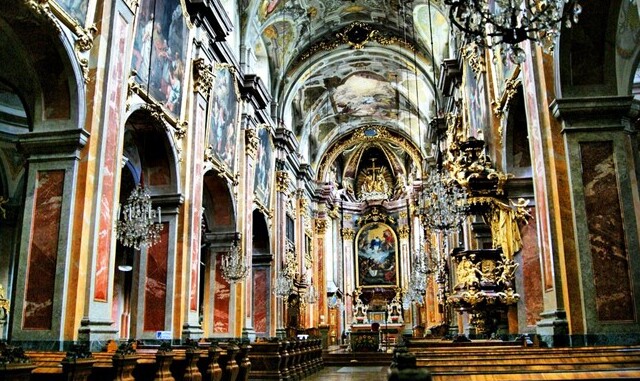

In the heart of Sankt Pölten, the capital of Lower Austria, stands the Dom zu St. Pölten, an architectural gem that tells the story of centuries of faith, struggle, and artistic expression. Known formally as Dom Mariä Himmelfahrt, this cathedral is a testament to the rich tapestry of history that has shaped this region since its inception.
The origins of the Dom date back to the 13th century, but the site itself holds a far older legacy. It is believed that around 790 AD, a Benedictine monastery was established here, marking the beginning of religious significance in the area. This monastery housed the relics of Saint Hippolytus, after whom the city itself is named. The monastery's importance grew when, in 828, it became affiliated with the Diocese of Passau, turning into a center for missionary activities, particularly influencing regions like Great Moravia.
The tumultuous history of the Dom continued with the invasion of the Magyars around 907, which led to its near-total destruction. It wasn’t until after the Battle of Lechfeld in 955 that rebuilding efforts commenced, paving the way for the first documented reference to the site in a charter from Emperor Otto II to Bishop Pilgrim of Passau in 976. The abbey transitioned to an Augustinian canonry under Bishop Altmann of Passau but faced dissolution during the Josephine Reforms in 1784, marking a significant shift in its operational history.
Architecturally, the Dom presents a façade that may seem unassuming at first glance, yet it is the Baroque interior that captivates visitors. With its ornate altars, stunning frescoes, and intricate stucco work, the interior is a visual feast. The high altar, a masterpiece of craftsmanship, is adorned with vivid depictions of the Assumption of Mary, echoing the cathedral's dedication. Artists of the Baroque era, such as Johann Michael Rottmayr, contributed to the heavenly allure of the interior, which invites contemplation and reverence.
Beyond its architectural splendor, the Dom is a vital part of local culture. Sankt Pölten celebrates numerous festivals throughout the year, and the cathedral often plays a central role in these events. Holy Week and Christmas are particularly significant, drawing crowds for special services that blend tradition with community spirit. The cathedral’s bells can be heard ringing throughout the town, marking the passage of time and echoing the rhythms of daily life.
Culinary traditions in Sankt Pölten also reflect the area's cultural richness. Visitors can relish northern Austrian cuisine, which is characterized by hearty dishes. Try the Wiener Schnitzel, a breaded veal dish, often served with potato salad, or the Tafelspitz, boiled beef served with root vegetables and a side of apple-horseradish sauce. Pair your meal with a local Niederösterreich wine, known for its refreshing quality, or sample a glass of Sturm, a semi-fermented grape juice, particularly popular during the fall harvest season.
While many visitors marvel at the grandeur of the Dom’s interior, some lesser-known curiosities await those willing to explore. For instance, few know that the cathedral’s altar houses a relic believed to be a fragment of Saint Hippolytus, attracting not just pilgrims but also art enthusiasts who admire the fusion of faith and artistry. Additionally, hidden in the cathedral’s crypt are remnants of ancient foundations, offering a glimpse into the architectural evolution over the centuries.
For those planning a visit, the best time to explore the Dom and its surroundings is during the spring and early autumn months when the weather is pleasantly mild. Aim to arrive early in the day to enjoy the peaceful atmosphere before the crowds descend. Don’t forget to look up; the ceiling frescoes are often regarded as one of the highlights of the visit.
Whether you are drawn in by the historical narratives, the breathtaking artistry, or the rich local culture, the Dom zu St. Pölten promises an experience that resonates deep within the heart of Austria. For a more personalized exploration of this enchanting city, consider using the Secret World app to curate your own unique itinerary.


