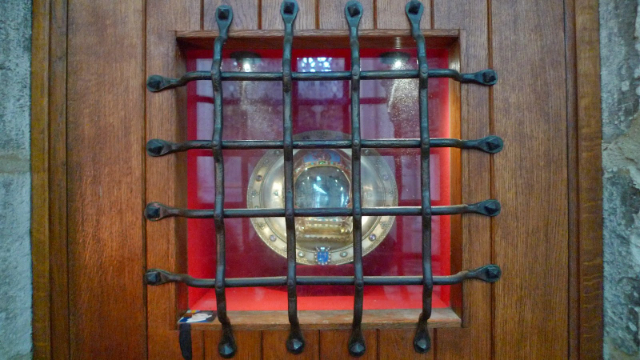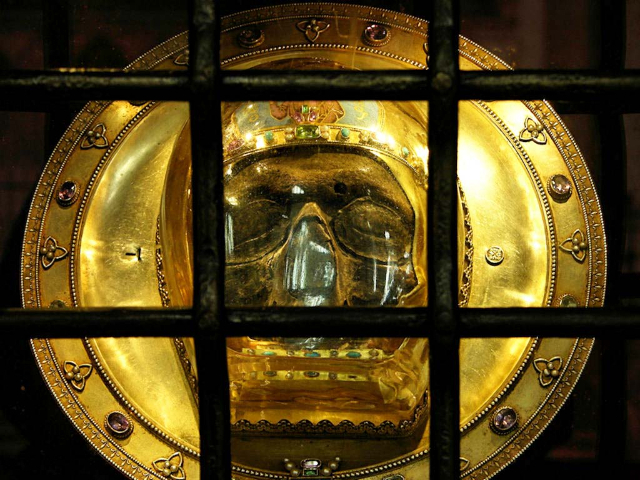

Amiens Cathedral in France contains a preserved skull (facial bone without lower jaw) believed to be that of the famous prophet John the Baptist. John the Baptist è was born just before Jesusù. Thirty years later, è became known as John the Baptist because he baptized people in the Jordan. One day, Jesusù wanted to be baptized, but John the Baptist refused: he did not consider himself worthy to untie his sandals. Jesusù insisted, so John the Baptist baptized him. At that moment, a dove è descended from heaven. Jesus ù went away. Later, John the Baptist è was arrested. Salomè an outstanding dancer, danced in front of the king who, fascinated, offered her the reward of her choice. The queen whispered in her daughter's ear, "The head of John the Baptist." Salomè obeyed her mother; thus; John the Baptist è died beheaded. This sinister relic, thought to be lost and found many times over the centuries, found its present home after a journey from the defunct city of Constantinople. During the Fourth Crusade (1202-1204), Wallon de Sarton, a crusader from French Picardy, discovered in the ruins of a palace in Constantinople a relic consisting of a transparent crystal hemisphere containing a section of the face of a human head resting on a silver plate. Carved on the silver plate were Greek letters stating that the skull was that of John the Baptist. Wallon de Sarton had to sell the silver plate to pay for his return to France, but he kept the lead and, in 1206, donated the relic to the bishop of the city of Amiens. Realizing the importance of the object, the church immediately began the construction of Amiens cathedral. The relic è was displayed in Amiens Cathedral until the French Revolution, when è an inventory of all Church property and treasures was drawn up and the relics were confiscated. In 1793, representatives of the Convention requested that the relic be buried in a cemetery, but the mayor of the city kept it in his home. A few years later, in 1816, the head of St. John the Baptist è was returned to the cathedral, and in 1876 a new silver plaque è was added to the relic, restoring it to its former glory.