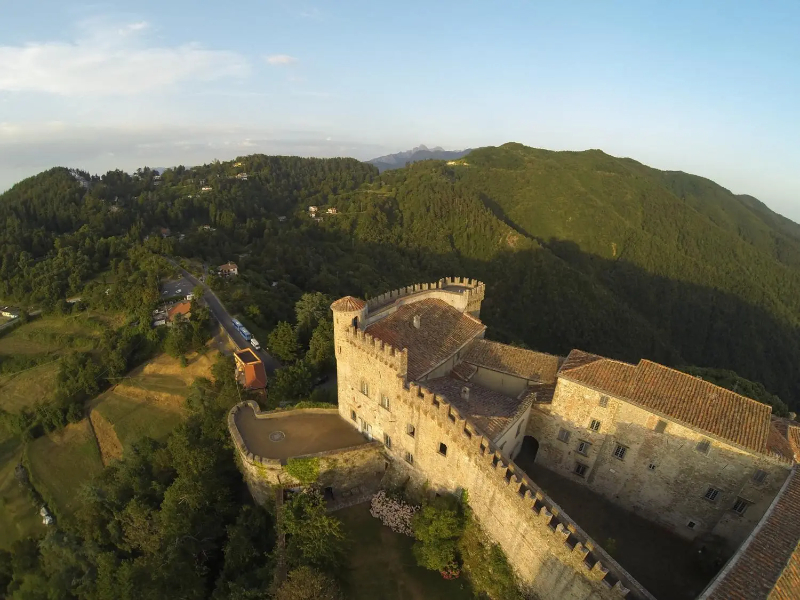
The Malaspina Castle in Fosdinovo is a historic residence registered with the A.D.S.I. - Association of Italian Historic Houses - and bound by the Superintendence for Artistic and Architectural Heritage. It is located in the town of Fosdinovo in the province of Massa Carrara and is the largest and best-preserved castle in Lunigiana. The first to be named Malaspina was Alberto, a direct descendant of Oberto, founder of the noble and illustrious Obertenghi family (945 AD). Theories and legends are wasted on the origin of this name. One of these, illustrated in a painting preserved in a room in the castle, traces its origin to the year 540 AD when the young nobleman Accino Marzio avenged his father's death by surprising the Frankish king Teodoboerto in his sleep and stabbing him in the throat with a thorn. The king's desperate cry "Ah ! mala spina !" gave rise to the surname and, later, the family motto "Sum mala spina bonis, sum bona spina malis." The castle, a fiefdom of one of the branches of the Malaspina family of Ramo Fiorito from the 14th to the 18th century, has considerable historical and architectural importance. Construction of the imposing fortress, which blends so incredibly with the sandstone rock that it appears to be carved from living stone, began in the second half of the 12th century. Raised to dominate and defend the primitive Castro di Fosdinovo, in 1340 it was officially ceded by the Nobles of Fosdinovo to Spinetta Malaspina. He thus created the marquisate of Fosdinovo residing in the Castle, which his grandson Galeotto later enlarged and embellished. The Castle of Fosdinovo consists of a quadrangular plan with four round oriented towers, a semicircular bastion, two inner courtyards, patrol walkways above the roofs, hanging gardens, loggias and an outpost towards the village called in ancient times the "spike," a formidable defensive tool-a sort of ravelin.

Protected in ancient times by a drawbridge, the 13th-century entrance gate leads onto a small courtyard in pure Romanesque style where a marble column supports its upper loggias. From the small courtyard where defensive cannons once stood, wide flights of stairs lead up to the large central courtyard. This features an elegant Renaissance portico with stone columns, a well and a beautiful 16th-century marble portal that introduces us to a tour of the Castle's rooms, furnished and frescoed in the late 1800s: the Entrance Hall, the Dining Room with its large 18th-century fireplace and 17th-century apothecary ceramics, the Throne Room, the great Hall with adjoining drawing rooms and the trap room with the torture chamber below. It is said that it was from this very room that Marchesa Cristina Pallavicini, a wicked and lustful woman, eliminated her lovers by dropping them into the trapdoor located at the foot of the bed. And pitfalls were precisely a prerogative of the castle. There were three, two in the loggia overlooking the kitchen garden and one in the corner tower. At their base were embedded sharp knives with the tip pointing upward, so that the wretch, once he fell through the spring-activated trapdoor, was immediately seized by death. In addition to these dreadful instruments of torture, there was another even more terrible one. This was an iron arm protruding from the wall of the tower, to which was attached a pulley and a ring walled into the ground, connected by a rope. The tortured person was hung to left dangling in front of the eyes of the whole village until he was dead.
In the oldest east tower is Dante's "chamber" where, according to tradition, the supreme poet slept when he was housed at the castle during his period of exile. The frescoes in the large central hall depict precisely Dante's ancient friendship with the Malaspina family. The tour of the castle continues on the upper floors among countless other furnished rooms and along the patrol walkway, above the rooftops, which offers a panoramic spectacle of incomparable beauty.