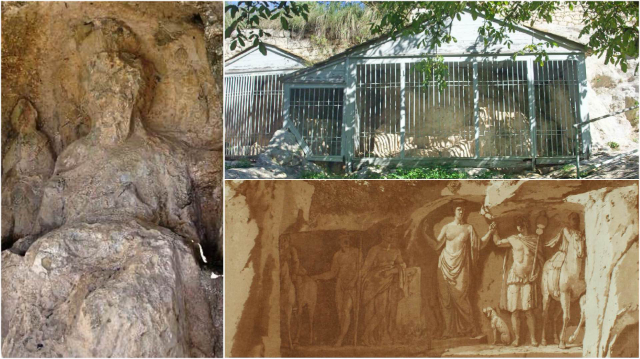
Tucked away beyond the present-day town of Palazzolo Acreide, in the direction of Noto, lies a true archaeological treasure: the Santoni. This complex represents the most complete and extensive set of sculpted reliefs dedicated to the cult of the Magna Mater that the ancient world has handed down to us.The site houses twelve impressive rock-carved paintings, ten of which depict the same female figure seated frontally, while the other two present more complex scenes with a multitude of characters. These twelve "Santoni" are unique high reliefs. In each depiction appears the goddess Cybele, seated on a throne wearing a chiton, a long robe, and a himation, a surcoat that descends from one shoulder and wraps around her waist to her knees. On her head she wears the himation and her hair plaited over her shoulders and chest, while in her right hand she holds a patera and in the other a tympanum, a kind of drum.On either side of the throne or in the scene are always one or two lions, animals sacred to the goddess. The small figures depicted beside the goddess Cybele, sometimes at the top and sometimes at the bottom, represent minor deities or priests of the goddess. In the largest sculpture in the complex, the second, Cybele is depicted standing life-size, with Hermes and Marsyas on one side and two horsemen, the Dioscuri, closing the scene on the other.Unfortunately, the state of preservation of the sculptures is bad due to vandalism by a farmer tired of the frequent visits. Nevertheless, although ruined, these figures retain a special charm, perhaps amplified by the suggestion of the place and the mystery surrounding the cult of the goddess in Palazzolo Acreide. According to the scholar L. Bernabò Brea, the sculptures are crude in both depiction and execution, surely an expression of popular worship and representation.Imagining these figures, now faded and deteriorated, colored and adorned with bronze or gold crowns, bracelets of various values (the holes drilled next to the heads and arms testify to this), and other ornaments such as fabrics and garlands of flowers, oaks or pines, the memory and suggestion of this archaeological complex will remain unique in the visitor's memory. The cult of Magna Mater, an ancient Eastern practice, also spread to Syracuse in the fourth century B.C., and it is likely that it spread from there to Akrai. The sculptures have been dated to the 3rd century B.C., adding even more charm and antiquity to this extraordinary archaeological complex.The Santoni of Palazzolo Acreide represent an authentic treasure that allows us to immerse ourselves in the ancient practice of Magna Mater worship. Despite their present deteriorated condition, these rock-carved sculptures continue to exert a unique fascination, bearing witness to a distant and mysterious past.Visitors can imagine the figures of the Santoni, once adorned with precious crowns and ornaments, vibrant and colorful. Their depictions of the goddess Cybele, seated on a throne with her flowing robes and the symbols she holds, transport us back in time and allow us to imagine the fervor and devotion of the followers of this ancient cult.Unfortunately, vandalism has damaged these sculptures, but their evocative power persists. The figures of lions, other divine figures, and details carved into the rock tell us of a fascinating past and a cult that influenced the life and culture of Palazzolo Acreide.This archaeological site, dated to the 3rd century B.C., is an extraordinary testimony to an ancient religious practice and the cultural richness of Palazzolo Acreide. Visiting the Santoni is a unique experience that allows us to connect with the ancient history of the city and admire the skill of the ancient artists who created these unique sculptures.