
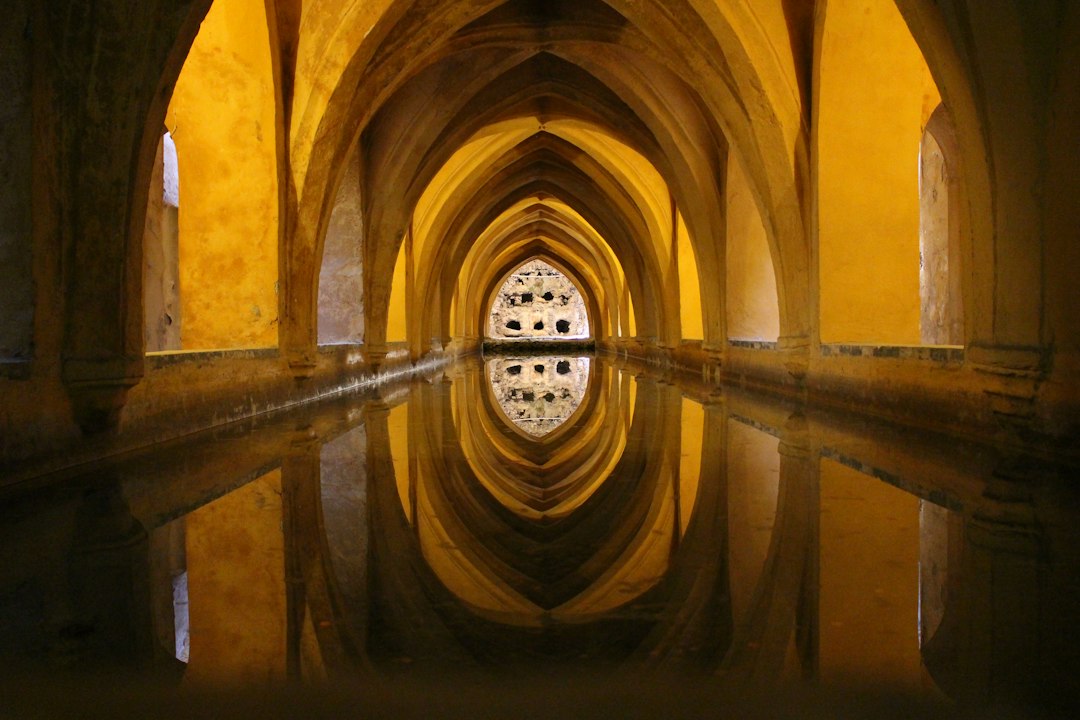

Descend the worn stone steps and the heat of Morocco disappears. Beneath the medina of El Jadida — the city that the Portuguese called Mazagan — an underground hall opens up that seems suspended between two worlds: the real one, made of columns and Gothic arches, and the reflected one, floating on a thin layer of water that covers the floor like a liquid mirror. The Portuguese Cistern is one of those places where architecture ceases to be functional and becomes something more difficult to define.
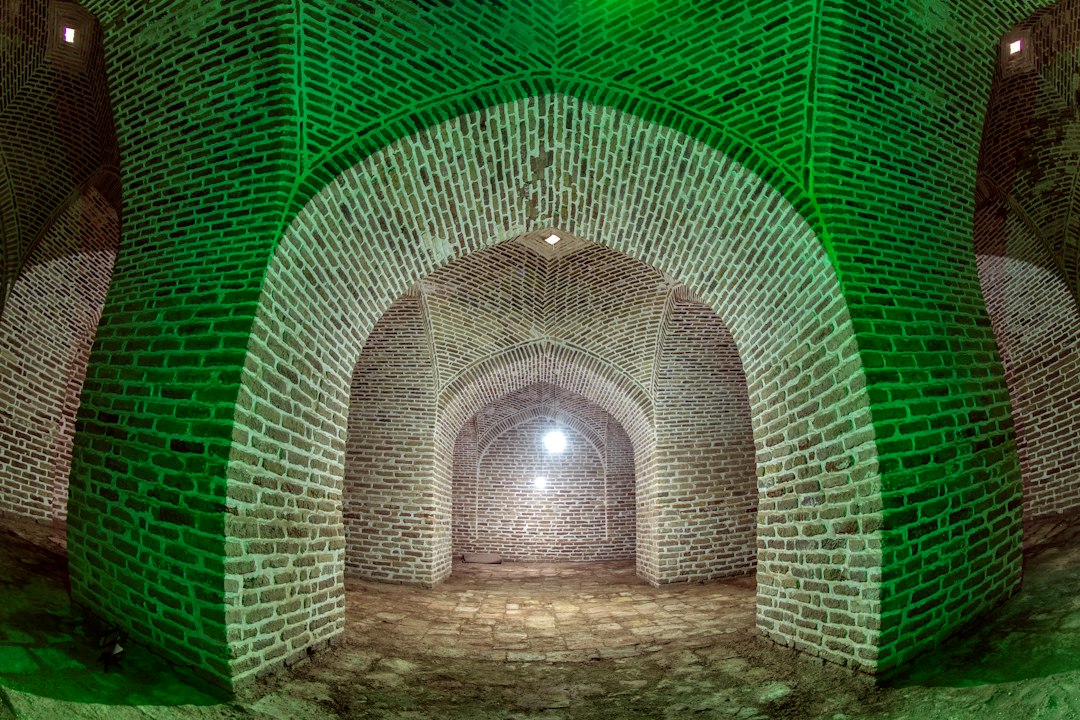
Built by the Portuguese in 1514 as a military arsenal and later converted into a cistern for collecting rainwater, this underground structure has survived centuries of colonial history, battles, and abandonment. It is part of the UNESCO site of Mazagan, recognized in 2004 as an exceptional example of cultural exchange between European and Moroccan cultures in the 16th century. Today it is one of the best-preserved monuments of the entire Portuguese heritage in Africa.
The architecture: Gothic and light on water
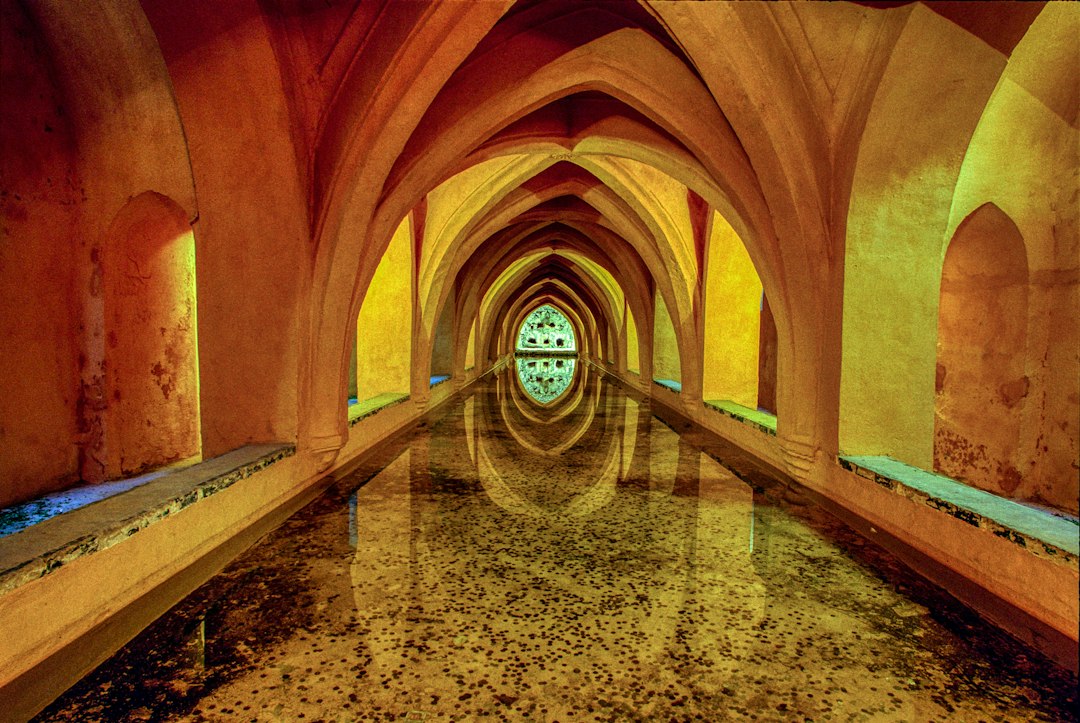
The plan of the cistern is almost square, with sides of about 34 meters, and the roof is supported by 25 pillars that rise up to five meters in height, connecting in ribbed vaults clearly inspired by Manueline Gothic — the Portuguese architectural style of the late 15th and early 16th centuries that blends Gothic elements with marine and oriental motifs. The ribs of the vaults intertwine with a rigorous geometry that, reflected in the still water of the floor, generates an effect of almost impossible symmetry: each arch finds its perfect double below, and walking along the perimeter of the hall means moving in a duplicated universe.
Light enters through a single circular opening at the center of the ceiling, an oculus that projects a beam of natural light onto the water. In the central hours of the day, this beam illuminates the central pillars with theatrical intensity, creating sharp contrasts between golden stone and shadow. It is this opening that transforms a purely engineering space into something visually extraordinary. Not surprisingly, director Orson Welles chose this cistern to shoot some scenes of his Othello in 1952, sensing that no artificial set could compete with that environment.
The history of Mazagan and the role of the cistern
The Portuguese founded Mazagan in 1502 as a commercial and military outpost on the Atlantic coast of Morocco. The cistern was built about ten years later, probably designed by Portuguese military engineers, to ensure the water autonomy of the fortress in case of siege. When in 1769 the troops of Sultan Mohammed III reconquered the city, the Portuguese abandoned it by blowing up part of the walls. The cistern, buried and protected by its own depth, remained intact.
For almost a century, the building was forgotten or ignored, until in the 19th century local authorities rediscovered the structure during urban excavation work. Since then, it has remained open to the public, with conservation interventions that have maintained the thin layer of water on the floor — not a coincidence, but a deliberate choice to preserve the visual effect that makes it unique. The walls still show traces of original Portuguese plaster, and in some places, signs of manual work on the stone can be observed.
How to visit the Portuguese Cistern
The cistern is located in the heart of the historic medina of El Jadida, about 100 kilometers south of Casablanca along the Atlantic coast. El Jadida can be reached by bus from Casablanca in less than two hours, or by shared taxi. Once in the city, the cistern is easily reachable on foot from the main gate of the Portuguese medina, following the main street towards the center.
The entrance ticket is symbolic — around 10 Moroccan dirhams, equivalent to about one euro — and the visit lasts on average 20-30 minutes. The best time to visit is between 10 and 12 in the morning, when sunlight enters through the central oculus at the maximum angle and directly illuminates the water on the floor. Avoid the summer months in the afternoon hours: the heat outside makes the thermal contrast with the interior more pleasant, but tourist groups tend to crowd the space during the peak hours of July and August. Bring a flashlight or use your phone's flashlight: some side areas remain in shadow even during peak hours and are worth observing closely to appreciate the details of the capitals and vaults.
What to Observe Carefully
Once inside, resist the temptation to take photos immediately. Allow your eyes to adjust to the dim light for at least two minutes: only then does the depth of the arches reflected in the water become fully visible. Approach the central pillars and look up along the ribs: the convergence of the Gothic ribs towards the ceiling is geometrically precise and reveals the technical skill of the Portuguese craftsmen of the 16th century.
Also pay close attention to the floor: the layer of water is very thin, almost imperceptible, but uniform. This is not the result of random infiltrations, but rather a controlled drainage system that maintains a constant level. It is a detail that many visitors overlook, but it explains why the cistern has preserved its visual effect for centuries.


