
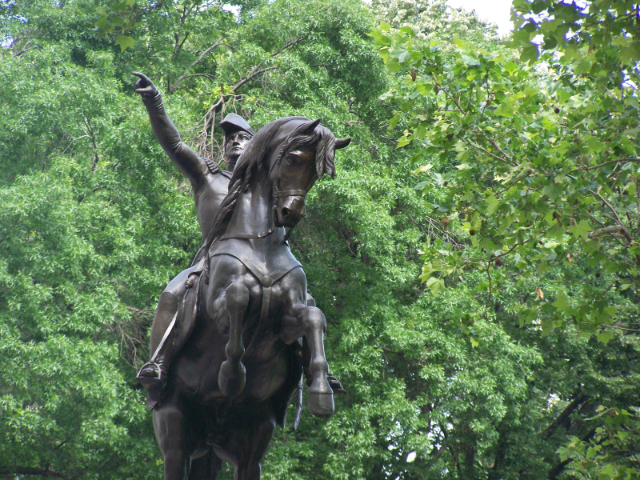

Amidst the bustling urban landscape of New York City, a striking bronze equestrian statue stands as a testament to the enduring legacy of independence and the pursuit of freedom. This statue, located at the southern end of Central Park, near the intersection of Avenue of the Americas and Central Park South, honors José de San Martín, an Argentine general whose strategic brilliance helped liberate Argentina, Chile, and Peru from Spanish rule in the early 19th century. The sculpture is not only a reminder of San Martín's pivotal role in South American history but also a symbol of the shared values between nations across the Americas.
The statue of José de San Martín was unveiled in New York City in 1951, a gift from the people of Argentina to the United States. It represents the deep historical ties and mutual respect between the two nations. San Martín, born in 1778 in Yapeyú, a small town in what was then the Viceroyalty of the Río de la Plata, is often referred to as the "Liberator of Argentina.” His efforts alongside other prominent figures such as Simón Bolívar, were crucial in the wave of independence movements that swept through South America in the early 1800s. This era, marked by battles and strategic campaigns, eventually led to the independence of Argentina in 1816, followed by Chile in 1818, and Peru in 1821.
The statue itself is a work of art, crafted by the renowned French sculptor Louis-Joseph Daumas. It captures San Martín poised confidently on horseback, a pose symbolizing leadership and determination. The bronze figure is mounted on a sturdy granite pedestal, which adds to its imposing presence. The architectural style of the statue, with its classic yet dynamic form, reflects the neoclassical trends of the late 19th and early 20th centuries, emphasizing heroism and the grandeur of historical figures.
Visitors to the statue will find it nestled among the verdant surroundings of Central Park, offering a serene contrast to the vibrant energy of the city. This location, known as the Artists’ Gate, is not only a place of reflection but also an intersection of cultures, where the past and present converge. The park itself is a cultural hub, often hosting events that celebrate the diverse communities of New York City, including those of Latin American descent, who regard San Martín as a symbol of their rich heritage.
While exploring the nearby areas, one might be tempted to indulge in the culinary delights that New York City offers, which include a variety of Argentine flavors. A visit to an Argentine restaurant in the city may introduce you to the rich and savory taste of asado, a traditional barbecue that is a staple in Argentine gastronomy. Pair it with a glass of Malbec, a wine that is as robust and flavorful as the history it represents. Empanadas, with their crisp pastry and savory fillings, provide another delightful taste of Argentina, reflecting a fusion of indigenous and Spanish culinary traditions.
A lesser-known curiosity about the statue of José de San Martín is its connection to the broader network of statues honoring him across the globe, each one a symbol of his far-reaching influence. In fact, similar statues can be found in prominent locations such as Buenos Aires, Lima, and even Washington, D.C. These statues serve as silent witnesses to San Martín's enduring impact, illustrating how his legacy transcends borders and continues to inspire efforts toward freedom and unity.
For those planning to visit, the best time to view the statue is during the spring or fall when the weather in New York City is mild and the park is at its most picturesque. Early mornings or late afternoons provide a quieter experience, allowing for contemplation and appreciation of the statue's historical significance. Don't miss the opportunity to observe the intricate details of the sculpture, from the lifelike depiction of San Martín's attire to the powerful stance of his horse, every element crafted with precision to evoke a sense of awe and reverence.
As you stand before the statue of José de San Martín, take a moment to reflect on the profound influence of this remarkable figure. His vision for a liberated South America and his strategic brilliance continue to resonate, reminding us of the enduring power of leadership and the relentless pursuit of freedom.


