


At dawn, when the sky transitions from black to orange, the three granite towers that give the park its name seem to ignite from within. The Torres del Paine rise over 2,800 meters above sea level in Chilean Patagonia, and their vertical shape — almost artificial, almost impossible — emerges from a landscape that changes color every hour of the day. This is not rhetoric: it is the physics of light at high altitudes, where the atmosphere is thin and the contrasts are brutal.

The Torres del Paine National Park is located in the Magallanes region, in the far south of Chile, about 112 kilometers from Puerto Natales, the nearest city that serves as a logistical base for most visitors. Established as a national park in 1959, it covers an area of about 181,000 hectares and includes glaciers, intensely turquoise lakes, pampas, and lenga forests — the southern beech that turns red and gold in autumn.
The granite towers: an improbable geometry
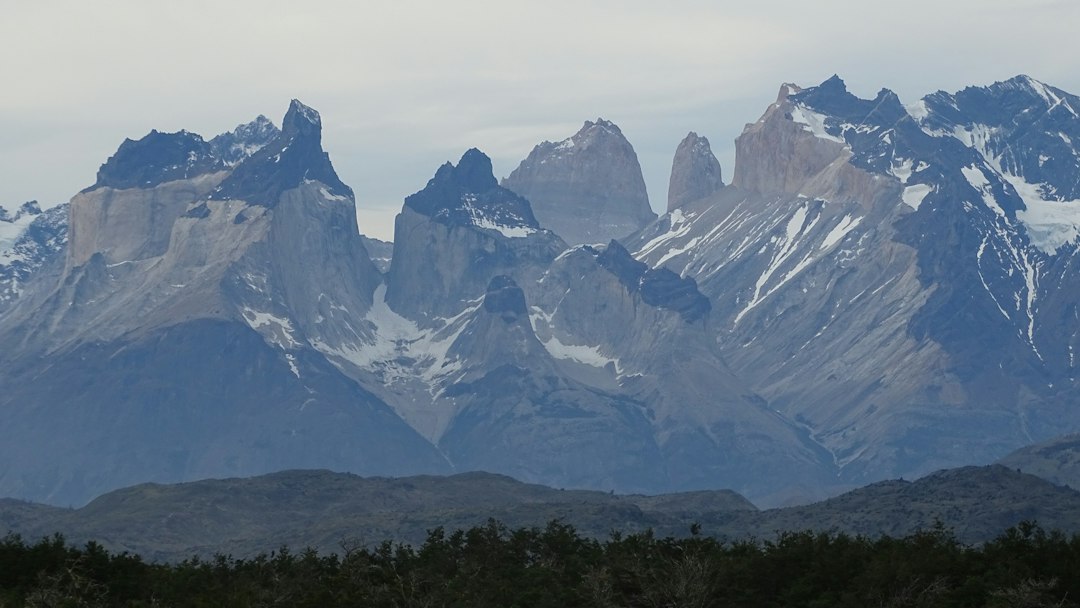
The three main towers — Paine Grande, Paine Central, and Paine Sur — are the result of millions of years of geological activity: a granite laccolith pushed upwards and then sculpted by Pleistocene glaciers. The tallest tower, the Sur Tower, reaches 2,850 meters. Viewed from the Mirador Base Torres, the viewpoint accessible by a round trip hike of about 18-20 kilometers, they appear as vertical blades reflecting in a small glacial lake of turquoise-green at their feet.
The color of that lake changes with the light: lead-gray on cloudy days, emerald green when the sun is high, almost white during gusts of wind that lift the glacial dust. Those who arrive at the mirador in the early morning hours, when the slanting light hits the east walls of the towers, witness a chromatic progression that goes from bright orange to pale pink in just a few minutes. It is the phenomenon that locals simply call "the dawn of the towers," and to see it, many hikers leave the base camps at 3 or 4 in the morning.

The colors of the park at different times of the day
In the early morning, the Nordenskjöld Lake — one of the most visible lakes along the park's main road — reflects the mountains with an almost unreal clarity. The intense turquoise of the water is due to the presence of glacial flour, very fine particles of rock crushed by glaciers that remain suspended. At noon, with the sun high, the colors become saturated: the blue of the lake, the white of the Grey glacier in the background, the green of the pampas. In the late afternoon, when the Patagonian clouds — almost always present — turn shades of purple and orange, the towers cast long shadows to the east.

The Andean condors (Vultur gryphus) are a constant presence in the park. With a wingspan that can exceed three meters, they glide using the thermal currents that form along the rocky walls. Seeing them up close does not require special luck: just stay quietly at the open viewpoints, such as the Condor Viewpoint along the road between the entrance and Pehoé Lake.
How to organize the visit for the views

Access to the park requires the payment of an entrance fee: for foreign visitors, the cost is around 21,000 Chilean pesos per day, but it is advisable to check the updated rates on the official CONAF (National Forest Corporation) website, the agency that manages the park. Online booking is mandatory for those who intend to walk the W circuit or the full circuit, the two main routes that traverse the most spectacular areas.
Those who want to limit themselves to the views without camping can base themselves in Puerto Natales and organize day trips by minivan or with local tour operators. The best season runs from October to March, with November and December offering longer days and relatively stable weather conditions. The wind is the most unpredictable factor: gusts of 100 km/h are not rare even in summer, and can make it difficult to even stand on exposed viewpoints. Wearing waterproof layers and bringing sunglasses with side protection is not optional.
What to observe physically on site
In addition to the towers, the park offers a view of the Grey Glacier, a glacial front that descends from the Southern Patagonian Ice Field — the third largest ice field in the world — down to the lake of the same name. From a viewpoint above the lake, one can see the ice blocks breaking off and floating in the water, of an almost electric blue. The vegetation changes abruptly with altitude: the lenga gives way to low shrubs, then to bare rock and orange lichens that dot the gray granite.
The park is large enough to make every corner visually different, but the logic of the views always follows the same rule: early morning light and late afternoon light are the golden hours. Those arriving by bus from Puerto Natales at 7 in the morning and positioning themselves at Lake Pehoé by 9 will have the illuminated towers in front of them, the glacier in the background, and, with a bit of patience, a condor in flight.


