
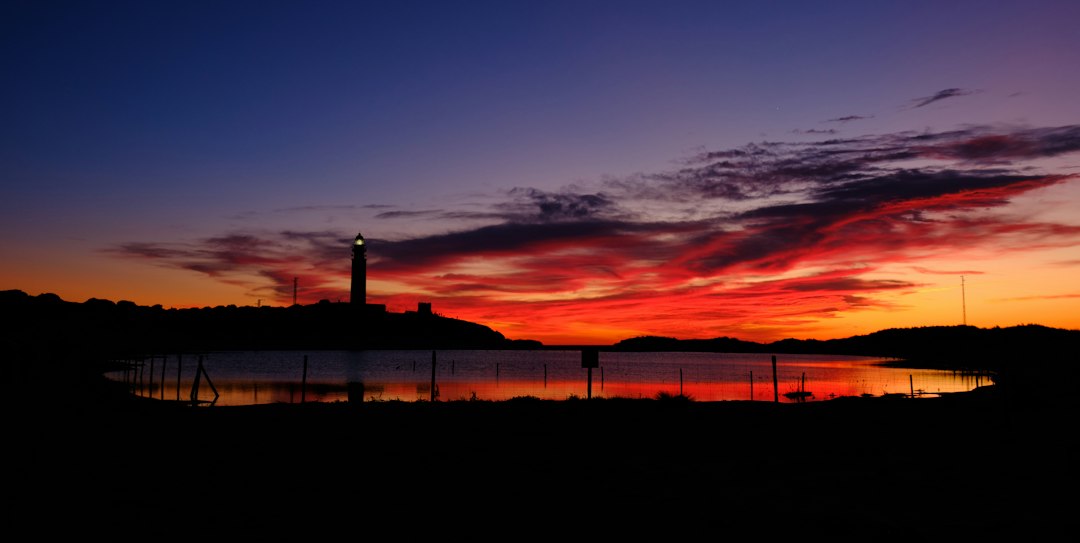

The wind blows strong on Cape Trafalgar, and the white tower of the lighthouse stands out against a sky that seems larger than usual. We are a few kilometers from Barbate, in the province of Cádiz, on that low sandy promontory where on October 21, 1805, the fleets of Napoleon and Nelson clashed in one of the most decisive naval battles in modern history. Today those waters are populated by seagulls and surfers, but the presence of the past is still felt, engraved in the very name of the place.
The Trafalgar Lighthouse is one of the most recognizable symbols of the Andalusian Atlantic coast. Built in the second half of the nineteenth century and inaugurated in 1862, it rises about 34 meters on a small sandy islet connected to the mainland by a thin natural isthmus. The cylindrical tower made of white limestone is visible from afar both from the sea and from the coast, and its light — still operational today — has a range that exceeds 22 nautical miles, guiding vessels through the Strait of Gibraltar.
The story that can be felt on the promontory
Reaching the lighthouse means crossing an area of protected dunes, where low vegetation resistant to the wind grows among the light sand. The cape itself is a protected natural area, part of the Breña Natural Park and the Barbate Marshes. Even before the lighthouse was built, this cape was already famous — or infamous — for the battle of 1805, in which British Admiral Horatio Nelson defeated the Franco-Spanish fleet, but lost his life during the fighting. The name Trafalgar probably derives from the Arabic Taraf al-Gharb, meaning "the extremity of the west."
Looking out to sea from the foot of the tower, one understands why these waters have been the scene of such dramatic events: the currents of the Strait of Gibraltar meet here with the open Atlantic, creating unpredictable marine conditions. On clear days, with optimal visibility, it is possible to glimpse the African coast of Morocco on the horizon — a detail that no photograph can fully capture and that alone is worth the trip.
How the lighthouse looks up close
The tower is accessible to visitors at certain times of the year, although the openings may vary seasonally. Externally, the typical architectural details of Spanish lighthouses from the era are immediately noticeable: the massive base, the narrow windows, the lantern at the top protected by a painted metal structure. Surrounding the tower are the historic buildings of the lighthouse keepers, which are no longer permanently inhabited as automation has made continuous human presence unnecessary.
The sandy isthmus leading to the lighthouse can be walked in a few minutes, but during high tides, access may be partially flooded. It is one of those places that change appearance depending on the time and season: at sunset, when the slanting light colors the white tower orange and the sea turns pink, the landscape becomes almost unreal. It is not rhetoric: it is simply what happens here every evening.
What to do in the surroundings
The Cabo de Trafalgar is surrounded by some of the most beautiful beaches on the coast of Cadiz. The Playa de los Caños de Meca, just a few minutes' walk to the north, is a long stretch of golden sand frequented mainly by surfers and kitesurfers, thanks to the constant wind that characterizes this area. To the south, you can easily reach Barbate, a fishing town known for its processing of bluefin tuna using the traditional almadraba technique, a fishing trap used in these waters for centuries.
Those who want to delve into the history of the naval battle can visit the Naval Museum in Madrid or look for informational panels along the path that runs along the cape. There is no dedicated museum on site, but the informational signs along the trail provide a historical summary sufficient to contextualize what you see.
Practical tips for the visit
The best time to visit the Trafalgar Lighthouse is in the late afternoon, about an hour before sunset: the light is perfect for photographs and the heat of the day subsides. In summer, especially in August, the area is very crowded: it is advisable to arrive early in the morning to find parking without difficulty. There are no direct public transport options to the lighthouse, so it is necessary to have your own or a rented car: the nearest parking is about 500 meters from the tower, from which you proceed on foot.
Access to the outer area of the lighthouse is generally free and open. Bring enough water, especially in summer, because there are no bars or refreshment points nearby. Comfortable shoes are essential for walking on the sand and on the dirt paths. Plan for at least an hour and a half to enjoy the place without rushing, including a stop on the dunes.


