



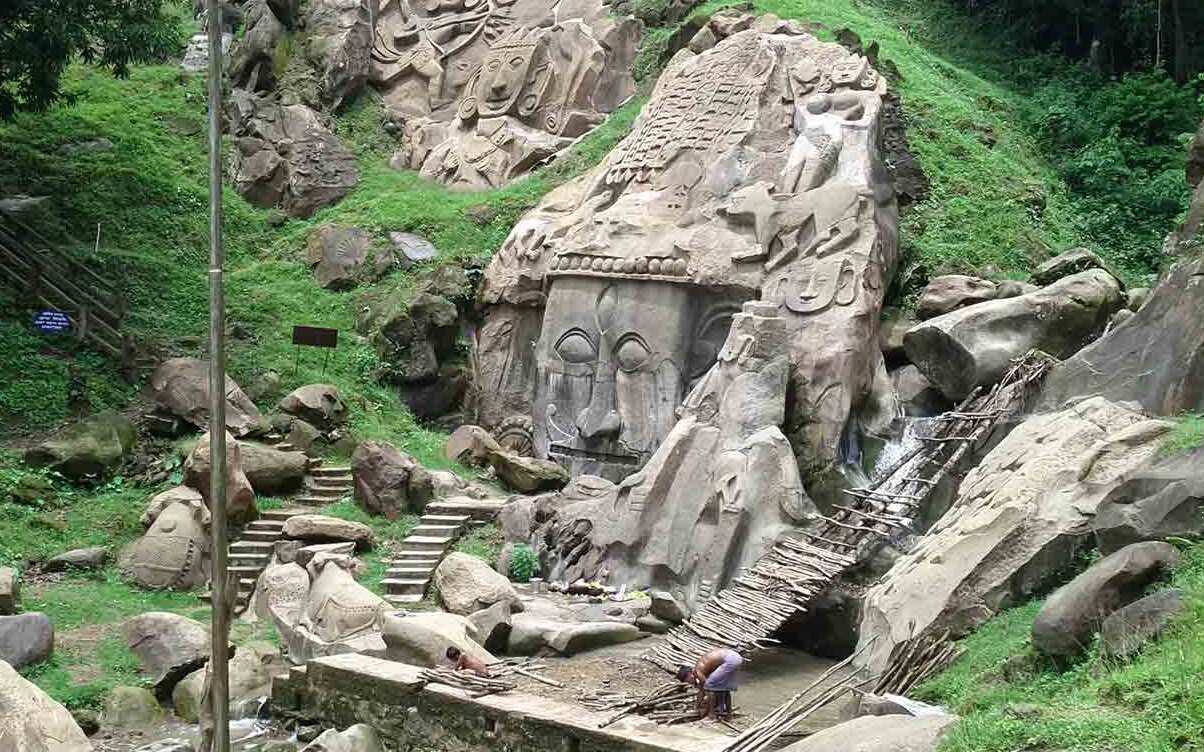
Unakoti or Unokoti – the word itself has an aura of grandeur in it. Unakoti literally means “one less than a crore”. That is a huge number! Legend has it that the hills of Unakoti had one 99,99,999 rock-cut images of Gods and Goddesses.The Unakoti Tirtha located about 180 km from Tripura's capital, Agartala, and just about 8 km from the sub-divisional headquarters of Kailasahwar town, is a unique place which bears no resemblance to any other place in the country in terms of sheer grandeur and artistry.Among the rock-cut sculptures is a 33-ft-high bust of Lord Shiva. It includes an 11-ft-high headgear which is now partly broken. The bust is the central figure in the complex and is locally called Unakotiswara Kalabhairava. The bust of Shiva is identified from the third eye and a trident. There are two figures seated on either side of the bust. One of the figures is believed to be that of the goddess Durga seated on a lion while the other one is believed to be that of Ganga astride a capricorn.
Another three-eyed figure some distance away is believed to be that of Surya or Lord Vishnu. A massive Ganesh figure is also carved in the complex while there is a chaturmukha Shivlinga nearby. Among other rock-cut and stone images are those of Vishnu, Nandi, Narasimha, Ravana, Hanuman, and several unidentified deities. The consensus among archeologists is that although the predominant influence of the Shiva cult is obvious, the sculptures were also influenced by several other cults like Tantric, Shakti, and Hatha yogis. It is also inferred that the site dates back to the period between the 12th and 16th centuries, and that the sculptures belong to two different periods of art.
