
← Back

Unakoti or Unokoti and its Rocks

Unakoti, Tripura, India ★★★★☆ 399 views
Maya Wilde
Unakoti
🏆 AI Trip Planner 2026

Get the free app

Discover the best of Unakoti with Secret World — the AI trip planner with 1M+ destinations. Get personalized itineraries, hidden gems and local tips. Free on iOS & Android.

🧠 AI Itineraries 🎒 Trip Toolkit 🎮 KnowWhere Game 🎧 Audio Guides 📹 Videos
Scan to download iOS / Android
Scan for AppGallery Huawei users

About Unakoti or Unokoti and its Rocks

Unakoti or Unokoti and its Rocks - Unakoti | Secret World Trip Planner

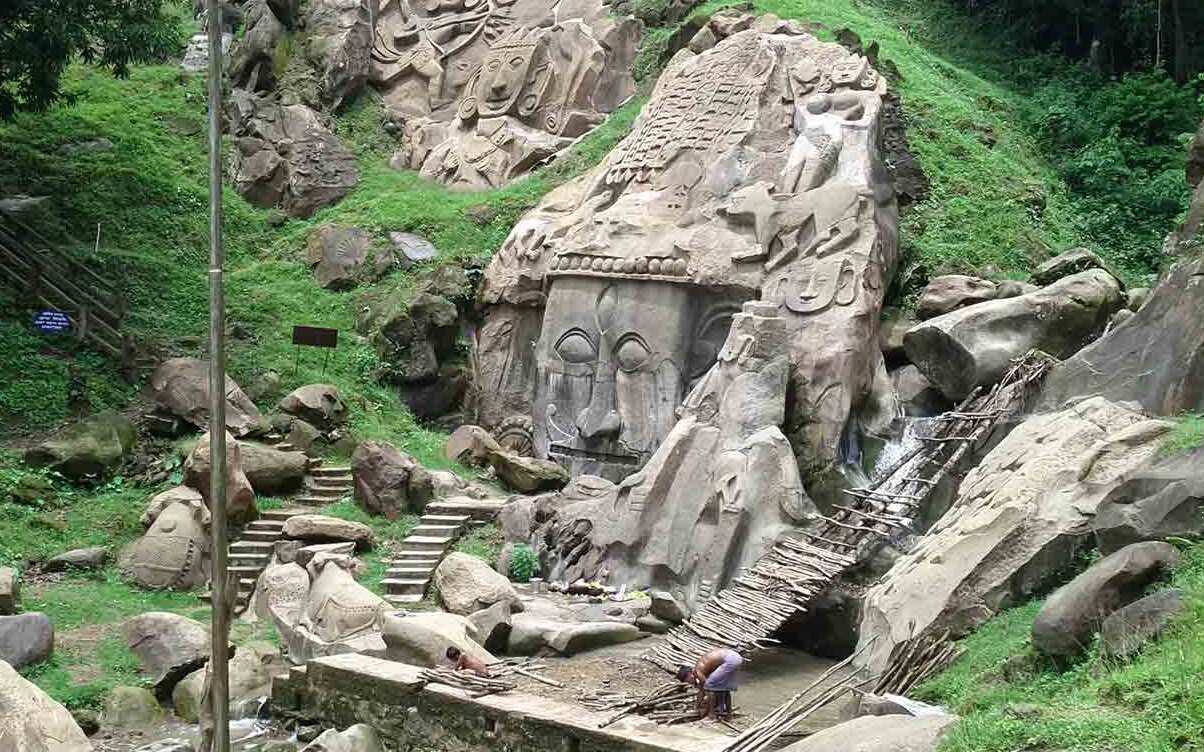
Unakoti or Unokoti – the word itself has an aura of grandeur in it. Unakoti literally means “one less than a crore”. That is a huge number! Legend has it that the hills of Unakoti had one 99,99,999 rock-cut images of Gods and Goddesses.The Unakoti Tirtha located about 180 km from Tripura's capital, Agartala, and just about 8 km from the sub-divisional headquarters of Kailasahwar town, is a unique place which bears no resemblance to any other place in the country in terms of sheer grandeur and artistry.Among the rock-cut sculptures is a 33-ft-high bust of Lord Shiva. It includes an 11-ft-high headgear which is now partly broken. The bust is the central figure in the complex and is locally called Unakotiswara Kalabhairava. The bust of Shiva is identified from the third eye and a trident. There are two figures seated on either side of the bust. One of the figures is believed to be that of the goddess Durga seated on a lion while the other one is believed to be that of Ganga astride a capricorn.

Another three-eyed figure some distance away is believed to be that of Surya or Lord Vishnu. A massive Ganesh figure is also carved in the complex while there is a chaturmukha Shivlinga nearby. Among other rock-cut and stone images are those of Vishnu, Nandi, Narasimha, Ravana, Hanuman, and several unidentified deities. The consensus among archeologists is that although the predominant influence of the Shiva cult is obvious, the sculptures were also influenced by several other cults like Tantric, Shakti, and Hatha yogis. It is also inferred that the site dates back to the period between the 12th and 16th centuries, and that the sculptures belong to two different periods of art.

Buy Unique Travel Experiences

Powered by Viator

See more on Viator.com

Frequently Asked Questions

Unakoti literally means 'one less than a crore,' referring to the legendary 99,99,999 rock-cut images of Gods and Goddesses said to be carved into the hills. According to local legend, Lord Shiva was creating these divine sculptures when he left the area, leaving one image incomplete, hence the name Unakoti.
Unakoti is located approximately 180 km from Agartala, Tripura's capital, and just 8 km from the town of Kailasahwar. You can hire a taxi or take a bus from Agartala to reach this unique rock-cut temple complex, making it an accessible day trip or short excursion from the city.
The centerpiece of Unakoti is a magnificent 33-ft-high rock-cut bust of Lord Shiva, locally known as Unakotiswara Kalabhairava, which features an 11-ft-high headgear (now partially broken) and is identifiable by its third eye and trident. Flanking this central figure are sculptures of Goddess Durga on a lion and Ganga on a capricorn, among numerous other deities carved throughout the complex.
Archeologists believe the sculptures at Unakoti date back to between the 12th and 16th centuries, belonging to two different periods of art. While the Shiva cult's influence is predominant, the site also shows influences from Tantric, Shakti, and Hatha yoga traditions, reflecting a syncretic approach to Hindu religious expression.
Beyond the main Shiva bust, Unakoti features rock-cut and stone images of Ganesh, Vishnu, Surya, Nandi, Narasimha, Ravana, Hanuman, and a chaturmukha (four-faced) Shivlinga. The complex also contains several unidentified deity sculptures, making it a comprehensive open-air gallery of Hindu religious art spanning multiple traditions.