
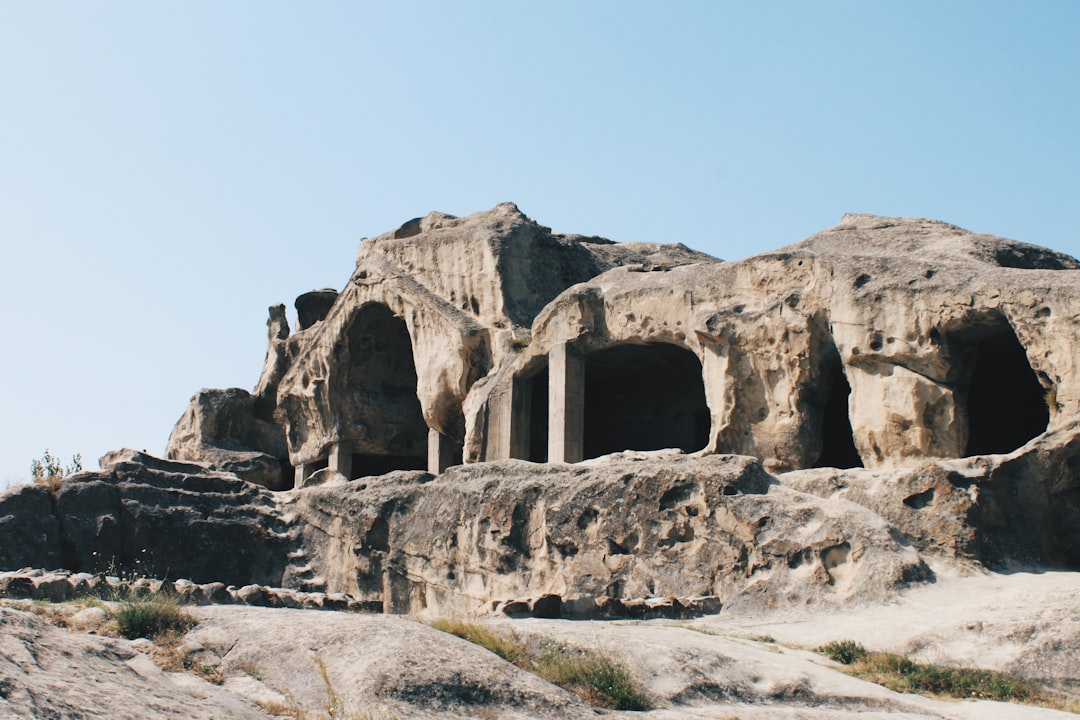

You walk on a road wide enough for two side-by-side carts, but there is no asphalt under your feet — there is red sandstone, shaped three thousand years ago by human hands. Uplistsikhe is not a site of ruins in the traditional sense: it is an entire city carved directly from the face of a cliff overlooking the Mtkvari River, in the Shida Kartli region, a few kilometers from present-day Gori. Its streets, its halls, its warehouses, and its temples were not built — they were hewn from the rock, centimeter by centimeter, over the course of centuries.

The origins of Uplistsikhe date back to the first millennium BC, making it one of the oldest rock settlements in the entire Caucasian region. The site reached its peak between the 9th and 11th centuries AD, when it housed an estimated population of 20,000 to 30,000 inhabitants and served as an important commercial and religious center along the caravan routes that traversed Georgia. Its decline began with the Mongol invasion of the 13th century, which devastated the city and marked its gradual abandonment.
A city with a pharmacy, bakery, and theater

What makes Uplistsikhe extraordinary is not only its antiquity but the functional precision with which the spaces have been conceived. Walking through the approximately 700 identifiable environments, one recognizes structures with specific uses: there are rooms interpreted by archaeologists as pharmacies, equipped with niches in the rock for the storage of herbs and preparations; there are bakeries with ovens carved into the floor; there is even what is identified as an outdoor theater, with steps hewn from stone overlooking a natural stage.
The main streets still retain the deep ruts left by the wheels of carts — a physical detail that immediately strikes the visitor, as it transforms a historical site into something tangible and human. Those depressions in the rock are direct evidence of daily traffic that took place for centuries. The columns carved into the ceilings of some rooms show Hellenistic influences, a testament to the commercial and cultural contacts that the city maintained with the Mediterranean world.

The pagan temple and the Christian basilica
Uplistsikhe was originally a pagan religious center, dedicated to the worship of pre-Christian deities, and its sacred importance preceded its urban function by a long time. The religious heart of the site is occupied by a large rock-cut temple with monolithic columns, dating back probably to the Hellenistic period, which still shows its almost intact layout today. The interior preserves traces of decorations and votive niches that allow one to imagine the rituals that took place there.

After the Christianization of Georgia, which occurred in the 4th century AD, the site was not abandoned but reinterpreted: above some pagan structures, a three-nave Christian basilica was built, partially constructed in traditional masonry and partially carved into the rock. This overlapping of religious layers — pre-Christian paganism, then Georgian Christianity — makes Uplistsikhe an architectural document of rare complexity. The basilica is still standing and can be visited, with its arches opening up to the view of the underlying river.
How to get there and when to visit

Uplistsikhe is located about 10 kilometers east of Gori, the city also known as the birthplace of Stalin. From Tbilisi, Gori can be reached in about an hour and a half by marshrutka — the shared minibuses — that depart from the Didube bus station. From Gori, the most practical way to reach the site is by taxi, which takes about fifteen minutes. There is also the option to arrive by train to Gori and continue by taxi.
The best time to visit is early in the morning, preferably in the months of April, May, or September, when temperatures are mild and the slanting light on the red sandstone walls highlights the details of the carvings. In summer, the rock accumulates considerable heat and the site, lacking shade in most of its paths, becomes tiring to traverse during the central hours of the day. Allow at least two hours for a complete visit, three if you want to take your time observing the architectural details closely. The entrance ticket costs a few Georgian lari — an affordable amount — and includes access to the entire rock complex.
What to Observe Up Close
Once on site, avoid limiting yourself to the main path and descend to the lower levels of the cliff, where some of the best-preserved rooms are located. Observe the coffered ceilings of some representative halls: they imitate in stone the wooden structures typical of Georgian architecture of the time, with a precision that reveals a surprising technical level. On the walls of many rooms, you can still see the grooves where the door frames used to slide — a minute detail that conveys the idea of lived spaces, not monuments.
Uplistsikhe does not ask to be interpreted: it asks to be traversed slowly, with your eyes down on the grooves of the roads and your hands resting on the rock walls that three thousand years of wind and rain have not completely erased.


