


At the first light of dawn, when the valley of Baños de Agua Santa is still shrouded in twilight, the Tungurahua volcano — or what remains of its active cone — begins to breathe. From the viewpoint known as Volcán Eyes Viewpoint, or Eagle's Nest, a column of steam can be seen silently rising above the Amazon rainforest, while the sky transitions from anthracite gray to burnt orange. It is a spectacle that cannot be constructed with words: it is understood only when it is in front of you.

The viewpoint is located on the heights overlooking Baños de Agua Santa, an Ecuadorian city situated at about 1,800 meters above sea level in the province of Tungurahua. The city is known for being one of the main access points to the Amazon region and for its location at the foot of the namesake volcano, one of the most active in Ecuador. The viewpoint can be reached on foot with a short hike from the urban center, following trails that ascend through the dense vegetation of the cloud forest, the forest of clouds that characterizes these transitional altitudes between the Andes and the Amazon.
The ascent: a path through mist and vegetation

The route to reach the Eagle's Nest does not require technical equipment, but it is advisable to wear hiking shoes with good grip, as the ground can be slippery, especially in the morning hours when the night dew has not yet dried. The ascent takes approximately between 20 and 40 minutes depending on the starting point in the city and the individual pace. Along the way, there are sections where the vegetation closes overhead, creating natural tunnels of tree ferns and bromeliads.
As you gain altitude, the valley begins to open up behind you, and you can start to glimpse the colorful roofs of Baños below, with the cathedral serving as a visual landmark. The air becomes cooler and more humid, and on certain days you literally walk inside the clouds even before reaching the summit.

The panorama: colors that change with the light
Once you arrive at the viewpoint, the view opens up to a scene that changes radically depending on the time of day. At dawn, when conditions are favorable, the Tungurahua emerges from the darkness like a dark silhouette with the plume of steam illuminated by the rising sun in shades ranging from pink to gold. The valley below is still in shadow, and the chromatic contrast between the volcanic cone and the sky that lights up is among the most intense that can be observed in this Andean region.
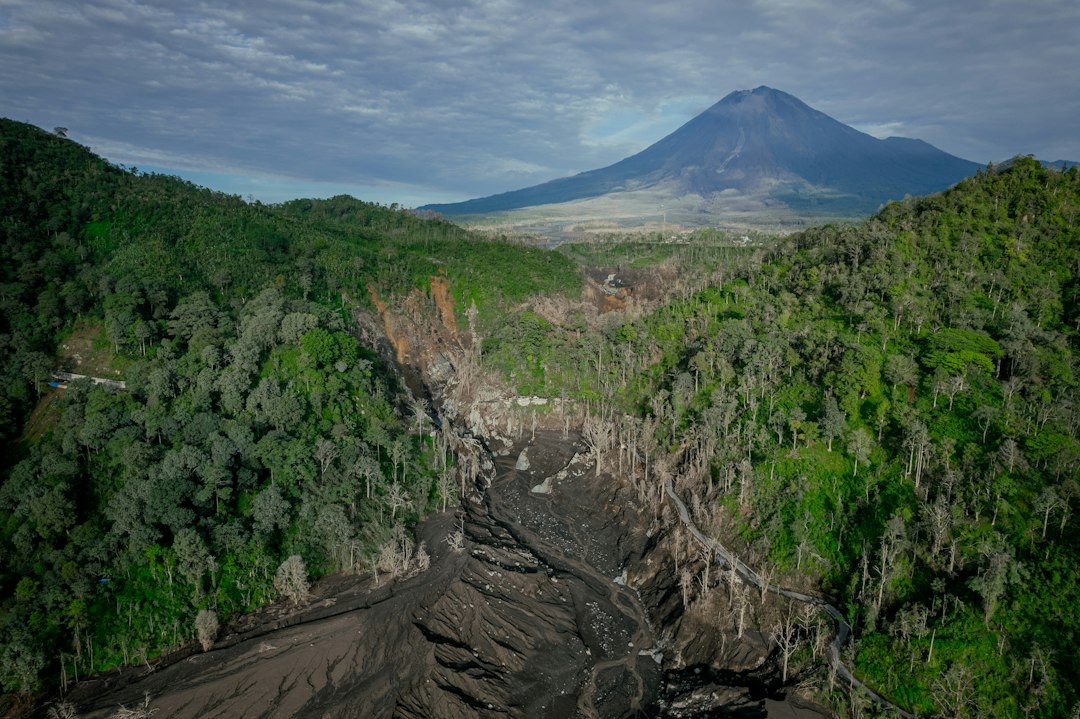
Throughout the morning, if the sky remains clear, the green of the Amazon rainforest that covers the slopes becomes increasingly saturated, almost unreal. The canyons where the tributary rivers of the Pastaza flow are clearly distinguishable, and in the distance, you can sense the Pailón del Diablo waterfall, although to see it up close you need to descend along the Ruta de las Cascadas. In the afternoon, clouds tend to accumulate rapidly around the volcano, and the view closes off just as spectacularly, with the mist rising up the slopes like smoke.
The Tungurahua Volcano: What Can Be Observed

The Tungurahua is a stratovolcano that reaches an altitude of 5,023 meters. It has experienced periods of intense eruptive activity, particularly significant between the late 1990s and the early 2000s, with eruptions that have repeatedly affected the surrounding communities. From the viewpoint, on clearer mornings, the steam that rises from the summit can be clearly observed, a sign of ongoing fumarolic activity. This is not an eruption, but a continuous breath that reminds us of the living nature of this mountain.
The perspective from the Eagle's Nest is particularly effective because it allows one to frame the volcano in relation to the valley and the city: it is immediately clear how close Baños is built to the volcano, and one understands why the inhabitants have such a direct and ambivalent relationship with the mountain that looms over them.
Practical tips for the visit
The best time to go up is between 6:00 and 8:00 in the morning: during this time frame, the chances of seeing the Tungurahua are significantly higher, as the afternoon clouds have not yet formed. Bringing a second layer of clothing is advisable even in warm seasons, because the temperature at altitude can be cool and the wind can be felt on the open viewpoint platform. It is useful to have water and a flashlight with you if you plan to leave before dawn.
There is no entrance ticket for the public trail that leads to the viewpoint. To reach the starting point of the trail, it is enough to ask for directions in downtown Baños: the locals are used to questions from visitors and the trail is generally marked. It is advisable to avoid the ascent in case of heavy rain, not so much for the volcanic risk but for the slipperiness of the ground.


