
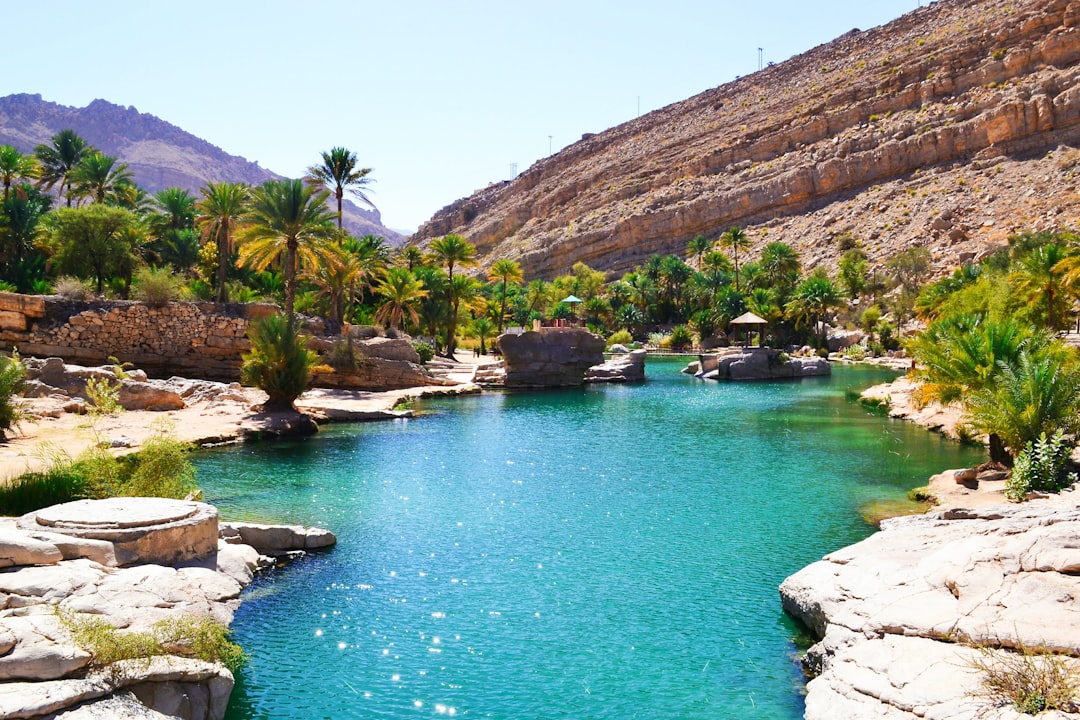

The water flows silently between walls of ochre limestone, reflecting the intense green of the date palms that crowd along the banks. At Wadi Bani Khalid, in the heart of the Eastern Hajar Mountains of Oman, nature has built something extraordinary: a system of perennial freshwater pools that do not dry up even in the driest months, fed by underground springs that have filtered through the rock for centuries.

Located in the Sharqiyah region, about 200 kilometers east of Muscat, this wadi is one of the few in Oman to maintain a constant flow of water throughout the year. It is not an artificial park nor a garden designed by human hands: it is an ecosystem that has spontaneously developed around these springs, where the fuchsia-flowered bougainvillea climbs the rocks next to the gnarled trunks of date-laden palms, creating a chromatic contrast with the barren desert that surrounds the wadi for miles in every direction.
A natural garden among the rocks

Walking along the path that leads to the main pools means crossing an unexpected green corridor. The date palms — cultivated by local communities for generations — form a natural canopy above the trail, and the sound of water flowing between the boulders accompanies every step. The pools are arranged in a cascading manner on different levels, with water overflowing from one to another in small natural waterfalls. The color of the water varies from emerald green to turquoise depending on the depth and the light of the day.
Among the vegetation, there are also sidr trees, whose wild fruit is traditionally harvested by the inhabitants of nearby villages. Bougainvillea plants, likely introduced in past centuries through trade routes that crossed Oman, have perfectly naturalized in this humid microclimate, adding splashes of vivid color to the landscape. It is a garden that no architect has designed, but it bears the imprint of the patient work of those who have lived here and have learned to coexist with the precious water of the wadi.

The cave and its waters
Beyond the main pools, a narrow path leads to the entrance of a natural cave that opens in the rock face. Inside, the water reaches a depth of about two meters in some places, and the temperature drops significantly compared to the outside — a remarkable relief during the summer months when the thermometer can exceed 40 degrees Celsius in the surrounding plain. The cave is not artificially lit, so bringing a flashlight is essential for those who want to explore its interior beyond the first meters illuminated by natural light.

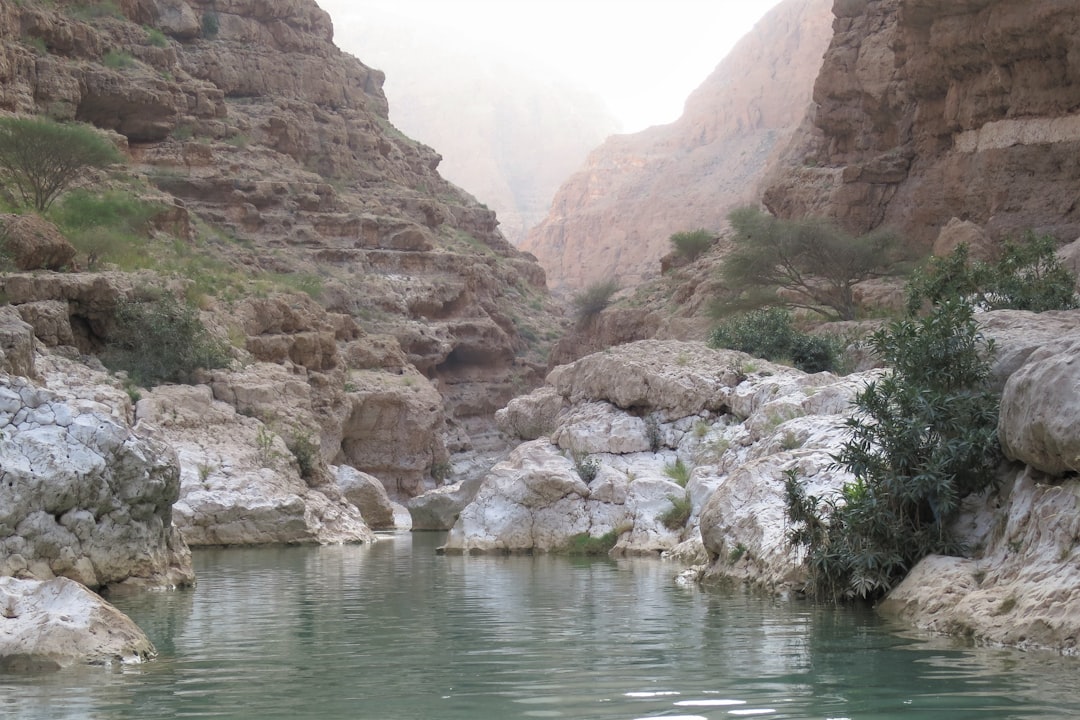
The walls of the cave show geological layers visible to the naked eye: bands of limestone in different shades that tell millions of years of marine sedimentation, a reminder that these mountains were an ocean floor before being uplifted by the tectonic collision that formed the Arabian Peninsula. Swimming in the clear waters of the cave, with the rock above your head and light filtering in from the entrance, is a physically memorable experience.
How to get there and when to visit
The most practical way to reach Wadi Bani Khalid is to rent a vehicle in Muscat or in Sur, the nearest coastal city, located about 100 kilometers away. The paved road goes all the way to the main parking lot, from which the pools can be reached in a walk of about 10-15 minutes on a well-marked path. A 4x4 vehicle is not necessary to get there, unlike many other wadis in Oman.
The best time to visit is between October and April, when the temperatures are bearable and the early morning light illuminates the pools at a favorable angle, enhancing the color of the water. Arriving by 8:30 in the morning allows you to enjoy the place in relative tranquility, before the tour buses from Muscat drop off their passengers mid-morning. Entrance is generally free, although there are small kiosks run by local residents nearby where you can buy water and snacks at reasonable prices.
Respect for the place and practical advice
Wadi Bani Khalid is a place frequented by Omani families as well, especially on weekends. The dress code requires moderation: very minimal swimwear is not appropriate, and women would do well to bring a sarong or a t-shirt to wear in the water. This is not a secondary detail: respecting local customs ensures a better welcome and helps preserve the accessibility of the site for future visitors.
Bringing a reusable water bottle is a wise choice for both practical and environmental reasons. The sun reflected off the water and light-colored rocks can be intense even in the morning hours, so sunscreen and sunglasses are essential gear. Finally, it is worth dedicating at least two or three hours to the visit, without rushing: the slow pace of the water flowing between the rocks naturally invites one to slow down, and hurrying would mean missing the best part of this green corner of Oman.


