


The water is cold, transparent, and of a turquoise so intense that it seems artificial. Wadi Bani Khalid is located in the Al Sharqiyah region, in the heart of the eastern Hajar mountains of Oman, and owes its existence to perennial springs that feed its natural pools year-round, even in the driest months of the surrounding desert. This is one of the few wadis in Oman that does not dry up in summer, a feature that makes it unique in the country's natural landscape.

Reaching the site takes about two and a half hours of driving from Muscat, following the main road to Sur and then diverting inland through a landscape of ochre rocks and date palms. The last stretch before the pools is paved and accessible even with regular vehicles, which has helped make the place a popular destination for both international tourists and Omanis themselves, especially on weekends.
A canyon that becomes a cave

The most surprising feature of Wadi Bani Khalid is not the outdoor pools, but the possibility of literally swimming inside a natural cave. Ascending the canyon for a few hundred meters beyond the main pools, the passage narrows and the rock ceiling lowers to form a semi-submerged environment where light filters from the outside, creating blue reflections on the water. The more adventurous visitors swim to the end of this natural tunnel, where the silence is almost total and the water temperature remains constant and refreshing even during the summer months when external temperatures exceed 40 degrees Celsius.
The walls of the canyon display clearly visible geological layers, with limestone that has been sculpted over time by water into rounded and smooth shapes. On the banks, some ghaf trees — the national tree of Oman — grow directly from the cracks in the rock, adapted to survive with their roots submerged in the underground waters. This spontaneous vegetation contributes to the atmosphere of an oasis suspended in time that characterizes the entire site.

The therapeutic experience of water
There are no thermal facilities built in Wadi Bani Khalid: the therapy is that of natural water, silence, and the shade of the rocky walls. Immersing oneself in the pools after hours of driving in the heat of the desert has an immediate and physically perceivable effect on the body. The water, coming from underground springs, maintains a cool temperature even in the height of summer, offering a thermal contrast that many visitors describe as deeply rejuvenating.

The bottom of the pools is visible at every point thanks to the exceptional transparency of the water, and in some areas, small fish can be seen swimming around the bathers without showing any fear. This coexistence with the local fauna adds a sensory dimension to the experience: contact with an intact aquatic ecosystem, amidst one of the most arid landscapes of the Arabian Peninsula, produces a pleasant sense of estrangement that is difficult to replicate elsewhere.
The village and the human context
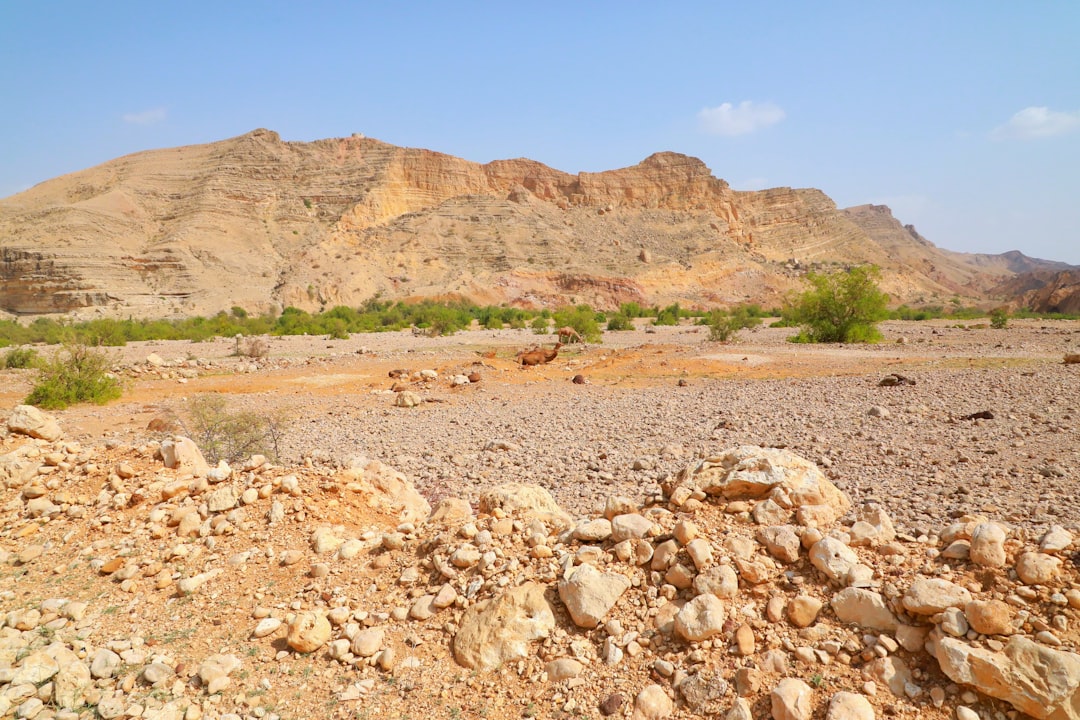
Just a few minutes' walk from the pools is the village of Bani Khalid, inhabited by a local community that partly lives off the tourism generated by the wadi. Some families run small kiosks where they sell fresh water, fruit juices, and simple dishes of Omani cuisine. The presence of the village reminds us that this is not an isolated natural park but a lived-in place, where the relationship between the community and water is ancient and daily.
The traditional houses of the village, built of stone and mud, are visible from the access road and represent an example of vernacular architecture adapted to the desert climate. Some buildings feature wind towers, traditional Omani architectural elements designed to capture breezes and cool the indoor spaces before the advent of air conditioning.
Practical tips for the visit
The best time to visit Wadi Bani Khalid is in the early morning hours, preferably before 9:00 AM, when the light is side-lit and the pools are not yet crowded. On weekends and during Omani national holidays, the site can become very busy, with families occupying all available shores. Wearing sturdy-soled shoes is essential for climbing up the canyon towards the cave, as the wet rocks can be slippery.
Entry to the site is free, but respectful clothing according to local customs is required: women should avoid very revealing swimsuits and it is recommended to bring a sarong. The minimum time for a satisfactory visit is about two hours, but those wishing to explore the cave and climb up the canyon should plan for at least three. There are no accommodation facilities directly on site, but the city of Sur, about an hour away, offers several lodging options.


