


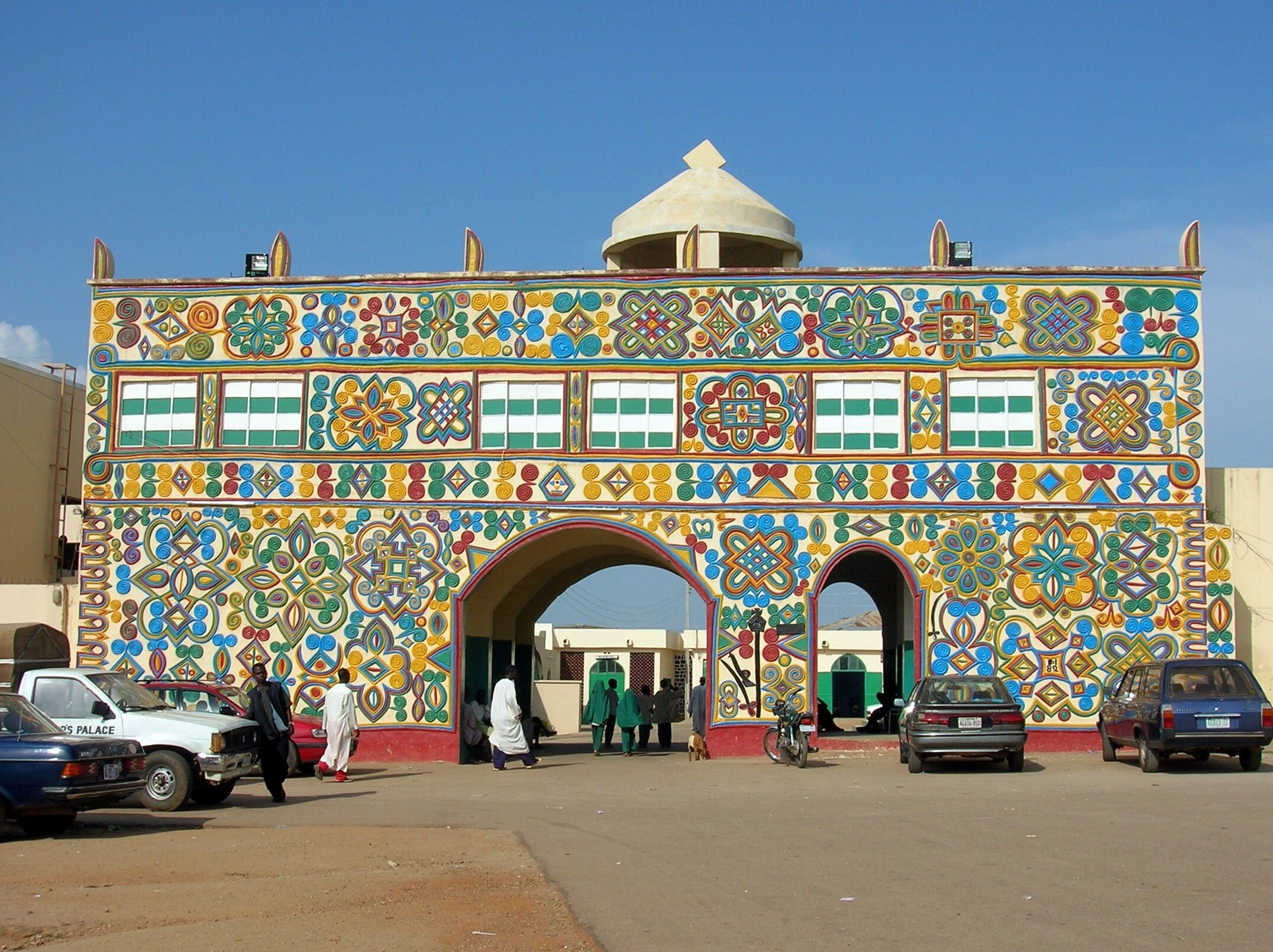
Located in the old part of Zaria, known as Birnin Zazzau (walled city of Zaria) or Zaria City, the gate (kofar gida) to the Emir's palace stands out as a colorful representation of the Hausa people and their ruler. The decorative designs on the façade reflect the stylistic characteristics of many Hausa buildings and art objects, and the gate itself is known throughout the region as an important cultural structure.
During the reign of Sarkin Ibrahim (r. 1924-1936), a new gate with a central arch was installed. Cars and horses could enter through the archway, while pedestrians passed through an open doorway to the right side. The thickness of the gate meant it could actually serve as a building, and the area to the left of the arch was used as a classroom. Like traditional Hausa homes, the roofline was punctuated by horn-like vertical projections known as zanko, At the time, this gate was whitewashed, its exterior decorated with large, abstract, curvilinear reliefs. Its earthen construction required resurfacing for maintenance, enabling periodic change.
The two succeeding Emirs, Ja'afaru (r. 1936-1959) and Mohammadu Aminu (1959-1975), ordered further embellishments and changes to the entrance. Under Sarkin Mohammadu Aminu’s reign, the motif size was decreased and became more intricate. By 1963, these reliefs were picked out in color. Sarkin Shehu Idris (r. 1975-) demolished the old kofar gida and erected a new gate in 1980-81. Alhaji Haruna, Zaria's then-master builder and descendent of Mallam Mikaila, the architect of the Zaria mosque, supervised the redesign, which abandoned earthen construction. The new building materials consisted of a concrete frame and cement blocks. Cement was combined with specially prepared mud and shaped by hand to create the relief decoration on the exterior.
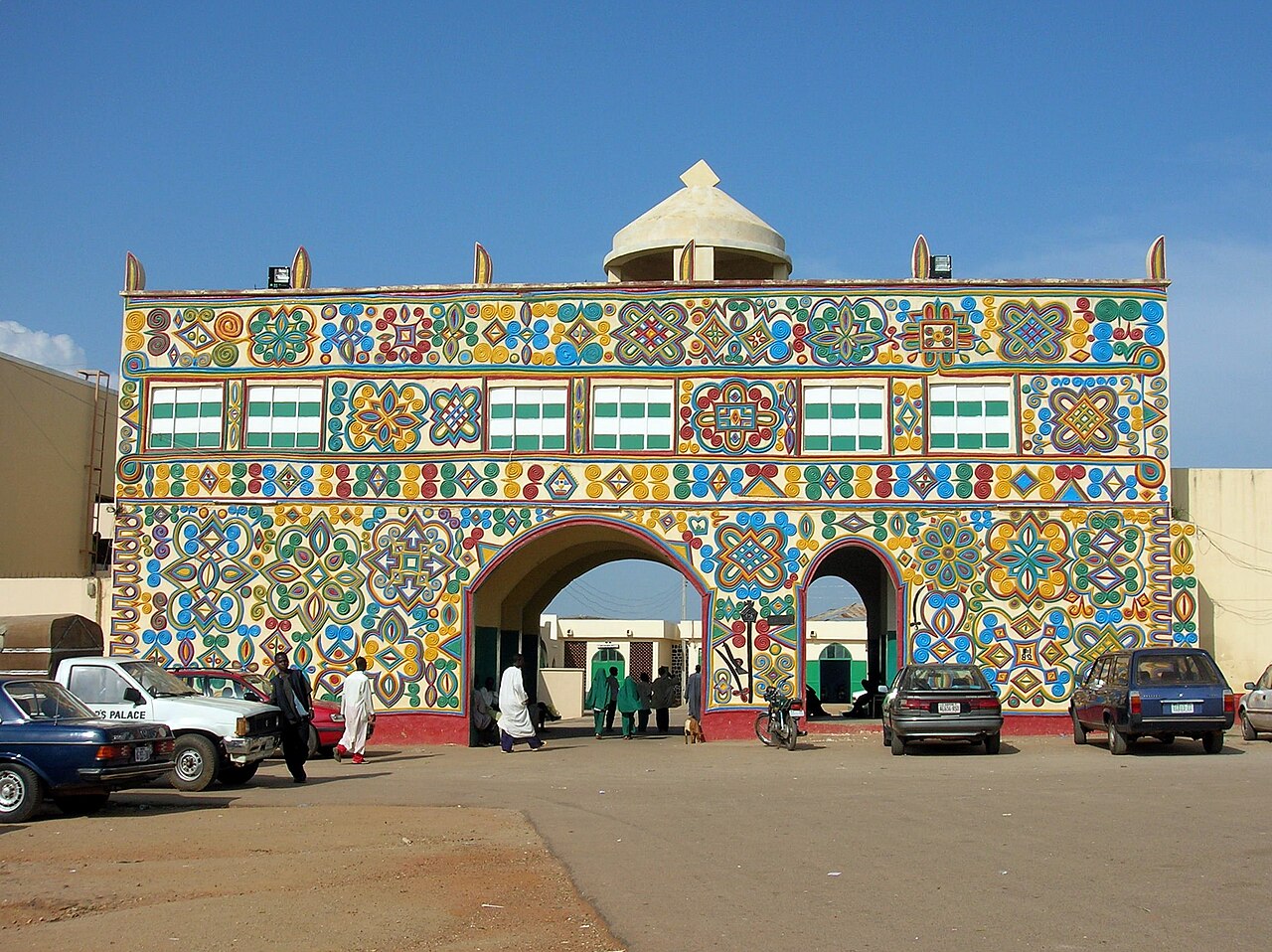
Motifs on the present gate include some of the original royal symbols, such as the staff of office, sword, and gun, all located at eye level on the wall section between vehicle and pedestrian openings. Daguna (s., dagi) or knot patterns appear throughout the design. The dagi or wise-man’s knot is a symbol that commonly appears on both Hausa buildings and Hausa embroidery and leatherwork. The conception of the dagi and other symbols seem to have been inspired by the cursive letters of Kufic Arabic script, then became the more abstract motifs that we see on the palace gate. Arabic script was considered sacred and therefore possessed supernatural powers of protection. Both legible and imitative script are hidden within sewn leather amulets for personal protection, and are considered equally effective. Manipulated and abstracted, the calligraphic forms can also serve as a protection for both real and figurative entrances. After the 1840s, relief decoration--first on interiors only, then on exteriors--flourished as one of the most distinct design elements of Zaria architecture, influencing Hausa design in general.
